Thank you for visiting SNEWPapers!
Sign up free
Literary
May 29, 1856
M'arthur Democrat
Mcarthur, Vinton County, Ohio
What is this article about?
In 1751, Virginia rifleman 'Death' (future General Morgan) uncovers Iroquois ambushing missing sentries at a frontier fort near Allegheny River, leads a successful counterattack, earns promotion to lieutenant, and marries Hester Stanhope.
Clipping
OCR Quality
95%
Excellent
Full Text
Selected Stories.
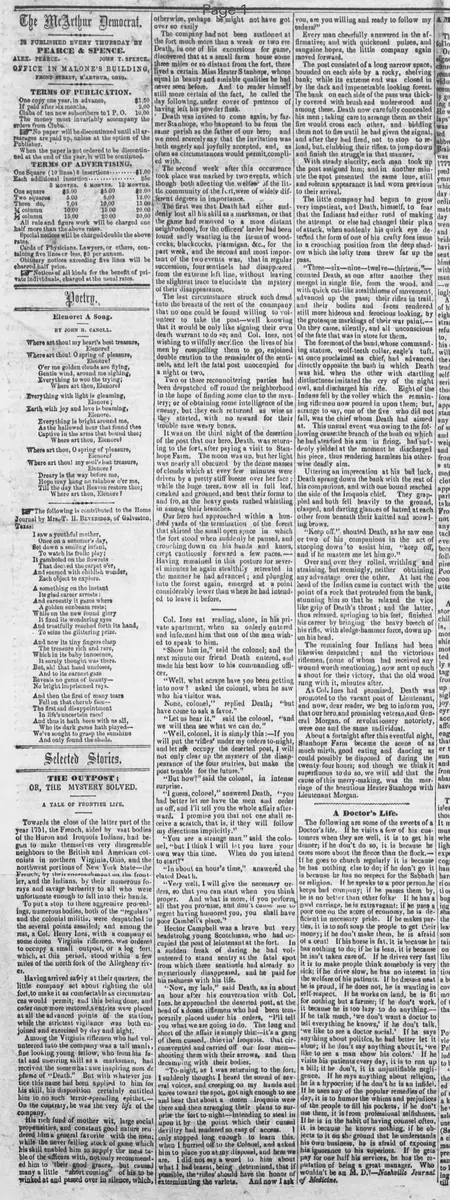
THE OUTPOST;
OR, THE MYSTERY SOLVED.
A TALE OF FRONTIER LIFE.
Towards the close of the latter part of the year 1751, the French, aided by vast bodies of the Huron and Iroquois Indians, had begun to make themselves very disagreeable neighbors to the British and American colonists in northern Virginia, Ohio, and the northwest portions of New York State—the French, by their encroachment on the frontier, and the Indians, by their numerous forays and savage barbarity to all who were unfortunate enough to fall into their hands.
To put a stop to these aggressive proceedings, numerous bodies, both of the "regulars" and the colonial militia, were despatched to the several points assailed; and among the rest, a Col. Henry Ines, with a company of some dozen Virginia riflemen, was ordered to occupy a small outpost, or a log fort, which, at this period, stood within a few miles of the north fork of the Allegheny river.
Having arrived safely at their quarters, the little company set about righting the old fort, to make it as comfortable as circumstances would permit; and this being done, and order once more restored, sentries were placed at all the advanced points of the station, while the strictest vigilance was both enjoined and exercised by day and night.
Among the Virginia riflemen who had volunteered into the company was a tall, manly, fine looking young fellow, who from his fatal and unerring skill as a marksman, had received the somewhat awe inspiring nom de plume of "Death." But with whatever justice this name had been applied to him for his skill, his disposition certainly entitled him to no such terror-spreading epithet.
On the contrary, he was the very life of the company. His rich fund of mother wit, large social propensities, and constant good nature rendered him a general favorite with the men; while the never failing stock of game which his skill enabled him to supply the mess table of the officers with, not only recommended him to their good graces, but caused many a little "short coming" of his to be winked at and passed over in silence, which, otherwise, perhaps he might not have got over so easily.
The company had not been stationed at the fort much more than a week or two ere Death, in one of his excursions for game, discovered that at a small farm house some three miles or so distant from the fort, there lived a certain Miss Hester Stanhope, whose equal in beauty and amiable qualities he had never seen before. And to render himself still more certain of the fact, he called the day following, under cover of pretence of having left his powder flask.
Death was invited to come again, by farmer Stanhope, who happened to be from the same parish as the father of our hero; and we need scarcely say that the invitation was both eagerly and joyfully accepted, and, as often as circumstances would permit, complied with.
The second week after this occurrence took place was marked by two events, which though both affecting the welfare of the little community of the fort, were of widely different degrees in importance.
The first was that Death had either suddenly lost all his skill as a marksman, or that the game had removed to a more distant neighborhood, for the officers' larder had been found sadly wanting in the items of woodcocks, blackcocks, plarmigan, &c., for the past week, and the second and most important of the two events was, that in regular succession, four sentinels had disappeared from the extreme left line, without leaving the slightest trace to elucidate the mystery of their disappearance.
The last circumstance struck such dread into the breasts of the rest of the company that no one could be found willing to volunteer to take the post—well knowing that it would be only like signing their own death warrant to do so; and Col. Ines, not wishing to wilfully sacrifice the lives of his men by compelling them to go, enjoined double caution to the remainder of the sentinels, and left the fatal post unoccupied for a night or two.
Two or three reconnoitering parties had been despatched off round the neighborhood in the hope of finding some clue to the mystery; or of obtaining some intelligence of the enemy, but they each returned as wise as they started, with no reward for their trouble save weary bones.
It was on the third night of the desertion of the post that our hero, Death, was returning to the fort, after paying a visit to Stanhope Farm. The moon was up, but her light was nearly all obscured by the dense masses of clouds which at every few minutes were driven by a pretty stiff breeze over her face; while the huge trees, now all in full leaf, creaked and groaned, and bent their forms to and fro, as the heavy gusts rushed whistling in among their branches.
Our hero had approached within a hundred yards of the termination of the forest that skirted the small open space in which the fort stood when suddenly he paused, and crouching down on his hands and knees, crept cautiously forward a few paces.
Having remained in this posture for several minutes he again stealthily retreated in the manner he had advanced: and plunging into the forest again, emerged at a point considerably lower than where he had intended to leave it before.
Col. Ines sat reading, alone, in his private apartment, when an orderly entered and informed him that one of the men wished to speak to him.
"Show him in," said the colonel: and the next minute our friend Death entered, and made his best bow to his commanding officer.
"Well, what scrape have you been getting into now?" asked the colonel, when he saw who his visitor was.
"None, colonel," replied Death; "but have come to ask a favor."
"Let us hear it," said the colonel, "and we will then see what we can do."
"Well, colonel, it is simply this:—If you will put the rifles under my orders to-night, and let me occupy the deserted post, I will not only clear up the mystery of the disappearance of the four sentries, but make the post tenable for the future."
"But how?" said the colonel, in intense surprise.
"I guess, colonel," answered Death, "you had better let me have the men and order us off, and I'll tell you the whole affair afterward. I promise you that not one shall receive a scratch, that is, if they will follow my directions implicitly."
"You are a strange man," said the colonel, "but I think I will let you have your own way this time. When do you intend to start?"
"In about an hour's time," answered the elated Death.
"Very well, I will give the necessary orders, so that you can start when you think proper. And what is more, if you perform all that you promise, and don't cause me to regret having humored you, you shall have poor Campbell's place."
Hector Campbell was a brave but very headstrong young Scotchman, who had occupied the post of lieutenant at the fort. In a sudden freak of daring he had volunteered to stand sentry at the fatal spot from which three sentinels had already so mysteriously disappeared, and he paid for his rashness with his life.
"Now, my lads," said Death, as in about an hour after his conversation with Col. Ines, he approached the deserted post, at the head of a dozen riflemen who had been temporarily placed under his orders, "I'll tell you what we are going to do. The long and short of the affair is simply this:—it's a gang of them cussed, thievin' Iroquois, that circumvented and carried off our four men—shooting them with their arrows, and then decamping with their bodies.
"To-night, as I was returning to the fort, I suddenly thought I heard the sound of several voices, and creeping on my hands and knees toward the spot, got nigh enough to see and hear that about a dozen Iroquois were there and then arranging their plans to surprise the fort to-night—intending to steal in upon it by the point which their cussed deviltry had rendered so easy of access. I only stopped long enough to learn this, when I hurried off to the Colonel, and asked him to place you at my disposal, and here we are. I did not say a word to him about what I had learnt, being determined, that if possible, the rifles should have the honor of exterminating the varlets. And now I ask you, are you willing and ready to follow my orders?"
Every man cheerfully answered in the affirmative; and with quickened pulses, and sanguine hopes, the little company again moved forward.
The post consisted of a long narrow space, bounded on each side by a rocky, shelving bank; while its extreme end was closed in by the dark and impenetrable looking forest. The bank on each side of the pass was thickly covered with brush and underwood and among these, Death now carefully concealed his men; taking care to arrange them so their fire would cross each other, and bidding them not to fire until he had given the signal, and after they had fired, not "to stop to reload, but, clubbing their rifles, to jump down and finish the struggle in that manner."
With steady alacrity, each man took up the post assigned him; and in another minute the spot presented the same lone, still and solemn appearance it had worn previous to their arrival.
The little company had begun to grow very impatient, and Death, himself, to fear that the Indians had either rued of making the attempt or else had changed their plan of attack, when suddenly his quick eye detected the form of one of his crafty foes issue in a crouching position from the deep shadow which the lofty trees threw far up the pass.
"Three—six—nine—twelve—thirteen,"—counted Death, as one after another they merged in single file, from the wood, and with quick cat-like stealthiness of movement advanced up the pass; their rifles in trail, and their bodies and faces rendered still more hideous and ferocious looking, by the grotesque markings of their war paint.—
On they came, silently, and all unconscious of the fate that was in store for them.
The foremost of the band, whose commanding stature, wolf-teeth collar, eagle's tuft at once proclaimed as chief, had advanced directly opposite the bush in which Death was hid, when the other with startling distinctness imitated the cry of the night owl, and discharged his rifle. Eight of the Indians fell by the volley which the remaining riflemen now poured in upon them; but, strange to say, one of the five who did not fall, was the chief whom Death had aimed at. This unusual event was owing to the following cause: the branch of the bush on which he had steadied his arm in firing, had suddenly yielded at the moment he discharged his piece, thus rendering harmless his otherwise deadly aim.
Uttering an imprecation at his bad luck, Death sprang down the bank with the rest of his companions, and with one bound reached the side of the Iroquois chief. They grappled and both fell heavily to the ground, clasped, and darting glances of hatred at each other from beneath their knitted and scowling brows.
"Keep off," shouted Death, as he saw one or two of his companions in the act of stooping down to assist him, "keep off, and if he masters me let him go."
Over and over they rolled, writhing and straining, but seemingly, neither obtaining any advantage over the other. At last the head of the Indian came in contact with the point of a rock that protruded from the bank, stunning him so that he relaxed the vice like grip of Death's throat; and the latter, thus released, springing to his feet, finished his career by bringing the heavy breech of his rifle, with sledge-hammer force, down upon his head.
The remaining four Indians had been likewise despatched; and the victorious riflemen, (none of whom had received any wound worth mentioning,) now sent up such a shout for their victory, that the old wood rung with it, minutes after.
As Col. Ines had promised, Death was promoted to the vacant post of Lieutenant, and now, dear reader, we beg to inform you, that our hero, and promising veteran, and General Morgan, of revolutionary notoriety were one and the same individual.
About a fortnight after this eventful night, Stanhope Farm became the scene of as much mirth, good eating and dancing as could possibly be disposed of during the twenty-four hours; and though we think it superfluous to do so, we will add that the cause of this merry-making, was the marriage of the beautiful Hester Stanhope with Lieutenant Morgan.
THE OUTPOST;
OR, THE MYSTERY SOLVED.
A TALE OF FRONTIER LIFE.
Towards the close of the latter part of the year 1751, the French, aided by vast bodies of the Huron and Iroquois Indians, had begun to make themselves very disagreeable neighbors to the British and American colonists in northern Virginia, Ohio, and the northwest portions of New York State—the French, by their encroachment on the frontier, and the Indians, by their numerous forays and savage barbarity to all who were unfortunate enough to fall into their hands.
To put a stop to these aggressive proceedings, numerous bodies, both of the "regulars" and the colonial militia, were despatched to the several points assailed; and among the rest, a Col. Henry Ines, with a company of some dozen Virginia riflemen, was ordered to occupy a small outpost, or a log fort, which, at this period, stood within a few miles of the north fork of the Allegheny river.
Having arrived safely at their quarters, the little company set about righting the old fort, to make it as comfortable as circumstances would permit; and this being done, and order once more restored, sentries were placed at all the advanced points of the station, while the strictest vigilance was both enjoined and exercised by day and night.
Among the Virginia riflemen who had volunteered into the company was a tall, manly, fine looking young fellow, who from his fatal and unerring skill as a marksman, had received the somewhat awe inspiring nom de plume of "Death." But with whatever justice this name had been applied to him for his skill, his disposition certainly entitled him to no such terror-spreading epithet.
On the contrary, he was the very life of the company. His rich fund of mother wit, large social propensities, and constant good nature rendered him a general favorite with the men; while the never failing stock of game which his skill enabled him to supply the mess table of the officers with, not only recommended him to their good graces, but caused many a little "short coming" of his to be winked at and passed over in silence, which, otherwise, perhaps he might not have got over so easily.
The company had not been stationed at the fort much more than a week or two ere Death, in one of his excursions for game, discovered that at a small farm house some three miles or so distant from the fort, there lived a certain Miss Hester Stanhope, whose equal in beauty and amiable qualities he had never seen before. And to render himself still more certain of the fact, he called the day following, under cover of pretence of having left his powder flask.
Death was invited to come again, by farmer Stanhope, who happened to be from the same parish as the father of our hero; and we need scarcely say that the invitation was both eagerly and joyfully accepted, and, as often as circumstances would permit, complied with.
The second week after this occurrence took place was marked by two events, which though both affecting the welfare of the little community of the fort, were of widely different degrees in importance.
The first was that Death had either suddenly lost all his skill as a marksman, or that the game had removed to a more distant neighborhood, for the officers' larder had been found sadly wanting in the items of woodcocks, blackcocks, plarmigan, &c., for the past week, and the second and most important of the two events was, that in regular succession, four sentinels had disappeared from the extreme left line, without leaving the slightest trace to elucidate the mystery of their disappearance.
The last circumstance struck such dread into the breasts of the rest of the company that no one could be found willing to volunteer to take the post—well knowing that it would be only like signing their own death warrant to do so; and Col. Ines, not wishing to wilfully sacrifice the lives of his men by compelling them to go, enjoined double caution to the remainder of the sentinels, and left the fatal post unoccupied for a night or two.
Two or three reconnoitering parties had been despatched off round the neighborhood in the hope of finding some clue to the mystery; or of obtaining some intelligence of the enemy, but they each returned as wise as they started, with no reward for their trouble save weary bones.
It was on the third night of the desertion of the post that our hero, Death, was returning to the fort, after paying a visit to Stanhope Farm. The moon was up, but her light was nearly all obscured by the dense masses of clouds which at every few minutes were driven by a pretty stiff breeze over her face; while the huge trees, now all in full leaf, creaked and groaned, and bent their forms to and fro, as the heavy gusts rushed whistling in among their branches.
Our hero had approached within a hundred yards of the termination of the forest that skirted the small open space in which the fort stood when suddenly he paused, and crouching down on his hands and knees, crept cautiously forward a few paces.
Having remained in this posture for several minutes he again stealthily retreated in the manner he had advanced: and plunging into the forest again, emerged at a point considerably lower than where he had intended to leave it before.
Col. Ines sat reading, alone, in his private apartment, when an orderly entered and informed him that one of the men wished to speak to him.
"Show him in," said the colonel: and the next minute our friend Death entered, and made his best bow to his commanding officer.
"Well, what scrape have you been getting into now?" asked the colonel, when he saw who his visitor was.
"None, colonel," replied Death; "but have come to ask a favor."
"Let us hear it," said the colonel, "and we will then see what we can do."
"Well, colonel, it is simply this:—If you will put the rifles under my orders to-night, and let me occupy the deserted post, I will not only clear up the mystery of the disappearance of the four sentries, but make the post tenable for the future."
"But how?" said the colonel, in intense surprise.
"I guess, colonel," answered Death, "you had better let me have the men and order us off, and I'll tell you the whole affair afterward. I promise you that not one shall receive a scratch, that is, if they will follow my directions implicitly."
"You are a strange man," said the colonel, "but I think I will let you have your own way this time. When do you intend to start?"
"In about an hour's time," answered the elated Death.
"Very well, I will give the necessary orders, so that you can start when you think proper. And what is more, if you perform all that you promise, and don't cause me to regret having humored you, you shall have poor Campbell's place."
Hector Campbell was a brave but very headstrong young Scotchman, who had occupied the post of lieutenant at the fort. In a sudden freak of daring he had volunteered to stand sentry at the fatal spot from which three sentinels had already so mysteriously disappeared, and he paid for his rashness with his life.
"Now, my lads," said Death, as in about an hour after his conversation with Col. Ines, he approached the deserted post, at the head of a dozen riflemen who had been temporarily placed under his orders, "I'll tell you what we are going to do. The long and short of the affair is simply this:—it's a gang of them cussed, thievin' Iroquois, that circumvented and carried off our four men—shooting them with their arrows, and then decamping with their bodies.
"To-night, as I was returning to the fort, I suddenly thought I heard the sound of several voices, and creeping on my hands and knees toward the spot, got nigh enough to see and hear that about a dozen Iroquois were there and then arranging their plans to surprise the fort to-night—intending to steal in upon it by the point which their cussed deviltry had rendered so easy of access. I only stopped long enough to learn this, when I hurried off to the Colonel, and asked him to place you at my disposal, and here we are. I did not say a word to him about what I had learnt, being determined, that if possible, the rifles should have the honor of exterminating the varlets. And now I ask you, are you willing and ready to follow my orders?"
Every man cheerfully answered in the affirmative; and with quickened pulses, and sanguine hopes, the little company again moved forward.
The post consisted of a long narrow space, bounded on each side by a rocky, shelving bank; while its extreme end was closed in by the dark and impenetrable looking forest. The bank on each side of the pass was thickly covered with brush and underwood and among these, Death now carefully concealed his men; taking care to arrange them so their fire would cross each other, and bidding them not to fire until he had given the signal, and after they had fired, not "to stop to reload, but, clubbing their rifles, to jump down and finish the struggle in that manner."
With steady alacrity, each man took up the post assigned him; and in another minute the spot presented the same lone, still and solemn appearance it had worn previous to their arrival.
The little company had begun to grow very impatient, and Death, himself, to fear that the Indians had either rued of making the attempt or else had changed their plan of attack, when suddenly his quick eye detected the form of one of his crafty foes issue in a crouching position from the deep shadow which the lofty trees threw far up the pass.
"Three—six—nine—twelve—thirteen,"—counted Death, as one after another they merged in single file, from the wood, and with quick cat-like stealthiness of movement advanced up the pass; their rifles in trail, and their bodies and faces rendered still more hideous and ferocious looking, by the grotesque markings of their war paint.—
On they came, silently, and all unconscious of the fate that was in store for them.
The foremost of the band, whose commanding stature, wolf-teeth collar, eagle's tuft at once proclaimed as chief, had advanced directly opposite the bush in which Death was hid, when the other with startling distinctness imitated the cry of the night owl, and discharged his rifle. Eight of the Indians fell by the volley which the remaining riflemen now poured in upon them; but, strange to say, one of the five who did not fall, was the chief whom Death had aimed at. This unusual event was owing to the following cause: the branch of the bush on which he had steadied his arm in firing, had suddenly yielded at the moment he discharged his piece, thus rendering harmless his otherwise deadly aim.
Uttering an imprecation at his bad luck, Death sprang down the bank with the rest of his companions, and with one bound reached the side of the Iroquois chief. They grappled and both fell heavily to the ground, clasped, and darting glances of hatred at each other from beneath their knitted and scowling brows.
"Keep off," shouted Death, as he saw one or two of his companions in the act of stooping down to assist him, "keep off, and if he masters me let him go."
Over and over they rolled, writhing and straining, but seemingly, neither obtaining any advantage over the other. At last the head of the Indian came in contact with the point of a rock that protruded from the bank, stunning him so that he relaxed the vice like grip of Death's throat; and the latter, thus released, springing to his feet, finished his career by bringing the heavy breech of his rifle, with sledge-hammer force, down upon his head.
The remaining four Indians had been likewise despatched; and the victorious riflemen, (none of whom had received any wound worth mentioning,) now sent up such a shout for their victory, that the old wood rung with it, minutes after.
As Col. Ines had promised, Death was promoted to the vacant post of Lieutenant, and now, dear reader, we beg to inform you, that our hero, and promising veteran, and General Morgan, of revolutionary notoriety were one and the same individual.
About a fortnight after this eventful night, Stanhope Farm became the scene of as much mirth, good eating and dancing as could possibly be disposed of during the twenty-four hours; and though we think it superfluous to do so, we will add that the cause of this merry-making, was the marriage of the beautiful Hester Stanhope with Lieutenant Morgan.
What sub-type of article is it?
Prose Fiction
What themes does it cover?
War Peace
Love Romance
What keywords are associated?
Frontier Life
Iroquois Attack
Mystery Solved
Daniel Morgan
Frontier Romance
Literary Details
Title
The Outpost; Or, The Mystery Solved. A Tale Of Frontier Life.
Key Lines
"Now, Dear Reader, We Beg To Inform You, That Our Hero, And Promising Veteran, And General Morgan, Of Revolutionary Notoriety Were One And The Same Individual."
"The Cause Of This Merry Making, Was The Marriage Of The Beautiful Hester Stanhope With Lieutenant Morgan."