Thank you for visiting SNEWPapers!
Sign up free
Herald Of The Times
Newport, Newport County, Rhode Island
What is this article about?
A private letter attributes John Quincy Adams' wrath against Rhode Island Whigs to humiliation from a past legislative controversy over a Masonic report, where he was accused of falsifying records. A New York Times excerpt harshly criticizes Adams' selfish, treacherous political character and inconsistencies.
Clipping
OCR Quality
Full Text
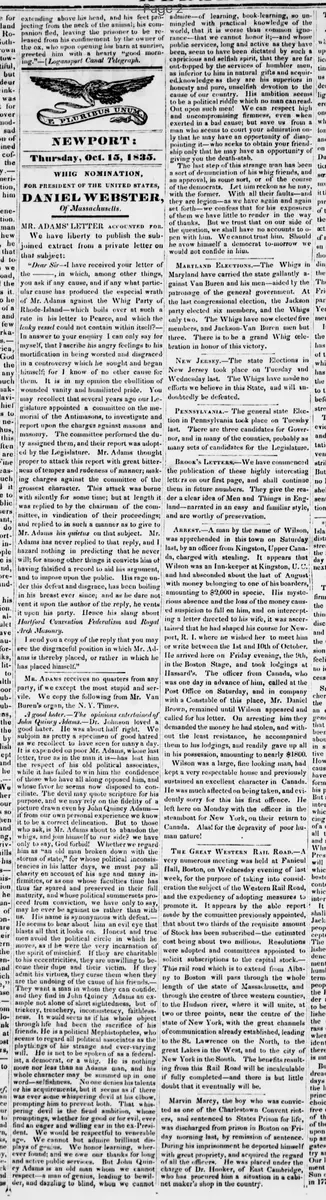
We have liberty to publish the subjoined extract from a private letter on that subject:
"Dear Sir—I have received your letter of the ___, in which, among other things, you ask if any cause, and if any what particular cause has produced the especial wrath of Mr. Adams against the Whig Party of Rhode-Island—which boils over at such a rate in his letter to Pearce, and which the leaky vessel could not contain within itself?—
In answer to your enquiry I can only say for myself, that I ascribe his angry feelings to his mortification in being worsted and disgraced in a controversy which he sought and began himself; for I know of no other cause for them. It is in my opinion the ebullition of wounded vanity and humiliated pride. You may recollect that several years ago our Legislature appointed a committee on the memorial of the Antimasons, to investigate and report upon the charges against masons and masonry.
The committee performed the duty assigned them, and their report was adopted by the Legislature. Mr. Adams thought proper to attack this report with great bitterness of temper and rudeness of manner; making charges against the committee of the grossest character.
This attack was borne with silently for some time; but at length it was replied to by the chairman of the committee, in vindication of their proceedings; and replied to in such a manner as to give to Mr. Adams his quietus on that subject. Mr. Adams has never replied to that reply, and I hazard nothing in predicting that he never will; for among other things it convicts him of having falsified a record to aid his argument, and to impose upon the public. His rage under this defeat and disgrace, has been boiling in his breast ever since; and as he dare not vent it upon the author of the reply, he vents it upon his party. Hence his slang about Hartford Convention Federalism and Royal Arch Masonry.
I send you a copy of the reply that you may see the disgraceful position in which Mr. Adams is thereby placed, or rather in which he has placed himself."
MR. Adams receives no quarters from any party, if we except the most stupid and servile. We copy the following from Mr. Van Buren's organ, the N. Y. Times.
A good hater.—The opinions entertained of John Quincy Adams.—Dr. Johnson loved a good hater. He was about half right. We subjoin as pretty a specimen of good hatred as we recollect to have seen for many a day. It is expended on poor Mr. Adams, whose hasty letter, true as it is in the man it is—has lost him the respect of his old political associates, while it has failed to win him the confidence of those who have all along opposed him, and whose favor he seems now disposed to conciliate. The devil may quote scripture for his purpose, and we may rely on the fidelity of a picture drawn even by John Quincy Adams—if from our own personal experience we know it to be a correct delineation. But to those who ask, is Mr. Adams about to abandon the whigs, and join himself to our side? we have only to say, God forbid! Whether we regard him as "an old man broken down with the storms of state," for whose political inconsistencies in his latter days, we must pay all charity on account of his age and many infirmities, or as one whose faculties time has thus far spared and preserved in their full maturity, and whose political somersets proceed from conviction, we have only to say, may he ever be against us rather than with us. His name is synonymous with defeat.—
He seems to bear about him an evil eye that blasts all that it looks on. Honest and true men avoid the political circle in which he moves, as if he were the very incarnation of the spirit of mischief. If they are charitable to his eccentricities, they are unwilling to become their dupe and their victim. If they admit his virtues, they curse them when they are the undoing of the cause of his friends.—
They want a man in whom they can confide, and they find in John Quincy Adams an example not alone of short sightedness, but of trickery, treachery, inconsistency, faithlessness. It would seem as if his whole object through life had been the sacrifice of his friends. He is a political Mephistopheles, who seems to regard all political associates as the playthings of his strange and ever-varying will. He is not to be spoken of as a federalist, a democrat, or a whig. He is nothing more nor less than an Adams man, and his whole character may be summed up in one word—selfishness. "No one denies his talents or his acquirements, but it seems as if there was ever some whispering devil at his elbow, prompting him to prevent both. That whispering devil is the fiend ambition, whose promptings, whether for good or for evil, ever find an eager and willing ear in the ex-President. We would be respectful to venerable age.
We cannot but admire brilliant displays of genius. We honor learning, wherever found; and we owe our thanks for long and active public services. But John Quincy Adams is an old man whom we cannot respect—a man of genius, leading to bewilder, and dazzling to blind, whom we cannot admire—of learning, book-learning, so unmingled with practical knowledge of the world, that it is worse than common ignorance—that we cannot honor it;—and whose public services, long and active as they have been, seem to have been dictated by such a capricious and selfish spirit, that they are far out-topped by the services of humbler men, as inferior to him in natural gifts and acquired knowledge as they are his superiors in honesty and pure, unselfish devotion to the cause of our country. His ambition seems to be a political riddle which no man can read.
Out upon such men! We can respect high and uncompromising firmness, even when exerted in a bad cause; but save us from a man who seems to court your admiration only that he may have an opportunity of disappointing it—who seeks to obtain your friendship only that he may have an opportunity of giving you the death-stab.
The last step of this strange man has been a sort of denunciation of his whig friends, and an approval, in some sort, of the course of the democrats. Let him reckon as he may, with the former. With all their faults—and they are legion—as we have again and again set forth—we confess that for his exposures of them we have little to render in the way of thanks. But we trust that on our side of the question, we shall have no accounts to open with him. We cannot trust him. Should he avow himself a democrat to-morrow we would not confide in him.
What sub-type of article is it?
What themes does it cover?
What keywords are associated?
What entities or persons were involved?
Where did it happen?
Story Details
Key Persons
Location
Rhode Island
Event Date
Several Years Ago
Story Details
John Quincy Adams' anger towards Rhode Island Whigs stems from humiliation in a legislative controversy over a Masonic report, where his attack on the committee was rebutted, convicting him of falsifying records; a New York Times piece denounces his treacherous, selfish political character.