Thank you for visiting SNEWPapers!
Sign up free
The Brooksville Sun Journal
Brooksville, Hernando County, Florida
What is this article about?
Article defends educational TV against criticisms on homework access and pacing, notes student adjustment to less repetition improving note-taking. Highlights advantages: higher retention, better-prepared teachers with support, visual demos, dual instructors. Author, ex-AV instructor at Auburn and TV physics teacher in Alabama, urges informed evaluation during adjustment phase.
Clipping
OCR Quality
Full Text
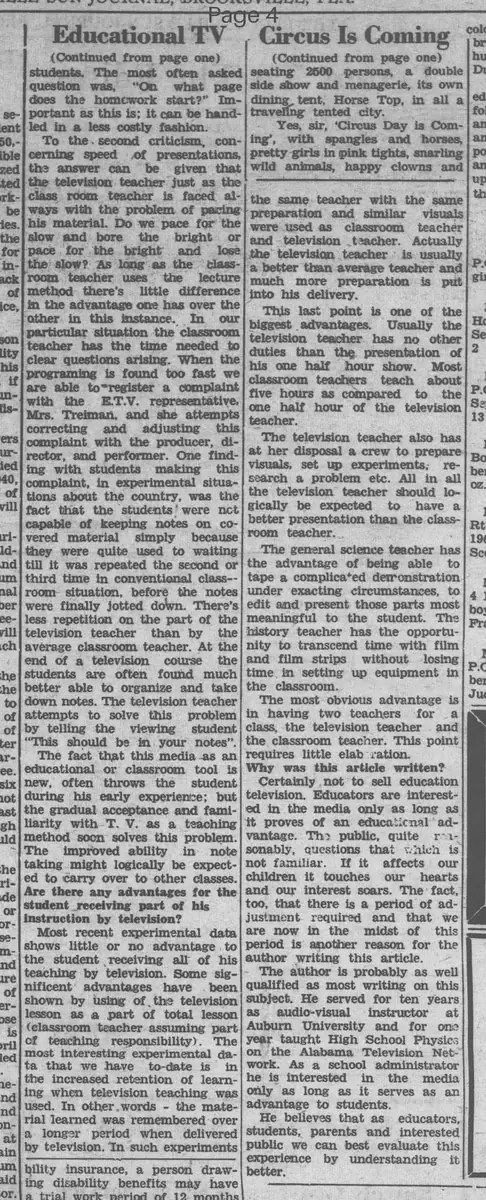
(Continued from page one)
students. The most often asked question was, "On what page does the homework start?" Important as this is; it can be handled in a less costly fashion.
To the second criticism, concerning speed of presentations, the answer can be given that the television teacher just as the class room teacher is faced always with the problem of pacing his material. Do we pace for the slow and bore the bright or pace for the bright and lose the slow? As long as the class-room teacher uses the lecture method there's little difference in the advantage one has over the other in this instance. In our particular situation the classroom teacher has the time needed to clear questions arising. When the programing is found too fast we are able to register a complaint with the E.T.V. representative, Mrs. Treiman, and she attempts correcting and adjusting this complaint with the producer, director, and performer. One finding with students making this complaint, in experimental situations about the country, was the fact that the students were not capable of keeping notes on covered material simply because they were quite used to waiting till it was repeated the second or third time in conventional class-room situation, before the notes were finally jotted down. There's less repetition on the part of the television teacher than by the average classroom teacher. At the end of a television course the students are often found much better able to organize and take down notes. The television teacher attempts to solve this problem by telling the viewing student "This should be in your notes".
The fact that this media as an educational or classroom tool is new, often throws the student during his early experience; but the gradual acceptance and familiarity with T. V. as a teaching method soon solves this problem. The improved ability in note taking might logically be expected to carry over to other classes.
Are there any advantages for the student receiving part of his instruction by television?
Most recent experimental data shows little or no advantage to the student receiving all of his teaching by television. Some significant advantages have been shown by using of the television lesson as a part of total lesson (classroom teacher assuming part of teaching responsibility). The most interesting experimental data that we have to-date is in the increased retention of learning when television teaching was used. In other words - the material learned was remembered over a longer period when delivered by television. In such experiments the same teacher with the same preparation and similar visuals were used as classroom teacher and television teacher. Actually the television teacher is usually a better than average teacher and much more preparation is put into his delivery.
This last point is one of the biggest advantages. Usually the television teacher has no other duties than the presentation of his one half hour show. Most classroom teachers teach about five hours as compared to the one half hour of the television teacher.
The television teacher also has at her disposal a crew to prepare visuals, set up experiments; research a problem etc. All in all the television teacher should logically be expected to have a better presentation than the class-room teacher.
The general science teacher has the advantage of being able to tape a complicated demonstration under exacting circumstances, to edit and present those parts most meaningful to the student. The history teacher has the opportunity to transcend time with film and film strips without losing time, in setting up equipment in the classroom.
The most obvious advantage is in having two teachers for a class, the television teacher and the classroom teacher. This point requires little elaboration.
Why was this article written? Certainly not to sell education television. Educators are interested in the media only as long as it proves of an educational advantage. The public, quite reasonably, questions that which is not familiar. If it affects our children it touches our hearts and our interest scars. The fact, too, that there is a period of adjustment required and that we are now in the midst of this period is another reason for the author writing this article.
The author is probably as well qualified as most writing on this subject. He served for ten years as audio-visual instructor at Auburn University and for one year taught High School Physics on the Alabama Television Network. As a school administrator he is interested in the media only as long as it serves as an advantage to students.
He believes that as educators, students, parents and interested public we can best evaluate this experience by understanding it better.
What sub-type of article is it?
What keywords are associated?
What entities or persons were involved?
Where did it happen?
Story Details
Key Persons
Location
Auburn University, Alabama Television Network
Story Details
The article addresses criticisms of educational television (ETV) such as homework page queries and presentation speed, explaining adjustments and benefits like improved note-taking. It highlights advantages including better retention, dedicated teacher preparation, visual aids, and dual teaching. The author, experienced in audio-visual instruction and TV teaching, advocates understanding ETV's adjustment period for evaluation.