Thank you for visiting SNEWPapers!
Sign up free
The Enquirer
Richmond, Henrico County, Virginia
What is this article about?
A detailed rebuttal by 'One of the Protesters' against 'One of the People's' defenses of James Madison's presidential candidacy. The author criticizes Madison's lack of energy, past federalist associations, handling of the Yazoo compromise, and other actions, while defending the Protesters' protest against the Washington caucus nomination.
Merged-components note: These components form a continuous response by 'One of the Protesters' spanning pages 2-3 with sequential reading orders; relabeled to letter_to_editor as it fits reader response/debate format better than editorial.
Clippings
1 of 2
OCR Quality
Full Text
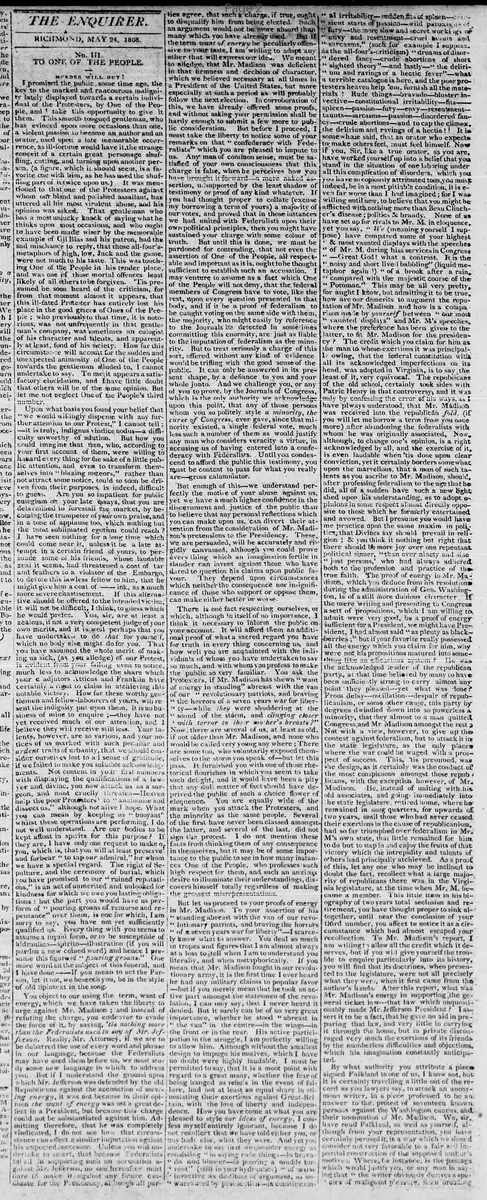
I promised the public some time ago, the key to the marked and rancourous malignity lately displayed towards a certain individual of the Protesters, by One of the People, and I take this opportunity to give it to them. This smooth tongued gentleman, who has evinced upon more occasions than one, a violent passion to become an author and an orator, used upon a late memorable occurrence, as ill-fortune would have it, the strange conceit of a certain great personage shuffling, cutting, and turning upon another person, (a figure, which it should seem, is a favorite one with him, as he has used the shuffling part of it twice upon us.) It was mentioned to that one of the Protesters against whom our bland and polished assailant, has uttered all his most virulent abuse, and his opinion was asked. That gentleman who has a most unlucky knack of saying what he thinks upon most occasions, and who ought to have been made wiser by the memorable example of Gil Blas and his patron, had the sad mischance to reply, that those all-four's-metaphors of high, low, Jack and the game, were not much to his taste. This was touching One of the People in his tender place, and was one of those mortal offences least likely of all others to be forgiven. 'Tis presumed he soon heard of the criticism, for from that moment almost it appears, that this ill-fated Protester has entirely lost his place in the good graces of One of the People; who previously to that time, it is notorious, was not unfrequently in that gentleman's company, was sometimes an eulogist of his character and talents, and apparently at least, fond of his society. How far this circumstance will account for the sudden and unexpected animosity of One of the People towards the gentleman alluded to, I cannot undertake to say. To me it appears a satisfactory elucidation, and I have little doubt that others will be of the same opinion. But let me not neglect One of the People's third number.
Upon what basis you found your belief that "we would willingly dispense with any further attention to our Protest," I cannot tell; it is truly, indignus vindice nodus—a difficulty unworthy of solution. But how you could imagine that men, who, according to your first account of them, were willing to hazard every thing for the sake of a little public attention, and even to transform themselves into "blazing meteors," rather than not attract some notice, could so soon be driven from their purposes, is indeed, difficult to guess. Are you so impatient for public eulogium on your late essays, that you are determined to forestall the market, by becoming the trumpeter of your own praise, and in a tone of applause too, which nothing but the most sublimated egotism could reach? I have seen nothing for a long time which could come near it, unless it be a late attempt in a certain friend of yours, to persuade some of his friends, whose laudable zeal it seems, had threatened a coat of tar and feathers to a violator of the Embargo, to devote this lawless fellow to him, that he might give him a coat of—ink, as a much more severe chastisement. If this alternative should be offered to the intended victim, it will not be difficult, I think, to guess which he would prefer. You, sir, are at least a zealous, if not a very competent judge of your own merits, and it is well perhaps that you have undertaken to do that for yourself, which no body else might do for you. That you have assumed the whole merit of making us sick, (as you allege) of our Protest, is evident from your failing even to notice, much less to acknowledge the share which your co-adjutors Atticus and Franklin have certainly a right to claim in achieving this notable victory. How far these worthy gentlemen and fellow-labourers of yours, will resent the indignity put upon them, it is no business of mine to enquire;—they have not yet received much of our attention, and I believe they will receive still less. Your talents, however, are so various, and your notices of us marked with such peculiar and ardent traits of urbanity, that we should consider ourselves lost to a sense of gratitude, if we failed to make you suitable acknowledgments. Not content in your first numbers with displaying the qualifications of a lawyer and divine, you now attack us as a surgeon, and most cruelly threaten—Heaven help the poor Protesters! to "anatomise and dissect us," although not alive I hope. What you can mean by keeping us "buoyant" whilst these operations are performing, I do not well understand. Are our bodies to be kept afloat in spirits for this purpose? If they are, I have only one request to make of you, which is, that you will at least preserve and forbear "to tap our admiral," for whom we have a special regard. The right of sepulture, and the ceremony of burial, which you have promised to our "ruined reputations," is an act of unmerited and unlooked for kindness for which we owe you lasting obligations: but the part you would have us perform of "pouring groans of remorse and repentance" over them, is one for which, I am sorry to say, you have not yet sufficiently qualified us. Every thing with you seems to assume a liquid form, or to be susceptible of hydraullco-spirito-illustration (if you will pardon a new coined word) and hence I presume this figure of "pouring groans." One more word on the subject of this funeral, and I have done.—If you mean to act the Parson, let it not, we beseech you, be in the style of old Spintext in the song.
You object to our using the term, want of energy, which we have taken the liberty to urge against Mr. Madison; and instead of refuting the charge, you endeavor to evade the force of it, by saying, 'tis nothing more than the Federalists used to say of Mr. Jefferson. Really, Mr. Attorney, if we are to be debarred the use of every word and phrase in our language, because the Federalists may have used them before us, we must study some new language in which to address you. But if I understand the ground upon which Mr. Jefferson was defended by the old Republicans against the accusation of wanting energy, it was not because in their opinion the want of energy was not a great defect in a President, but because this charge could not be substantiated against him. Admitting therefore, that he was completely vindicated, I do not see how that circumstance can affect a similar imputation against his expected successor. Unless you will undertake to assert, that because Federalists failed in supporting such an accusation against Mr. Jefferson, no one hereafter must dare to make it against any future candidate for the Presidency, although all parties agree, that such a charge, if true, ought to disqualify him from being elected. Such an argument would not be more absurd than many which you have already used. But if the term want of energy be peculiarly offensive to your taste, I am willing to adopt any other that will express our idea. We meant to allege, that Mr. Madison was deficient in that firmness and decision of character, which we believed necessary at all times in a President of the United States, but more especially at such a period as will probably follow the next election. In corroboration of this, we have already offered some proofs, and without asking your permission shall be hardy enough to submit a few more to public consideration. But before I proceed, I must take the liberty to notice some of your remarks on that "confederacy with Federalists" which you are pleased to impute to us. Any man of common sense, must be satisfied of your own consciousness that this charge is false, when he perceives how you have brought it forward a mere naked assertion, unsupported by the least shadow of testimony or proof of any kind whatever. If you had thought proper to collate (excuse my borrowing a term of yours) a majority of our votes, and proved that in those instances we had united with Federalists upon their own political principles, then you might have sustained your charge with some colour of truth. But until this is done, we must be pardoned for contending, that not even the assertion of One of the People, all respectable and important as it is, ought to be thought sufficient to establish such an accusation. I may venture to assume as a fact which One of the People will not deny, that the federal members of Congress have to vote, like the rest, upon every question presented to that body, and if it be a proof of federalism to be caught voting on the same side with them, the majority, who might easily by reference to the Journals be detected in sometimes committing this enormity, are just as liable to the imputation of federalism as the minority. But to treat seriously a charge of this sort, offered without any kind of evidence would be trifling with the good sense of the public. It can only be answered in its present shape, by a defiance to you and your whole junto. And we challenge you, or any of you to prove, by the Journals of Congress, which is the only authority we acknowledge upon this point, that any of those persons whom you so politely style a minority, the curse of Congress, ever gave, since that minority existed, a single, federal vote, much less such a number of them as would justify any man who considers veracity a virtue, in accusing us of having entered into a confederacy with Federalists. Until you condescend to afford the public this testimony, you must be content to pass for what you really are—gross calumniator.
But enough of this—we understand perfectly the motive of your abuse against us, yet we have a much higher confidence in the discernment and justice of the public than to believe that any personal reflections which you can make upon us, can divert their attention from the consideration of Mr. Madison's pretensions to the Presidency. These, we are persuaded, will be accurately and rigidly canvassed, although you could prove every thing which an imagination fertile in slander can invent against those who have dared to question his claims upon public favour.
They depend upon circumstances which neither the consequence nor insignificance of those who support or oppose them, can make either better or worse.
There is one fact respecting ourselves, or which, although in itself of no importance, I think it necessary to inform the public on your account. It will afford them an additional proof of what a sacred regard you have for truth in every thing concerning us, and how well you are acquainted with the individuals of whom you have undertaken to say so much, and with whom you profess to make the public so very familiar. You ask the Protesters, if Mr. Madison has shewn "want of energy in standing" abreast with the van of our "revolutionary patriots, and braving the horrors of a seven years war for liberty—while they were shuddering at the sound of the storm, and clinging closer with terror to their mother's breasts?"
Now, there are several of us, at least as old, if not older than Mr. Madison, and none who would be called very young any where; There are some too, who voluntarily exposed themselves to the storm you speak of—but let this pass. It furnished you with one of those rhetorical flourishes in which you seem to take such delight, and it would have been a pity that any dull matter of fact should have deprived the public of such a choice flower of eloquence. You are equally wide of the mark when you attack the Protesters, and the minority as the same people. Several of the first have never been classed amongst the latter, and several of the last, did not sign the protest. I do not mention these facts from thinking them of any consequence in themselves, but it may be of some importance to the public to see in how many instances One of the People, who professes such high respect for them, and such an anxious desire to illuminate their understandings, discovers himself totally regardless of making the grossest misrepresentations.
But let us proceed to your proofs of energy in Mr. Madison. To your assertion of his "standing abreast with the van of our revolutionary patriots, and braving the horrors of a seven years war for liberty"—I scarcely know what to answer. You deal so much in tropes and figures that I am almost always at a loss to tell when I am to understand you literally, and when metaphorically. If you mean that Mr. Madison fought in our revolutionary army, it is the first time I ever heard he had any military claims to popular favor—but if you merely mean that he took an active part amongst the statesmen of the revolution, I can only say, that I never heard it denied. But it surely can be of no very great importance, whether he stood "abreast in the van" in the centre—in the wings—in the front or in the rear. His active participation in the struggle, I am perfectly willing to allow him. Although without the smallest design to impugn his motives, which I have no doubt were highly laudable, I must be permitted to say, that it is a moot point with regard to a great many, whether the fear of being hanged as rebels in the event of failure, had not at least an equal share in stimulating their exertions against Great-Britain, with the love of liberty and independence. How you have come at what you are pleased to style our ideas of energy, I confess myself entirely ignorant, because I do not recollect that we have told either you, or any body else, what they were. And yet you undertake to say that we consider energy as consisting "in saying rude things—in bravado and bluster—in pouring a muddy torrent" (still in your hydraulics) "of course invective as destitute of argument, as unwarranted by provocation—in constitutional irritability—sudden fits of spleen—transient starts of passion—wild paroxysms of fury—the more slow and secret workings of envy and resentment—cruel taunts and sarcasms," (such for example I suppose, as the all-four's-criticism) "dreams of disordered fancy—crude abortions of short sighted theory"—and lastly—"the delirium and ravings of a hectic fever"—what a terrible catalogue is here, and the poor protesters heaven help 'em, furnish all the materials! Rude things—bravado—bluster—invective—constitutional irritability—fits—spleen—passion—fury—envy—resentment—taunts—sarcasms—disordered fancy—crude abortions—and to cap the climax, the delirium and ravings of a hectic!! It is somewhere said, that an orator who expects to make others feel, must feel himself. Now if you, Sir, like a true orator, as you are, have worked yourself up into a belief that you stand in the situation of one laboring under all this complication of disorders, which you have so copiously attributed to us, you must indeed, be in a most pitiable condition, it is even far worse than I had imagined; for I was willing until now, to believe that you might be afflicted with nothing more than Beau Clincher's disease; politics & brandy. None of us have set up for rivals to Mr. M. in eloquence, yet you say, "We (meaning yourself I suppose) have compared some of your highest & most vaunted displays with the speeches of Mr. M. during his services in Congress Great God! what a contrast. It is the noisy and short lived babbling (liquid metaphor again!) of a brook after a rain. compared with the majestic course of the Potomac." This may be all very pretty, for aught I know, but admitting it to be true, how are our demerits to augment the reputation of Mr. Madison, and how is a comparison made by yourself between "our most vaunted displays" and Mr. M's speeches, where the preference has been given to the latter, to fit Mr. Madison for the presidency? The credit which you claim for him as the man to whose exertions it was principally owing, that the federal constitution with all its acknowledged imperfections on its head, was adopted in Virginia, is to say the least of it, very equivocal. The republicans of the old school, certainly took sides with Patrick Henry in that controversy; and it was only by confessing the error of his ways, as I have always understood, that Mr. Madison was received into the republican fold, (if you will let me borrow a term from you once more) after abandoning the federalists with whom he was originally associated. Now, although, to change one's opinion, is a right acknowledged by all, and the exercise of it, is even laudable when 'tis done upon clear conviction, yet it certainly borders somewhat upon the marvellous, that a man of such talents as you ascribe to Mr. Madison, should, after professing federalism to the age that he did, all of a sudden have such a new light shed upon his understanding, as to adopt opinions in some respect almost directly opposite to those which he formerly entertained and avowed. But I presume you would have me practice upon the same maxim in politics: that Divines say should prevail in religion; & you think it nothing but right that there should be more joy over one repentant political sinner, "than over ninety and nine just persons," who had always adhered both to the profession and practice of the true faith. The proof of energy in Mr. Madison, which you deduce from his resolutions during the administration of Gen. Washington, is of a still more dubious character. If the mere writing and presenting to Congress a set of propositions, which I am willing to admit were very good, be a proof of energy sufficient for a President, we might have Presidents, I had almost said "as plenty as blackberries:" but if your favorite really possessed all the energy which you claim for him, why were not his propositions matured into something like an efficacious system? He was the acknowledged leader of the republican party, at that time believed by many to have been sufficiently strong to carry almost any point they pleased—yet what was done? From delay—oscillation—despair of republicanism, or some other cause, this party by degrees dwindled down into so powerless a minority, that they almost to a man quitted Congress, and Mr. Madison amongst the rest Not with a view, however, to give up the contest against federalism, but to attack it in the state legislature, as the only places where the war could be waged with a prospect of success. This, 'tis presumed, was the design, as it certainly was the conduct of the most conspicuous amongst those republicans, with the exception however, of Mr Madison. He, instead of uniting with his old associates, and going immediately into the state legislature, retired home, where he remained in snug quarters, for upwards of two years, until those who had never ceased their exertions in the Cause of republicanism, had so far triumphed over federalism in Mr. M's own state, that little remained for him to do but to step in and enjoy the fruits of that victory which the intrepidity and talents of others had principally achieved. As a proof of this, let any one who may be inclined to doubt the fact, recollect what a large majority of republicans there was in the Virginia legislature, at the time when Mr. M. became a member. This little item in his biography of two years total seclusion and retirement, you have thought proper to sink altogether, until near the conclusion of your third number, you affect to notice it as a circumstance which had almost escaped your recollection. To Mr. Madison's report, I am willing to allow all the credit which it deserves, but if you will give yourself the trouble to enquire particularly into its history, you will find that its doctrines, when presented to the legislature, were not all precisely what they were, when it first came from the author's hands. After this report, what was Mr. Madison's energy in supporting the general ticket law—that law which unquestionably made Mr. Jefferson President? I assert it to be a fact, that he gave no aid in preparing that law, and very little in carrying it through the house, but in private discouraged very much the exertions of its friends, by the numberless difficulties and objections, which his imagination constantly anticipated.
By what authority you attribute a piece signed Falkland to one of us, I know not, but it is certainly travelling a little out of the record as you lawyers say, to attack an anonymous writer, in a piece professed to be an answer to the protest of seventeen known persons against the Washington caucus, and their nomination of Mr. Madison. We, sir, have read Falkland, as well as yourself, although from your representation, you have certainly perused it, in a way which we should consider not very favorable to a fair and impartial construction of the supposed author's motives. Where, for instance, is the passage which would justify you, or any man in saying that "the writer obviously derives a species of malignant pleasure, from broiling
"Over this imaginary triumph" (of Henry over Madison) "although if gained, it would have been at the expense of his country."--or that this writer "probably thought the defence of the alien and sedition laws, a better cause than contending for previous amendments to the constitution."
When a man thus willfully and knowingly asserts, what he must be, and is conscious that he cannot support, 'tis hard to say what treatment he deserves. You know, Sir, as well as any man, that the gentleman to whom you allude is one of the last men in the United States; against whom such insinuations can obtain any credit with those who have any knowledge either of his opinions or conduct. But let us return to your eulogium on Mr. Madison. of which we do not mean to lose sight, altho' your constant personal abuse of us, occasions as you no doubt wish, many digressions. You assert that you "have taken a rapid review of Mr. Madison's life, for the purpose of finding the occasion on which he betray-ed want of energy. and you cannot find it. On the contrary, in every crisis during his long and eventful political career, of four and thirty years, whenever the energy of the statesman was demanded, we have seen it illustriously displayed by him."
People seldom look much, for what they do not wish to find; if you had done so, it would have been impossible, with all your carelessness about plain matters of fact, that you could have made such a declaration. What becomes of that period of Mr. M's "long and eventful political career of four and thirty years," which elapsed between his leaving Congress, and going into the Virginia Legislature? Can you deny that period of his retirement to have been a crisis "when the energy of the statesman was demanded," as much as at any previous or subsequent time of the contest between Federalism and Republicanism, and where was he, how was he employed? This is a question to which the public have a right to claim an answer from one who endeavors to extort from them, for his candidate the praise of the "steady and unremitting energy of a firm and ardent patriot" I assert that his exertions did remit, and that too, for more than two years during a period, when they were as much wanted as they ever were.
You roundly declare that "you have not followed Mr. M. into his office under the present Administration, because since that time his course has been uniformly with the administration, and whatever you (the Protesters) may think of that course, the seal of approbation has been already fixed upon it by your country." If this be true, we are to understand the administration as approving of Mr. M's. conduct in the Yazoo business, which certainly formed a part; and a very important one of his course, or you could not have had the boldness to assert, that "his course had been uniformly with the administration." But this I am persuaded the friends of the administration will never admit. 'Tis certain they have always maintained the contrary. Still if it were possible that could be true, the other part of your declaration is totally destitute of foundation, for nothing is more true than that the public have not "fixed the seal of their approbation" to that part of their course, even if the administration are to be understood as approving of Mr. M's. opinion in favor of the Yazoo compromise, which you are the first man who has ever been bold enough to insinuate. But this I am convinced must be a slip of your pen, arising from your extreme solicitude to bolster Mr. M. with the popularity of the administration.
You complain of want of specification in our charges and demand both the "when and the where." You must surely calculate upon availing yourself of some forensic trick, and expect to prove an alibi, by this importunity for specification; but if you are really desirous of it, you shall have it once more: Our specific charges then, against Mr. Madison are, that he recommended in a certain report (the existence of which you have admitted) a compromise with a set of Yazoo Speculators, the principal condition of which was to give them five millions of dollars to relinquish their fraudulent pretensions to certain public lands, to which, according to his own shewing, they had no sort of claim whatever, either legal or equitable: that his exertions, shortly before he left Congress, relaxed by degrees, until he actually quitted his post--went home, and there remained for a considerable period during the most interesting part of the controversy which terminated in Mr. Jefferson's election: that he cannot be considered as having equal claims to the presidency with men not inferior to him in any respect, and superior to him in always having professed and acted upon the same political principles which they now entertain:--that he is one of the writers of the Federalist, a book containing some doctrines very objectionable to Republicans, and which there is not sufficient evidence to prove that he has altogether abandoned:--that instead of aiding with all his talents in promoting the general ticket law in his own state, without which Mr. Jefferson could not have been elected, a single individual was compelled to undertake it, and the support which Mr. Madison gave it, after it was brought into the House, was so very feeble and discouraging. that it was carried in a house having a decided majority of about forty republicans, by a majority. I think of only seven. And lastly, that Mr. M. is suspected of undue partiality (I mean no reflection on his motives) towards one of the belligerents. The proof of this charge is, that he in the winter 1805-6, in conversation with a certain member of congress on the subject of our Spanish Relations, avowed it as his opinion, that they never could be settled without the interposition of France, and said that the truth was that France wanted money and the United States must give it to her. I know not whether I quote the precise words, but the sentiment is precisely the same. Recollect, sir, that this has been mentioned more than once on the floor of congress, and a denial challenged. It never has been denied, and the public must judge whether such a declaration is evidence of the alledged partiality or not.--Whether it arises from good or bad motives, the public I conceive have no interest in enquiring--its existence is all which they are concerned to know. But I am gratified that after censuring us so heavily for dealing altogether in general accusations, you at last condescend to beg our pardon, and to acknowledge that we have specified one charge. viz: that of Mr. M's. retirement. How you have vindicated him, it is for others to say. It will be recollected, however, that many of his best friends. who certainly must have known his situation at least as well as you, blamed him for yielding to the storm, and they were not "Barbarians" either, but personally very much attached to Mr. M.--If I thought your favor of the least importance to us, I should really regret that we can please you neither by our "yeas and nays," which you decidedly condemn, nor by our efforts at speaking. which you say are much worse.
The above are some of the principal instances in the public character and conduct of Mr. M. which we consider as defects sufficient to disqualify him for the Presidency: and most of them are specifications of want of energy--firmness--decision, call it what you please, such as we believe all rational men will admit to be disqualifications.
Without following you through your catalogue of human butchers and tyrants, and a string of epithets and tropes illustrative, as you imagine, of their characters, permit me to ask what can be your motive for this enumeration? You dare not call us openly the admirers of any of these despots, because you are sensible that the public, who are rarely unjust, would pronounce it slander. But you insinuate as much when you say "this may be the species of energy which suits your projects." If I were disposed to retort in the same way, I might with much more colour of justice say--that you may be one of those men so aptly described by Martial, of whom he remarks "Iras et verba locant" they hire out their words and anger. I might conjecture that you may be one of those hungry and greedy expectants of office, who calculate upon recommending themselves to the patronage and favour of great men, by the virulence of their abuse against their supposed enemies, and expect the grade of their promotion to be measured by the quantum of rancour and malevolence infused into their philippicks. But if this may be your calculation, the worst enemies of Mr. Jefferson and Mr. Madison never imagined any thing half so bad of them. I might also guess, sir, by giving much less scope to my imagination than you have done, that you may be one of those unfortunate beings in whom the wounded pride of an author rises paramount to all moral considerations, and who stung to the very soul by an unlucky sarcasm on a favorite child of his fancy, does not scruple to involve sixteen persons, who are all with the exception of one or two, utterly unknown to him, in the same indiscriminate and immeasurable abuse with the man who alone has provoked his irascibility and upon whom he is so anxious to wreak his vengeance. I beg you will not venture to assert as you will be very ready to do, if I may judge of your future by your past liberality, that we should have been content to have that gentleman calumniated provided you had left us out of the scrape. No, sir, I know that gentleman's character, I have the vanity to believe somewhat better than One of the People, and admitting all the failings which impartiality can attribute to it, I am prepared to defend it against all assailants by facts which none can deny and arguments that I am persuaded none can controvert. With him, as long as he entertains the same principles both moral and political, which I know him to possess, I shall never consider it a disgrace for any man either to stand, or to fall.
By what authority you undertake to say that 'tis understood "we support" two particular gentlemen for the Presidency and Vice-Presidency. to whom you allude in such a way as not easily to be mistaken, I am yet to learn. 'Tis certain we have informed neither you nor the public, whom we should (to use your own polite language) "curse with our support" and when we had done so, one would think would be full as soon as you could know the fact. But we understand you, and in this you are pursuing the same laudable policy with most of your predecessors, and presuming upon our want of popularity, are attempting to injure to the extent of your power, those very gentlemen whom you pretend to admire, by giving them our votes, without waiting to hear whether we consent to it or not. This indirect mode of attaining an object which you dare not openly attempt is an artifice truly worthy of your talents and dispositions, but 'tis one which we hope and believe the Gentlemen who is honoured instead of being "cursed" with your support can not possibly countenance. You attempt next to prove us guilty of inconsistency in a way, that would disgrace even a school-boy not out of his reading lessons of two syllables. It is not even entitled to be called a sophism. You say we accuse Mr. Madison of wanting energy, and yet immediately after. charge him with writing the Federalist "in conjunction with Mr. Jay and Mr. Hamilton, in which the most objectionable doctrines of the latter were maintained.--Now the objection (whose objection) to the doctrines of the latter were that they were too energetic. In one breath then Mr. Madison wants energy, and in the next he has too much of it." This is syllogism with a vengeance! If the objection which you kindly put into our mouths, had really been made by us, then perhaps there might have been something like plausibility in your argument. And if you will take the liberty of forcing us to utter either other people's objections or your own, our refutation, one would imagine, would be no very difficult matter. Yet even with this assumed advantage, you have certainly made a very bungling hand of it, (if you will pardon a term not very classical;) how for instance, does a man's recommending a government too energetic. prove that he has energy himself? An ordinary reasoner would be apt to say that the more energetic the government proposed, the less energetic in the republican sense of the term, the individual who proposes it. But it belongs to extraordinary men, to reason in an extraordinary manner. It is not one thing to recommend such a constitution as republicans would think too energetic, & another thing to display in one's conduct that sort of energy which would lead us never to advise that which we declared unjust and inequitable. as Mr. Madison did in the Yazoo case:--to maintain always the same opinions when once formed upon mature reflection, as was not the case with Mr. Madison when he turned from federalism to Republicanism :--and lastly to struggle as long as there was hope in the cause which one believed right. which was not Mr. Madison's conduct when he retired from public life?
You complain again that we have not specified the particular objectionable passages in the Federalist. Would you have had our protest the size of a book? Unless you, or some other professed Republican had ever undertaken to defend those notorious doctrines, our specification we conceive was quite sufficient. Mr. Madison certainly permitted the book to go to the world with the sanction of his name, and he is therefore strictly responsible, not only for that part of it, which he himself wrote, but for that which was written in conjunction with Mr. Jay and Mr. Hamilton. Unless indeed you will venture to offer the same excuse for him on this occasion, as another able apologist did for his participation in the Yazoo Report, viz: "that he might perhaps have signed what he never read." Your confounding the support of our constitution after its amendments and ratification, with the recommendation of it previous to its adoption and with all its defects, is a piece of legerdemain worthy of you and of your cause. Bradley's funny summons and its funny vindication are nothing to it. You impute Federalism to Mr. Madison as a virtue, and to us as a crime, just as it suits your fancy. Your attempt to bolster up Mr. Madison's popularity with that of the administration is a counterpart of the same finesse. When we object to Mr. M's. official acts as a member of the administration, it may be then perfectly fair in you to endeavor to answer us, by calling us enemies to the administration, but you ought in common reason first to shew that we have thus objected. Our objections to him are most of them of prior date to his becoming Secretary of State, and those which have occurred since, have no other connexion with the administration, than what has been made thro' your instrumentality.
I must once more express my regret that you will insist upon so far identifying yourself with the people as always to speak in their persons. Thus you say, "we pity you --but our confidence in you is gone forever." I regret it, because I am ready to confess it would give me much concern to believe the fact with regard to the people. Your confidence, however, I am so far from desiring, that nothing would sooner make me begin to distrust myself, than the knowledge that I possessed it, and with regard to your pity, if you will only consent to withhold it until we ask for it, I shall desire nothing more of you.
Believe me, most candid, most liberal, most gentle counsellor, the people, whose confidence we are anxious to retain, are as unlike you, as correct reasoning is to flimsy sophistry--as justice to calumny--as truth to misrepresentation and slander.
With your charges against Mr. Pickering I have nothing to do. : He is a man with whom I have neither personal acquaintance, nor political sympathy. Nor shall I again notice your reiterated and general accusation of Federalism, farther than to call upon you, as you so often have done upon us, for specification. This clamour may serve your purpose perhaps with a few, but the rational part of the people, have seen too much of it in the same style. and know too well the design with which it is made, not to despise it. The insinuation of partiality to Britain and hostility to France (which. it would be equally fair to retort upon you, merely by changing the places of the terms France and Britain) is as much entitled as the other to public contempt. I have no wish that my country ever should be in so unfortunate a situation. as to afford either of us an opportunity of evincing the strength of our attachment by the extent of the sacrifices which we would make. But if such a period should ever arrive, the public will see. who best understand, and who will go farthest to promote and preserve all that freemen and patriots hold dear--the seventeen Protesters--or One of the People, who notwithstanding "he would be a General." has no higher claim, we believe to exclusive patriotism than other men.
I may with truth now exclaim, in the language of one who after relating a very long and dull tale, to the great annoyance of his audience, cried when he had nearly finished "courage, my friends, I see land;" I now see nearly the end of your third and last number, than which it has never fallen to my fortune to peruse a more finished specimen of mere verbiage. But I had undertaken to notice it, and to go through was indispensible. Your fame, sir, as a writer, would at least have lost nothing, if your zeal for Mr. Madison's election, or a passion perhaps not quite so laudable, had not stimulated you to the undertaking.
Our idea of the advantage of rotation in office, you have treated with the same candor, that you have observed towards us in every other respect--by totally misrepresenting it. Where for example, have we supposed that each succeeding President is to be so ignorant of the acts of his predecessor, as to be obliged "immediately upon his election gravely to sit down to review them, and to examine their tendency for the first time" or to be so ignorant of past events, "as to have to learn them by rummaging over the journals of his predecessors?" If you will both misquote and misrepresent us, there is no absurdity of which you may not convict us. But unfortunately for you there is no such opinion in our Protest, nor any thing from which it can be inferred. On the advantage of rotation in office. we think as other people do, nor shall we cease to express it, altho' you should insinuate that in doing so, we mean to intimate some treachery in the present administration. All that we have said on this subject is, that one of the principal benefits of rotation in office consists in the successor's not thinking himself bound to follow his predecessor in every thing, which he might be apt to do if he had been previously connected with him, as confident and adviser. However you may have "always thought, that the acts of the administration were always examined as they went along, their wisdom and tendency decided upon by the nation"—the people must know that there are many such things as state secrets--many acts of every administration which never can be known but by their successors, and which it may be beneficial to the nation to have scrutinized, and possibly exposed. And shall we be accused of an attempt to make the public believe there are now such secrets and such acts, merely because we have ventured to mention in general terms the possibility of their existence, in attempting to illustrate the advantages of rotation in office? Or do you expect the people to forego this advantage, lest by practicing on the doctrine, they should be thought to betray a want of proper confidence in the present administration? How your charge of squeamishness in us on this occasion will comport with your other accusations against us, of open and heinous offences perpetrated upon the government. you yourself can best explain. But for your unsolicited kindness in "speaking out for us, when you say we will not do it for ourselves," I cannot withhold my thanks. If the public are satisfied that you shall first invent secrets for us, and then explain them in your own way, it will be in vain for me to attempt any reply. Whenever sufficient evidence shall be produced from our own words and actions to prove our hostility to the general character and conduct of the present administration, I for one shall be ready to plead guilty : but until then, I shall rely upon the common sense and common justice of the people for taking a plain denial as an adequate answer to an assertion general in its nature and destitute of proof.
In the sincerity of your concluding exhortations and advice, I can place no confidence, whilst you undertake to assert as a fact "that we have an interest distinct from the people ; that our brains are disturbed by wicked dreams of ambition; and that we have departed from virtue and from the people." These are heavy charges, sir, and they come with peculiar grace from one who has an interest distinct from the people---who's gain is their loss---whose brain, it is said, has been disturbed by ambitious dreams (I will not say whether "wicked" or not) and whose claim to virtue has been evinced by accusing, without the smallest regard to fact, 17 men with most of whom he was entirely unacquainted, of almost every atrocious crime under Heaven. Farewell, sir, I have done with you. If you have no account to settle with your own conscience, your reformation is indeed a hopeless task.
To my Brother Protesters, and to the public, it may be thought perhaps that I owe some excuse, for some expressions which I may have used. If any should be of this opinion, I must plead the law of retaliation in justification. Those voluntary champions of Mr. Madison whose ideas of controversial courtesy and retributive justice lead them to answer all who venture to object to him as a President, by such decorous accusations as "Perjury &c." do not deserve, and can never receive, at least from me, any other Treatment. "To fight the devil with fire," I have always understood was allowable and proper.
ONE OF THE PROTESTERS.
What sub-type of article is it?
What themes does it cover?
What keywords are associated?
What entities or persons were involved?
Letter to Editor Details
Author
One Of The Protesters
Recipient
One Of The People
Main Argument
james madison is unfit for the presidency due to lack of energy and firmness, past federalist associations including authorship of the federalist papers, support for the yazoo compromise, retirement from politics during key periods, feeble support for the general ticket law, and suspected partiality toward france.
Notable Details