Thank you for visiting SNEWPapers!
Sign up free
Letter to Editor
April 20, 1769
The Virginia Gazette
Richmond, Williamsburg, Richmond County, Virginia
What is this article about?
Physician J.D. defends deviating from traditional medical rules to save patients, details successful treatment of a contagious malignant fever in Norfolk and Princess Anne counties with only one death among over 60 cases, and quotes Celsus and Tissot to support innovative practices.
Clipping
OCR Quality
98%
Excellent
Full Text
To Mess. Purdie & Dixon.
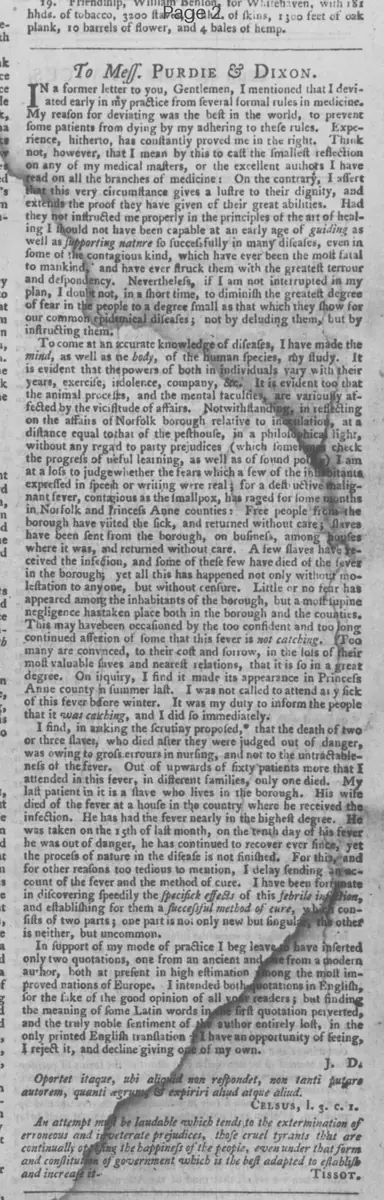
In a former letter to you, Gentlemen, I mentioned that I deviated early in my practice from several formal rules in medicine. My reason for deviating was the best in the world, to prevent some patients from dying by my adhering to these rules. Experience, hitherto, has constantly proved me in the right. Think not, however, that I mean by this to cast the smallest reflection on any of my medical masters, or the excellent authors I have read on all the branches of medicine: On the contrary, I assert that this very circumstance gives a lustre to their dignity, and extends the proof they have given of their great abilities. Had they not instructed me properly in the principles of the art of healing I should not have been capable at an early age of guiding as well as supporting nature so successfully in many diseases, even in some of the contagious kind, which have ever been the most fatal to mankind, and have ever struck them with the greatest terrour and despondency. Nevertheless, if I am not interrupted in my plan, I doubt not, in a short time, to diminish the greatest degree of fear in the people to a degree small as that which they show for our common epidemical diseases; not by deluding them, but by instructing them.
To come at an accurate knowledge of diseases, I have made the mind, as well as the body, of the human species, my study. It is evident that the powers of both in individuals vary with their years, exercise, indolence, company, &c. It is evident too that the animal processes, and the mental faculties, are variously affected by the vicissitude of affairs. Notwithstanding, in reflecting on the affairs of Norfolk borough relative to inoculation, at a distance equal to that of the pest house, in a philosophical light, without any regard to party prejudices (which sometimes check the progress of useful learning, as well as of sound policy) I am at a loss to judge whether the fears which a few of the inhabitants expressed in speech or writing were real; for a destructive malignant fever, contagious as the smallpox, has raged for some months in Norfolk and Princess Anne counties: Free people from the borough have visited the sick, and returned without care; slaves have been sent from the borough, on business, among houses where it was, and returned without care. A few slaves have received the infection, and some of these few have died of the fever in the borough; yet all this has happened not only without molestation to anyone, but without censure. Little or no fear has appeared among the inhabitants of the borough, but a most supine negligence has taken place both in the borough and the counties. This may have been occasioned by the too confident and too long continued assertion of some that this fever is not catching. Too many are convinced, to their cost and sorrow, in the loss of their most valuable slaves and nearest relations, that it is so in a great degree. On inquiry, I find it made its appearance in Princess Anne county in summer last. I was not called to attend any sick of this fever before winter. It was my duty to inform the people that it was catching, and I did so immediately.
I find, in asking the scrutiny proposed, that the death of two or three slaves, who died after they were judged out of danger, was owing to gross errors in nursing, and not to the untractableness of the fever. Out of upwards of sixty patients more than I attended in this fever, in different families, only one died. My last patient in it is a slave who lives in the borough. His wife died of the fever at a house in the country where he received the infection. He has had the fever nearly in the highest degree. He was taken on the 15th of last month, on the tenth day of his fever he was out of danger, he has continued to recover ever since, yet the process of nature in the disease is not finished. For this, and for other reasons too tedious to mention, I delay ending an account of the fever and the method of cure. I have been fortunate in discovering speedily the specifick effects of this febrile infection, and establishing for them a successful method of cure, which consists of two parts; one part is not only new but singular, the other is neither, but uncommon.
In support of my mode of practice I beg leave to have inserted only two quotations, one from an ancient and one from a modern author, both at present in high estimation among the most improved nations of Europe. I intended both quotations in English, for the sake of the good opinion of all your readers; but finding the meaning of some Latin words in the first quotation perverted, and the truly noble sentiment of the author entirely lost, in the only printed English translation I have an opportunity of seeing, I reject it, and decline giving one of my own.
J. D.
Oportet itaque, ubi aliquid non respondet, non tanti putare autorem, quanti agrum & experiri aliud atque aliud.
Celsus, l. 3. c. 1.
An attempt must be laudable which tends to the extermination of erroneous and inveterate prejudices, those cruel tyrants that are continually opposing the happiness of the people, even under that form and constitution of government which is the best adapted to establish and increase it.
Tissot.
In a former letter to you, Gentlemen, I mentioned that I deviated early in my practice from several formal rules in medicine. My reason for deviating was the best in the world, to prevent some patients from dying by my adhering to these rules. Experience, hitherto, has constantly proved me in the right. Think not, however, that I mean by this to cast the smallest reflection on any of my medical masters, or the excellent authors I have read on all the branches of medicine: On the contrary, I assert that this very circumstance gives a lustre to their dignity, and extends the proof they have given of their great abilities. Had they not instructed me properly in the principles of the art of healing I should not have been capable at an early age of guiding as well as supporting nature so successfully in many diseases, even in some of the contagious kind, which have ever been the most fatal to mankind, and have ever struck them with the greatest terrour and despondency. Nevertheless, if I am not interrupted in my plan, I doubt not, in a short time, to diminish the greatest degree of fear in the people to a degree small as that which they show for our common epidemical diseases; not by deluding them, but by instructing them.
To come at an accurate knowledge of diseases, I have made the mind, as well as the body, of the human species, my study. It is evident that the powers of both in individuals vary with their years, exercise, indolence, company, &c. It is evident too that the animal processes, and the mental faculties, are variously affected by the vicissitude of affairs. Notwithstanding, in reflecting on the affairs of Norfolk borough relative to inoculation, at a distance equal to that of the pest house, in a philosophical light, without any regard to party prejudices (which sometimes check the progress of useful learning, as well as of sound policy) I am at a loss to judge whether the fears which a few of the inhabitants expressed in speech or writing were real; for a destructive malignant fever, contagious as the smallpox, has raged for some months in Norfolk and Princess Anne counties: Free people from the borough have visited the sick, and returned without care; slaves have been sent from the borough, on business, among houses where it was, and returned without care. A few slaves have received the infection, and some of these few have died of the fever in the borough; yet all this has happened not only without molestation to anyone, but without censure. Little or no fear has appeared among the inhabitants of the borough, but a most supine negligence has taken place both in the borough and the counties. This may have been occasioned by the too confident and too long continued assertion of some that this fever is not catching. Too many are convinced, to their cost and sorrow, in the loss of their most valuable slaves and nearest relations, that it is so in a great degree. On inquiry, I find it made its appearance in Princess Anne county in summer last. I was not called to attend any sick of this fever before winter. It was my duty to inform the people that it was catching, and I did so immediately.
I find, in asking the scrutiny proposed, that the death of two or three slaves, who died after they were judged out of danger, was owing to gross errors in nursing, and not to the untractableness of the fever. Out of upwards of sixty patients more than I attended in this fever, in different families, only one died. My last patient in it is a slave who lives in the borough. His wife died of the fever at a house in the country where he received the infection. He has had the fever nearly in the highest degree. He was taken on the 15th of last month, on the tenth day of his fever he was out of danger, he has continued to recover ever since, yet the process of nature in the disease is not finished. For this, and for other reasons too tedious to mention, I delay ending an account of the fever and the method of cure. I have been fortunate in discovering speedily the specifick effects of this febrile infection, and establishing for them a successful method of cure, which consists of two parts; one part is not only new but singular, the other is neither, but uncommon.
In support of my mode of practice I beg leave to have inserted only two quotations, one from an ancient and one from a modern author, both at present in high estimation among the most improved nations of Europe. I intended both quotations in English, for the sake of the good opinion of all your readers; but finding the meaning of some Latin words in the first quotation perverted, and the truly noble sentiment of the author entirely lost, in the only printed English translation I have an opportunity of seeing, I reject it, and decline giving one of my own.
J. D.
Oportet itaque, ubi aliquid non respondet, non tanti putare autorem, quanti agrum & experiri aliud atque aliud.
Celsus, l. 3. c. 1.
An attempt must be laudable which tends to the extermination of erroneous and inveterate prejudices, those cruel tyrants that are continually opposing the happiness of the people, even under that form and constitution of government which is the best adapted to establish and increase it.
Tissot.
What sub-type of article is it?
Informative
Persuasive
What themes does it cover?
Health Medicine
What keywords are associated?
Medical Practice
Contagious Fever
Norfolk
Princess Anne
Inoculation
Patient Treatment
Celsus
Tissot
What entities or persons were involved?
J. D.
Mess. Purdie & Dixon.
Letter to Editor Details
Author
J. D.
Recipient
Mess. Purdie & Dixon.
Main Argument
the writer justifies early deviations from formal medical rules to prevent patient deaths, based on successful experience, particularly in treating a contagious malignant fever with high success rates, and aims to reduce public fears through instruction rather than delusion.
Notable Details
Treated Over 60 Patients With The Fever, Only One Death
Discusses Public Negligence And Fears Regarding Inoculation Versus The Fever
Quotes Celsus In Latin And Tissot In English To Support Innovative Practice