Thank you for visiting SNEWPapers!
Sign up free
Alexandria Daily Gazette, Commercial & Political
Alexandria, Virginia
What is this article about?
Contradictory reports from Cadiz in August 1809 detail the Peninsular War: rumors of French victory over combined British-Spanish forces near Seville-Madrid denied by later accounts; updates on Talavera battle, army positions, and movements of Wellesley, Victor, Soult, Venegas; Spanish patriots in favorable state, potential shift to Regency.
Merged-components note: Continuation of the foreign news article on affairs in Spain, with sequential reading order and adjacent spatial positioning in the right column.
Clipping
OCR Quality
Full Text
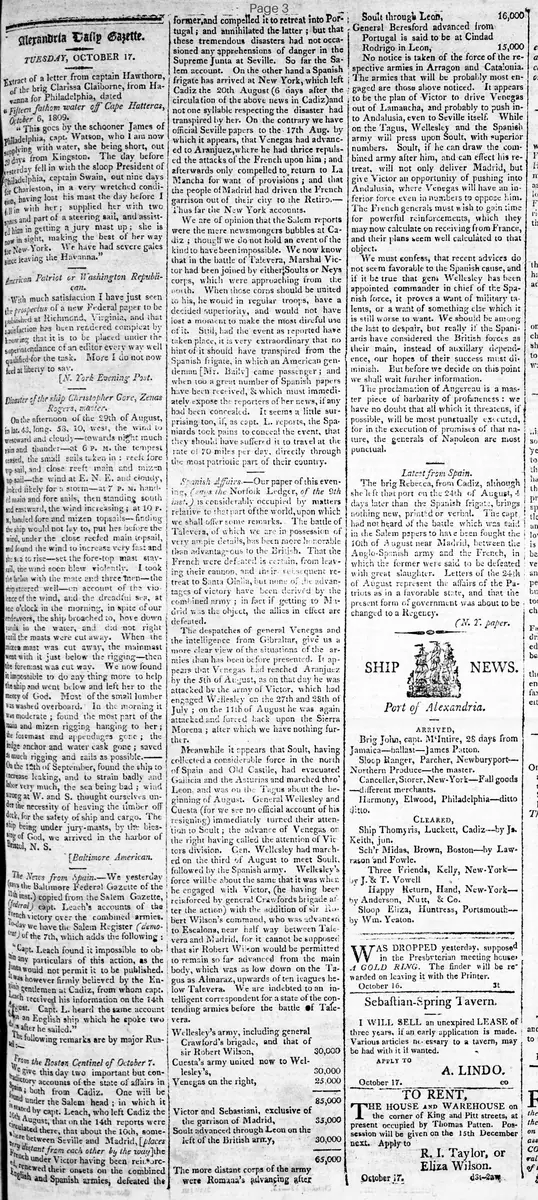
"Capt. Leach found it impossible to obtain any particulars of this action, as the junta would not permit it to be published. I was however firmly believed by the English gentlemen at Cadiz, from whom capt. Leach received his information on the 14th August. Capt. L. heard the same account on an English ship which he spoke two days after he sailed."
The following remarks are by major Russell:——
From the Boston Centinel of October 7.
We give this day two important but contradictory accounts of the state of affairs in Spain; both from Cadiz. One will be found under the Salem fund stated August 16th by capt. Leach on the head: in which it is reported who left Cadiz 14th reports were circulated there, that about the 10th, somewhere between Seville and Madrid, [places very distant from each other by the way the French renewed under their Victor onsets having been the combined English and Spanish armies, defeated the former, and compelled it to retreat into Portugal; and annihilated the latter: but that these tremendous disasters had not occasioned any apprehensions of danger in the Supreme Junta at Seville. So far the Salem account. On the other hand a Spanish frigate has arrived at New York, which left Cadiz the 20th August (6 days after the circulation of the above news in Cadiz) and not one syllable respecting the disaster had transpired by her. On the contrary we have official Seville papers to the 17th Aug. by which it appears, that Venegas had advanced to Aranjuez, where he had thrice repulsed the attacks of the French upon him; and afterwards only compelled to return to La Mancha for want of provisions; and that the people of Madrid had driven the French garrison out of their city to the Retiro.—Thus far the New York accounts.
We are of opinion that the Salem reports were the mere newsmongers bubbles at Cadiz; though we do not hold an event of the kind to have been impossible. We now know that in the battle of Talavera, Marshal Victor had been joined by either Soult's or Ney's corps, which were approaching from the north. When those corps should be united to his, he would in regular troops, have a decided superiority, and would not have lost a moment to make the most direful use of it. Still, had the event as reported have taken place, it is very extraordinary that no hint of it should have transpired from the Spanish frigate, in which an American gentleman [Mr. Bailey] came passenger; and when too a great number of Spanish papers have been received, & which must immediately expose the reporters of her news, if any had been concealed. It seems a little surprising too, if, as capt. L. reports, the Spaniards took pains to conceal the event, that they should have suffered it to travel at the rate of 70 miles per day, directly through the most patriotic part of their country.
Spanish Affairs.—Our paper of this evening, (says the Norfolk Ledger, of the 9th inst.) is considerably occupied by matters relative to that part of the world, upon which we shall offer some remarks. The battle of Talavera, of which we are in possession of very ample details, has been more honorable than advantageous to the British. That the French were defeated is certain, from leaving their cannon, and their subsequent retreat to Santa Olalla, but none of the advantages of victory have been derived by the combined army; in fact if getting to Madrid was the object, the allies in effect are defeated.
The despatches of general Venegas and the intelligence from Gibraltar, give us a more clear view of the situations of the armies than has been before presented. It appears that Venegas had reached Aranjuez by the 5th of August, as on that day he was attacked by the army of Victor, which had engaged Wellesley on the 27th and 28th of July; on the 11th of August he was again attacked and forced back upon the Sierra Morena; after which we have nothing further.
Meanwhile it appears that Soult, having collected a considerable force in the north of Spain and Old Castile, had evacuated Gallicia and the Asturias and marched thro Leon, and was on the Tagus about the beginning of August. General Wellesley and Cuesta (for we see no official account of his resigning) immediately turned their attention to Soult: the advance of Venegas on the right having called the attention of Victor's division. Cen. Wellesley had marched on the third of August to meet Soult, followed by the Spanish army. Wellesley's force will be about the same that it was when he engaged with Victor, (he having been reinforced by general Crawford's brigade after the action) with the addition of sir Robert Wilson's command, who was advanced to Escalona, near half way between Talavera and Madrid, for it cannot be supposed that sir Robert Wilson would be permitted to remain so far advanced from the main body, which was as low down on the Tagus as Almaraz, upwards of ten leagues below Talavera. We are indebted to an intelligent correspondent for a state of the contending armies before the battle of Talavera.
Wellesley's army, including general Crawford's brigade, and that of sir Robert Wilson, 30,000
Cuesta's army united now to Wellesley's, 30,000
Venegas on the right, 25,000
85,000
Victor and Sebastiani, exclusive of the garrison of Madrid, 35,000
Soult advanced through Leon on the left of the British army, 30,000
65,000
The more distant corps of the army were Romana's advancing after General Beresford advanced from Portugal is said to be at Ciudad Rodrigo in Leon, 15,000
No notice is taken of the force of the respective armies in Arragon and Catalonia. The armies that will be probably most engaged are those above noticed. It appears to be the plan of Victor to drive Venegas out of La Mancha, and probably to push into Andalusia, even to Seville itself. While on the Tagus, Wellesley and the Spanish army will press upon Soult, with superior numbers. Soult, if he can draw the combined army after him, and can effect his retreat, will not only deliver Madrid, but give Victor an opportunity of pushing into Andalusia, where Venegas will have an inferior force even in numbers to oppose him. The French generals must wish to gain time for powerful reinforcements, which they may now calculate on receiving from France, and their plans seem well calculated to that object.
We must confess, that recent advices do not seem favorable to the Spanish cause, and if it be true that gen Wellesley has been appointed commander in chief of the Spanish force, it proves a want of military talents, or a want of something else which it is still worse to want. We should be among the last to despair, but really if the Spaniards have considered the British forces as their main, instead of auxiliary dependence, our hopes of their success must diminish. But before we decide on this point we shall wait further information.
The proclamation of Augereau is a master piece of barbarity and profaneness: we have no doubt that all which it threatens, if possible, will be most punctually executed. for in the execution of promises of that nature, the generals of Napoleon are most punctual.
Latest from Spain.
The brig Rebecca, from Cadiz, although she left that port on the 24th of August, 4 days later than the Spanish frigate, brings nothing new, printed or verbal. The capt. had not heard of the battle which was said in the Salem papers to have been fought the 10th of August near Madrid, between the Anglo-Spanish army and the French, in which the former were said to be defeated with great slaughter. Letters of the 24th of August represent the affairs of the Patriots as in a favorable state, and that the present form of government was about to be changed to a Regency.
(N. Y. paper.)
What sub-type of article is it?
What keywords are associated?
What entities or persons were involved?
Where did it happen?
Foreign News Details
Primary Location
Spain
Event Date
August 1809
Key Persons
Outcome
rumored french defeat of combined english and spanish armies with retreat to portugal and annihilation of spanish forces; denied by later reports; french retreat from talavera leaving cannon; venegas repulses french at aranjuez then retreats for provisions; madrid patriots drive french to retiro; no confirmation of august 10 battle; patriots in favorable state.
Event Details
Contradictory accounts from Cadiz report rumored French victory around August 10 between Seville and Madrid over combined forces, believed by English gentlemen but dismissed as rumors; official papers show Venegas advancing to Aranjuez, repulsing French attacks, retreating to La Mancha; Talavera battle honorable but not advantageous for British, French retreated to Santa Olalla; Soult advances on Tagus, Wellesley marches to meet him; army strengths: Allies 85,000 vs French 65,000; French plan to gain time for reinforcements; Augereau's barbaric proclamation; later letters indicate favorable patriot affairs and potential Regency.