Thank you for visiting SNEWPapers!
Sign up free
Editorial
August 24, 1840
Vermont Watchman And State Journal
Montpelier, Washington County, Vermont
What is this article about?
Editorial defends William Henry Harrison against Loco Foco (Democrat) attacks by portraying critics as akin to old Federalists who opposed the War of 1812. Refutes charges of 'white slavery' approval, notes hypocrisy on banks, and criticizes weak responses to Ogle's exposes. Set in Vermont context, 1840 election.
Clipping
OCR Quality
95%
Excellent
Full Text
Washington Benevolent Societies—federalism.—Patriot.
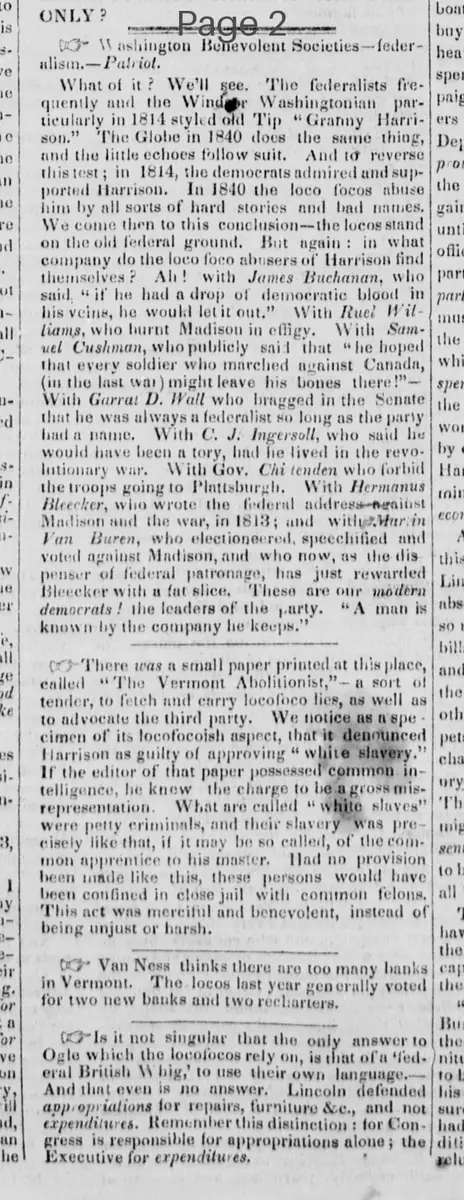
What of it? We'll see. The federalists frequently and the Windsor Washingtonian party particularly in 1814 styled old Tip "Granny Harrison." The Globe in 1840 does the same thing, and the little echoes follow suit. And to reverse this test; in 1814, the democrats admired and supported Harrison. In 1840 the loco focos abuse him by all sorts of hard stories and bad names. We come then to this conclusion—the locos stand on the old federal ground. But again: in what company do the loco foco abusers of Harrison find themselves? Ah! with James Buchanan, who said "if he had a drop of democratic blood in his veins, he would let it out." With Ruel Williams, who burnt Madison in effigy. With Samuel Cushman, who publicly said that "he hoped that every soldier who marched against Canada, (in the last war) might leave his bones there!" With Garret D. Wall who bragged in the Senate that he was always a federalist so long as the party had a name. With C. J. Ingersoll, who said he would have been a tory, had he lived in the revolutionary war. With Gov. Chittenden who forbade the troops going to Plattsburgh. With Hermanus Bleecker, who wrote the federal address—against Madison and the war, in 1813; and with Martin Van Buren, who electioneered, speechified and voted against Madison, and who now, as the dispenser of federal patronage, has just rewarded Bleecker with a fat slice. These are our modern democrats! the leaders of the party. "A man is known by the company he keeps."
There was a small paper printed at this place called "The Vermont Abolitionist,"—a sort of tender, to fetch and carry locofoco lies, as well as to advocate the third party. We notice as a specimen of its locofocoish aspect, that it denounced Harrison as guilty of approving "white slavery." If the editor of that paper possessed common intelligence, he knew the charge to be a gross misrepresentation. What are called "white slaves" were petty criminals, and their slavery was precisely like that, if it may be so called, of the common apprentice to his master. Had no provision been made like this, these persons would have been confined in close jail with common felons. This act was merciful and benevolent, instead of being unjust or harsh.
Van Ness thinks there are too many banks in Vermont. The locos last year generally voted for two new banks and two re-charters.
Is it not singular that the only answer to Ogle which the locofocos rely on, is that of a 'federal British Whig,' to use their own language.—And that even is no answer. Lincoln defended appropriations for repairs, furniture &c., and not expenditures. Remember this distinction: for Congress is responsible for appropriations alone; the Executive for expenditures.
What of it? We'll see. The federalists frequently and the Windsor Washingtonian party particularly in 1814 styled old Tip "Granny Harrison." The Globe in 1840 does the same thing, and the little echoes follow suit. And to reverse this test; in 1814, the democrats admired and supported Harrison. In 1840 the loco focos abuse him by all sorts of hard stories and bad names. We come then to this conclusion—the locos stand on the old federal ground. But again: in what company do the loco foco abusers of Harrison find themselves? Ah! with James Buchanan, who said "if he had a drop of democratic blood in his veins, he would let it out." With Ruel Williams, who burnt Madison in effigy. With Samuel Cushman, who publicly said that "he hoped that every soldier who marched against Canada, (in the last war) might leave his bones there!" With Garret D. Wall who bragged in the Senate that he was always a federalist so long as the party had a name. With C. J. Ingersoll, who said he would have been a tory, had he lived in the revolutionary war. With Gov. Chittenden who forbade the troops going to Plattsburgh. With Hermanus Bleecker, who wrote the federal address—against Madison and the war, in 1813; and with Martin Van Buren, who electioneered, speechified and voted against Madison, and who now, as the dispenser of federal patronage, has just rewarded Bleecker with a fat slice. These are our modern democrats! the leaders of the party. "A man is known by the company he keeps."
There was a small paper printed at this place called "The Vermont Abolitionist,"—a sort of tender, to fetch and carry locofoco lies, as well as to advocate the third party. We notice as a specimen of its locofocoish aspect, that it denounced Harrison as guilty of approving "white slavery." If the editor of that paper possessed common intelligence, he knew the charge to be a gross misrepresentation. What are called "white slaves" were petty criminals, and their slavery was precisely like that, if it may be so called, of the common apprentice to his master. Had no provision been made like this, these persons would have been confined in close jail with common felons. This act was merciful and benevolent, instead of being unjust or harsh.
Van Ness thinks there are too many banks in Vermont. The locos last year generally voted for two new banks and two re-charters.
Is it not singular that the only answer to Ogle which the locofocos rely on, is that of a 'federal British Whig,' to use their own language.—And that even is no answer. Lincoln defended appropriations for repairs, furniture &c., and not expenditures. Remember this distinction: for Congress is responsible for appropriations alone; the Executive for expenditures.
What sub-type of article is it?
Partisan Politics
What keywords are associated?
Harrison Defense
Loco Foco Criticism
Federalist Hypocrisy
Vermont Politics
1840 Election
White Slavery Charge
Ogle Response
What entities or persons were involved?
Harrison
James Buchanan
Ruel Williams
Samuel Cushman
Garret D. Wall
C. J. Ingersoll
Gov. Chittenden
Hermanus Bleecker
Martin Van Buren
Van Ness
Ogle
Lincoln
Federalists
Locos
Loco Focos
Democrats
The Vermont Abolitionist
The Globe
Editorial Details
Primary Topic
Defense Of Harrison Against Loco Foco Attacks
Stance / Tone
Strongly Pro Harrison, Anti Loco Foco
Key Figures
Harrison
James Buchanan
Ruel Williams
Samuel Cushman
Garret D. Wall
C. J. Ingersoll
Gov. Chittenden
Hermanus Bleecker
Martin Van Buren
Van Ness
Ogle
Lincoln
Federalists
Locos
Loco Focos
Democrats
The Vermont Abolitionist
The Globe
Key Arguments
Loco Focos Echo Federalist Insults Against Harrison From 1814
Democrats Supported Harrison In 1814 But Abuse Him Now, Placing Them On Old Federal Ground
Harrison's Critics Associate With Anti War Federalists Like Buchanan, Williams, Cushman, Wall, Ingersoll, Chittenden, Bleecker, And Van Buren
Charge Of Approving 'White Slavery' Is A Misrepresentation; It Was Merciful Treatment For Petty Criminals
Loco Focos Hypocritically Voted For New Banks Despite Complaints Of Too Many
Loco Focos' Response To Ogle Relies On A Federal British Whig And Fails To Address Expenditures