Thank you for visiting SNEWPapers!
Sign up free
Story
March 14, 1878
The Farmer And Mechanic
Raleigh, Wake County, North Carolina
What is this article about?
Col. R. H. Hardaway of Georgia defends his intensive farming practices of heavy manuring and thick corn planting on common pine land, sharing annual crop yields from 1866 to 1877 demonstrating consistent success through crop rotation and soil enrichment.
Clipping
OCR Quality
98%
Excellent
Full Text
Thick or Thin?
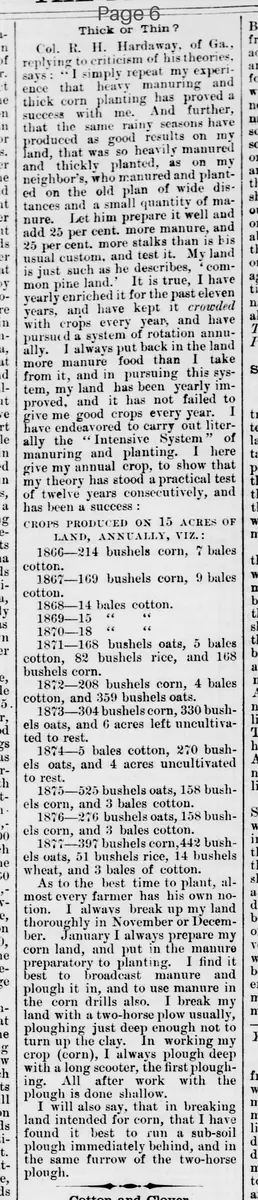
Col. R. H. Hardaway, of Ga., replying to criticism of his theories, says: "I simply repeat my experience that heavy manuring and thick corn planting has proved a success with me. And further, that the same rainy seasons have produced as good results on my land, that was so heavily manured and thickly planted, as on my neighbor's, who manured and planted on the old plan of wide distances and a small quantity of manure. Let him prepare it well and add 25 per cent. more manure, and 25 per cent. more stalks than is his usual custom, and test it. My land is just such as he describes, 'common pine land.' It is true, I have yearly enriched it for the past eleven years, and have kept it crowded with crops every year, and have pursued a system of rotation annually. I always put back in the land more manure food than I take from it, and in pursuing this system, my land has been yearly improved, and it has not failed to give me good crops every year. I have endeavored to carry out literally the "Intensive System" of manuring and planting. I here give my annual crop, to show that my theory has stood a practical test of twelve years consecutively, and has been a success:
CROPS PRODUCED ON 15 ACRES OF LAND, ANNUALLY, VIZ.:
1866—214 bushels corn, 7 bales cotton.
1867—169 bushels corn, 9 bales cotton.
1868—14 bales cotton.
1869—15 bales cotton.
1870—18 bales cotton.
1871—168 bushels oats, 5 bales cotton, 82 bushels rice, and 168 bushels corn.
1872—208 bushels corn, 4 bales cotton, and 359 bushels oats.
1873—304 bushels corn, 330 bushels oats, and 6 acres left uncultivated to rest.
1874—5 bales cotton, 270 bushels oats, and 4 acres uncultivated to rest.
1875—525 bushels oats, 158 bushels corn, and 3 bales cotton.
1876—276 bushels oats, 158 bushels corn, and 3 bales cotton.
1877—397 bushels corn, 442 bushels oats, 51 bushels rice, 14 bushels wheat, and 3 bales of cotton.
As to the best time to plant, almost every farmer has his own notion. I always break up my land thoroughly in November or December. January I always prepare my corn land, and put in the manure preparatory to planting. I find it best to broadcast manure and plough it in, and to use manure in the corn drills also. I break my land with a two-horse plow usually, ploughing just deep enough not to turn up the clay. In working my crop (corn), I always plough deep with a long scooter, the first ploughing. All after work with the plough is done shallow.
I will also say, that in breaking land intended for corn, that I have found it best to run a sub-soil plough immediately behind, and in the same furrow of the two-horse plough.
Col. R. H. Hardaway, of Ga., replying to criticism of his theories, says: "I simply repeat my experience that heavy manuring and thick corn planting has proved a success with me. And further, that the same rainy seasons have produced as good results on my land, that was so heavily manured and thickly planted, as on my neighbor's, who manured and planted on the old plan of wide distances and a small quantity of manure. Let him prepare it well and add 25 per cent. more manure, and 25 per cent. more stalks than is his usual custom, and test it. My land is just such as he describes, 'common pine land.' It is true, I have yearly enriched it for the past eleven years, and have kept it crowded with crops every year, and have pursued a system of rotation annually. I always put back in the land more manure food than I take from it, and in pursuing this system, my land has been yearly improved, and it has not failed to give me good crops every year. I have endeavored to carry out literally the "Intensive System" of manuring and planting. I here give my annual crop, to show that my theory has stood a practical test of twelve years consecutively, and has been a success:
CROPS PRODUCED ON 15 ACRES OF LAND, ANNUALLY, VIZ.:
1866—214 bushels corn, 7 bales cotton.
1867—169 bushels corn, 9 bales cotton.
1868—14 bales cotton.
1869—15 bales cotton.
1870—18 bales cotton.
1871—168 bushels oats, 5 bales cotton, 82 bushels rice, and 168 bushels corn.
1872—208 bushels corn, 4 bales cotton, and 359 bushels oats.
1873—304 bushels corn, 330 bushels oats, and 6 acres left uncultivated to rest.
1874—5 bales cotton, 270 bushels oats, and 4 acres uncultivated to rest.
1875—525 bushels oats, 158 bushels corn, and 3 bales cotton.
1876—276 bushels oats, 158 bushels corn, and 3 bales cotton.
1877—397 bushels corn, 442 bushels oats, 51 bushels rice, 14 bushels wheat, and 3 bales of cotton.
As to the best time to plant, almost every farmer has his own notion. I always break up my land thoroughly in November or December. January I always prepare my corn land, and put in the manure preparatory to planting. I find it best to broadcast manure and plough it in, and to use manure in the corn drills also. I break my land with a two-horse plow usually, ploughing just deep enough not to turn up the clay. In working my crop (corn), I always plough deep with a long scooter, the first ploughing. All after work with the plough is done shallow.
I will also say, that in breaking land intended for corn, that I have found it best to run a sub-soil plough immediately behind, and in the same furrow of the two-horse plough.
What sub-type of article is it?
Biography
Personal Triumph
What themes does it cover?
Triumph
Moral Virtue
What keywords are associated?
Intensive Farming
Heavy Manuring
Thick Corn Planting
Crop Yields
Soil Enrichment
Crop Rotation
What entities or persons were involved?
Col. R. H. Hardaway
Where did it happen?
Ga., Common Pine Land
Story Details
Key Persons
Col. R. H. Hardaway
Location
Ga., Common Pine Land
Event Date
1866 1877
Story Details
Col. Hardaway describes his successful intensive farming system involving heavy manuring, thick planting, crop rotation, and soil enrichment on 15 acres, yielding consistent crops over 12 years, and shares planting and plowing techniques.