Thank you for visiting SNEWPapers!
Sign up free
Story
February 24, 1849
New England Religious Herald
Hartford, Hartford County, Connecticut
What is this article about?
Biblical reflection on the Church at Ephesus, praised but warned by Christ for losing its first love, leading to its eventual destruction. Serves as a warning to churches and individuals to repent and maintain zeal to avoid losing divine privileges.
Clipping
OCR Quality
98%
Excellent
Full Text
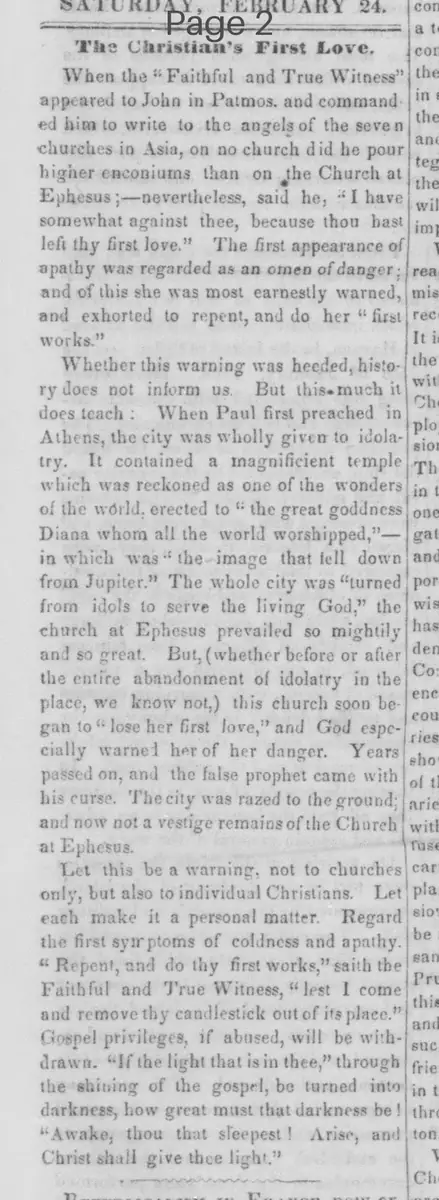
The Christian's First Love.
When the "Faithful and True Witness"
appeared to John in Patmos, and commanded
him to write to the angels of the seven
churches in Asia, on no church did he pour
higher encomiums than on the Church at
Ephesus;—nevertheless, said he, "I have
somewhat against thee, because thou hast
let thy first love." The first appearance of
apathy was regarded as an omen of danger;
and of this she was most earnestly warned,
and exhorted to repent, and do her "first
works."
Whether this warning was heeded, history
does not inform us. But this much it
does teach: When Paul first preached in
Athens, the city was wholly given to idolatry.
It contained a magnificent temple
which was reckoned as one of the wonders
of the world, erected to "the great goddess
Diana whom all the world worshipped,"—
in which was the image that fell down
from Jupiter." The whole city was "turned
from idols to serve the living God." The
church at Ephesus prevailed so mightily
and so great. But, (whether before or after
the entire abandonment of idolatry in the
place, we know not,) this church soon began
to "lose her first love," and God especially warned her of her danger. Years
passed on, and the false prophet came with
his curse. The city was razed to the ground
and now not a vestige remains of the Church
at Ephesus.
Let this be a warning, not to churches
only, but also to individual Christians. Let
each make it a personal matter. Regard
the first symptoms of coldness and apathy.
"Repent, and do thy first works," saith the
Faithful and True Witness, "lest I come
and remove thy candlestick out of its place."
Gospel privileges, if abused, will be withdrawn. "If the light that is in thee," through
the shining of the gospel, be turned into
darkness, how great must that darkness be!
"Awake, thou that sleepest! Arise, and
Christ shall give thee light."
When the "Faithful and True Witness"
appeared to John in Patmos, and commanded
him to write to the angels of the seven
churches in Asia, on no church did he pour
higher encomiums than on the Church at
Ephesus;—nevertheless, said he, "I have
somewhat against thee, because thou hast
let thy first love." The first appearance of
apathy was regarded as an omen of danger;
and of this she was most earnestly warned,
and exhorted to repent, and do her "first
works."
Whether this warning was heeded, history
does not inform us. But this much it
does teach: When Paul first preached in
Athens, the city was wholly given to idolatry.
It contained a magnificent temple
which was reckoned as one of the wonders
of the world, erected to "the great goddess
Diana whom all the world worshipped,"—
in which was the image that fell down
from Jupiter." The whole city was "turned
from idols to serve the living God." The
church at Ephesus prevailed so mightily
and so great. But, (whether before or after
the entire abandonment of idolatry in the
place, we know not,) this church soon began
to "lose her first love," and God especially warned her of her danger. Years
passed on, and the false prophet came with
his curse. The city was razed to the ground
and now not a vestige remains of the Church
at Ephesus.
Let this be a warning, not to churches
only, but also to individual Christians. Let
each make it a personal matter. Regard
the first symptoms of coldness and apathy.
"Repent, and do thy first works," saith the
Faithful and True Witness, "lest I come
and remove thy candlestick out of its place."
Gospel privileges, if abused, will be withdrawn. "If the light that is in thee," through
the shining of the gospel, be turned into
darkness, how great must that darkness be!
"Awake, thou that sleepest! Arise, and
Christ shall give thee light."
What sub-type of article is it?
Historical Event
Supernatural
What themes does it cover?
Moral Virtue
Providence Divine
Misfortune
What keywords are associated?
First Love
Church Ephesus
Biblical Warning
Repentance
Spiritual Apathy
Divine Judgment
What entities or persons were involved?
Church At Ephesus
John
Paul
Faithful And True Witness
Where did it happen?
Ephesus
Story Details
Key Persons
Church At Ephesus
John
Paul
Faithful And True Witness
Location
Ephesus
Story Details
Christ warns the Church at Ephesus via John for losing its first love despite initial praise and success in turning the city from idolatry; the church declines, leading to the city's destruction as a cautionary tale for repentance and maintaining spiritual zeal.