Thank you for visiting SNEWPapers!
Sign up free
The Enquirer
Richmond, Henrico County, Virginia
What is this article about?
Excerpt from Dr. Aikin's 'Geographical Delineations' describing the French national character, their historical amalgamation, revolutionary fervor leading to the overthrow of monarchy and institutions, resistance to foreign foes, expansion under the Republic, and rise of a Corsican general to Emperor, restoring arbitrary government and Catholicism while exiling the Bourbons.
Clipping
OCR Quality
Full Text
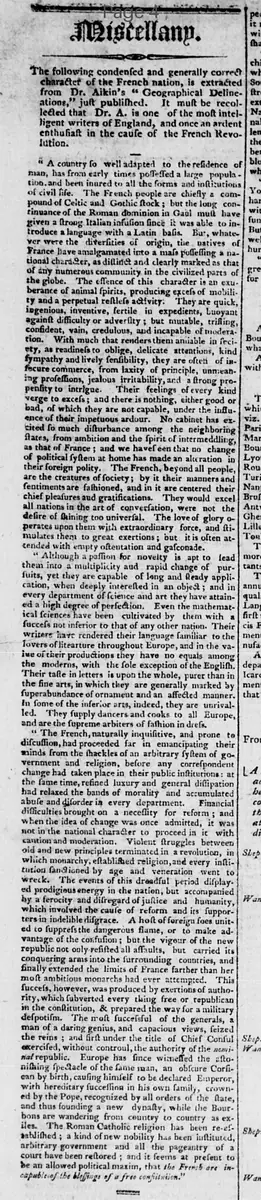
The following condensed and generally correct character of the French nation, is extracted from Dr. Aikin’s "Geographical Delineations," just published. It must be recollected that Dr. A. is one of the most intelligent writers of England, and once an ardent enthusiast in the cause of the French Revolution.
A country so well adapted to the residence of man, has from early times possessed a large population, and been inured to all the forms and institutions of civil life. The French people are chiefly a compound of Celtic and Gothic stock; but the long continuance of the Roman dominion in Gaul must have given a strong Italian infusion since it was able to introduce a language with a Latin basis. But, whatever were the diversities of origin, the natives of France have amalgamated into a mass possessing a national character, as distinct and clearly marked as that of any numerous community in the civilized parts of the globe. The essence of this character is an exuberance of animal spirits, producing excess of mobility and a perpetual restless activity. They are quick, ingenious, inventive, fertile in expedients, buoyant against difficulty or adversity; but mutable, trifling, confident, vain, credulous, and incapable of moderation. With much that renders them amiable in society, as readiness to oblige, delicate attentions, kind sympathy and lively sensibility, they are often objects of insecure commerce, from laxity of principle, unmeaning professions, jealous irritability, and a strong propensity to intrigue. Their feelings of every kind verge to excess; and there is nothing, either good or bad, of which they are not capable, under the influence of their impetuous ardor. No cabinet has excited so much disturbance among the neighboring states, from ambition and the spirit of intermeddling, as that of France; and we have seen that no change of political system at home has made an alteration in their foreign polity. The French, beyond all people, are the creatures of society; by it their manners and sentiments are fashioned, and in it are centered their chief pleasures and gratifications. They would excel all nations in the art of conversation, were not the desire of shining too universal. The love of glory operates upon them with extraordinary force, and stimulates them to great exertions; but it is often attended with empty ostentation and gasconade.
Although a passion for novelty is apt to lead them into a multiplicity and rapid change of pursuits, yet they are capable of long and steady application, when deeply interested in an object; and in every department of science and art they have attained a high degree of perfection. Even the mathematical sciences have been cultivated by them with a success not inferior to that of any other nation. Their writers have rendered their language familiar to the lovers of literature throughout Europe, and in the variety of their productions they have no equals among the moderns, with the sole exception of the English. Their taste in letters is upon the whole, purer than in the fine arts, in which they are generally marked by superabundance of ornament and an affected manner. In some of the inferior arts, indeed, they are unrivalled. They supply dancers and cooks to all Europe, and are the supreme arbiters of fashion in dress.
The French, naturally inquisitive, and prone to discussion, had proceeded far in emancipating their minds from the shackles of an arbitrary system of government and religion, before any correspondent change had taken place in their public institutions: at the same time, refined luxury and general dissipation had relaxed the bands of morality and accumulated abuse and disorder in every department. Financial difficulties brought on a necessity for reform; and when the idea of change was once admitted, it was not in the national character to proceed in it with caution and moderation. Violent struggles between old and new principles terminated in a revolution, in which monarchy, established religion, and every institution sanctioned by age and veneration went to wreck. The events of this dreadful period displayed prodigious energy in the nation, but accompanied by a ferocity and disregard of justice and humanity, which involved the cause of reform and its supporters in indelible disgrace. A host of foreign foes united to suppress the dangerous flame, or to make advantage of the confusion; but the vigour of the new republic not only resisted all assaults, but carried its conquering arms into the surrounding countries, and finally extended the limits of France farther than her most ambitious monarchs had ever attempted. This success, however, was produced by exertions of authority, which subverted every thing free or republican in the constitution, and prepared the way for a military despotism. The most successful of those generals, a man of a daring genius, and capacious views, seized the reins: and first under the title of Chief Consul exercised, without controul, the authority of the nominal republic. Europe has since witnessed the astonishing spectacle of the same man, an obscure Corsican by birth, causing himself to be declared Emperor, with hereditary succession in his own family, crowned by the Pope, recognized by all orders of the state and thus founding a new dynasty, while the Bourbons are wandering from country to country as exiles. The Roman Catholic religion has been re-established; a kind of new nobility has been instituted. Arbitrary government and all the pageantry of a court have been restored; and it seems at present to be an allowed political maxim, that the French are incapable of the blessings of a free constitution.
What sub-type of article is it?
What keywords are associated?
What entities or persons were involved?
Where did it happen?
Foreign News Details
Primary Location
France
Key Persons
Outcome
monarchy, established religion, and institutions overthrown; republic resisted foreign assaults, expanded territory; military despotism established with a corsican general as emperor, new dynasty founded, bourbons exiled; roman catholic religion re-established, new nobility instituted, arbitrary government restored.
Event Details
Description of French national character as exuberant, mobile, inventive yet mutable and excessive; historical emancipation leading to revolution due to financial difficulties and moral laxity; violent revolution destroying old institutions with ferocity; republic's vigorous resistance and conquests; rise of a daring Corsican general to Chief Consul then Emperor, founding new dynasty while exiling Bourbons; restoration of Catholicism, nobility, and court pageantry.