Thank you for visiting SNEWPapers!
Sign up free
Literary
February 14, 1891
Iron County News
Cedar City, Iron County, Utah
What is this article about?
In this chapter of a Franco-Prussian War story, Ninette aids her fugitive former lover's escape by boat to a haunted ruin, deceiving her husband Pierre. Later, Rose Michel informs Pierre of Ninette's suspicious midnight outings, sowing doubt in his mind about her fidelity.
Merged-components note: These two sequential components form a single chapter (IV) of the serialized story 'Link by Link' by Maurice Legrand, continuing across columns on the page.
Clipping
OCR Quality
98%
Excellent
Full Text
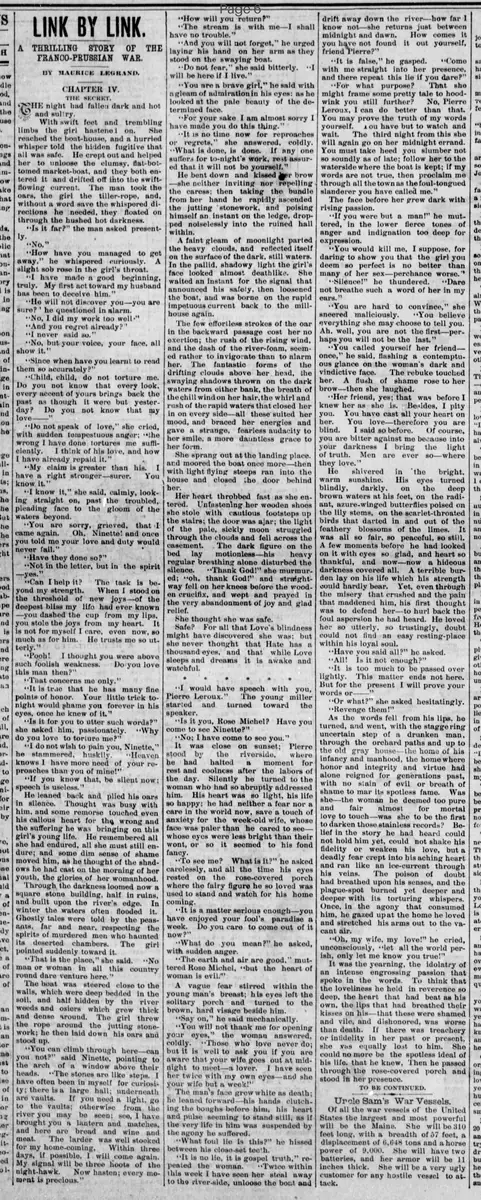
LINK BY LINK.
A THRILLING STORY OF THE FRANCO-PRUSSIAN WAR.
BY MAURICE LEGRAND.
CHAPTER IV.
THE SECRET.
The night had fallen dark and hot and sultry. With swift feet and trembling limbs the girl hastened on. She reached the boat-house, and a hurried whisper told the hidden fugitive that all was safe. He crept out and helped her to unloose the clumsy, flat-bottomed market-boat, and they both entered it and drifted off into the swift-flowing current. The man took the oars, the girl the tiller-rope, and, without a word save the whispered directions he needed, they floated on through the hushed hot darkness.
“Is it far?” the man asked presently.
“No.”
“How have you managed to get away,” he whispered curiously. A slight sob rose in the girl's throat.
“I have made a good beginning truly. My first act toward my husband has been to deceive him.”
“He will not discover you—you are sure?’ he questioned in alarm.
“No, I did my work too well.”
“And you regret already?”
“I never said so.”
“No, but your voice, your face, all show it.”
“Since when have you learnt to read them so accurately?’
“Child, child, do not torture me. Do you not know that every look, every accent of yours brings back the past as though it were but yesterday? Do you not know that my love— ”
“Do not speak of love.” she cried, with sudden tempestuous anger; “the wrong I have done tortures me sufficiently. I think of his love, and how I have already repaid it.”
“My claim is greater than his. I have a right stronger—surer. You know it.”
“I know it,” she said, calmly, looking straight on, past the troubled, pleading face to the gloom of the waters beyond.
“You are sorry, grieved, that I came again. Oh, Ninette! and once you told me your love and duty would never fail.”
“Have they done so?”
“Not in the letter, but in the spirit yes.”
“Can I help it? The task is beyond my strength. When I stood on the threshold of new joys—of the deepest bliss my life had ever known—you dashed the cup from my lips, you stole the joys from my heart. It is not for myself I care, even now, so much as for him. He trusts me so utterly.”
“Pooh! I thought you were above such foolish weakness. Do you love this man then?”
“That concerns me only.”
“It is true that he has many fine points of honor. Your little trick to-night would shame you forever in his eyes, once he knew of it.”
“Is it for you to utter such words?” she asked him, passionately. “Why do you love to torture me?”
“I do not wish to pain you, Ninette,” he stammered, huskily. “Heaven knows I have more need of your reproaches than you of mine!”
“If you know that, be silent now; speech is useless.”
He leaned back and plied his oars in silence. Thought was busy with him, and some remorse touched even his callous heart for the wrong and the suffering he was bringing on this girl's young life. He remembered all she had endured, all she must still endure; and some dim sense of shame moved him, as he thought of the shadows he had cast on the morning of her youth, the glories of her womanhood.
Through the darkness loomed now a square stone building, half in ruins, and built upon the river's edge. In winter the waters often flooded it. Ghostly tales were told by the peasants, far and near, respecting the spirits of murdered men who haunted its deserted chambers. The girl pointed suddenly toward it.
“That is the place,” she said. “No man or woman in all this country round dare venture here.”
The boat was steered close to the walls, which were deep bedded in the soil, and half hidden by the river weeds and osiers which grew thick and dense around. The girl threw the rope around the jutting stone-work; he then laid down his oars and stood up.
“You can climb through here—can you not?” said Ninette, pointing to the arch of a window above their heads. “The stones are like steps. I have often been in myself for curiosity; there is a large hall; underneath are vaults. If you need a light, go to the vaults; otherwise from the river you may be seen; see, I have brought you a lantern and matches, and here are bread and wine and meat. The larder was well stocked for my home-coming. Within three days, if possible, I will come again. My signal will be three hoots of the night-hawk. Now hasten; every moment is precious.”
“How will you return?”
“The stream is with me—I shall have no trouble.”
“And you will not forget,” he urged, laying his hand on her arm as they stood on the swaying boat.
“Do not fear,” she said bitterly. “I will be here if I live.”
“You are a brave girl.” he said with a gleam of admiration in his eyes: as he looked at the pale beauty of the determined face.
“For your sake I am almost sorry I have made you do this thing.”
“It is no time now for reproaches or regrets,” she answered, coldly.
“What is done, is done. If any one suffers for to-night's work, rest assured that it will not be yourself.”
He bent down and kissed her brow—she neither inviting nor repelling the caress: then taking the bundle from her hand he rapidly ascended the jutting stonework, and poising himself an instant on the ledge, dropped noiselessly into the ruined hall within.
A faint gleam of moonlight parted the heavy clouds, and reflected itself on the surface of the dark, still waters. In the pallid, shadowy light the girl's face looked almost deathlike. She waited an instant for the signal that announced his safety, then loosened the boat, and was borne on the rapid impetuous current back to the mill-house again.
The few effortless strokes of the oar in the backward passage cost her no exertion; the rush of the rising wind, and the dash of the river-foam, seemed rather to invigorate than to alarm her. The fantastic forms of the drifting clouds above her, the swaying shadows thrown on the dark waters from either bank, the breath of the chill wind on her hair, the whirl and rush of the rapid waters that closed her in on every side—all these suited her mood, and braced her energies and gave a strange, fearless audacity to her smile, a more dauntless grace to her form.
She sprang out at the landing place, and moored the boat once more—then with light flying steps ran into the house and closed the door behind her.
Her heart throbbed fast as she entered. Unfastening her wooden shoes she stole with cautious footsteps up the stairs; the door was ajar; the light of the pale, sickly moon struggled through the clouds and fell across the casement. The dark figure on the bed lay motionless—his heavy regular breathing alone disturbed the silence.
“Thank God!” she murmured; “oh, thank God!” and straightway fell on her knees before the wooden crucifix, and wept and prayed in the very abandonment of joy and glad relief.
She thought she was safe. Safe? For all that Love's blindness might have discovered she was; but she never thought that Hate has a thousand eyes, and that while Love sleeps and dreams it is awake and watchful.
“I would have speech with you, Pierre Leroux.”
The young miller started and turned toward the speaker.
“Is it you, Rose Michel? Have you come to see Ninette?”
“No; I have come to see you.”
It was close on sunset; Pierre stood by the riverside, where he had halted a moment for rest and coolness after the labors of the day. Silently he turned to the woman who had so abruptly addressed him. His heart was so light, his life so happy; he had neither a fear nor a care in the world now, save a touch of anxiety for the week-old wife, whose face was paler than he cared to see—whose eyes were less bright than their wont, or so it seemed to his fond fancy.
“To see me? What is it?” he asked carelessly, and all the time his eyes rested on the rose-covered porch where the fairy figure he so loved was used to stand and watch for his home coming.
“It is a matter serious enough—you have enjoyed your fool's paradise a week. Do you care to come out of it now?”
“What do you mean?” he asked, with sudden anger.
“The earth and air are good,” muttered Rose Michel, “but the heart of woman is evil.
A vague fear stirred within the young man's breast; his eyes left the solitary porch and turned to the brown, hard visage beside him.
“Say on,” he said mechanically.
“You will not thank me for opening your eyes,” the woman answered, coldly. “Those who love never do; but it is well to ask you if you are aware that your wife goes out at midnight to meet a lover. I have seen her twice with my own eyes—and she your wife but a week!”
The man's face grew white as death; he leaned forward—his hands clutching the boughs before him, his heart and pulse seeming to stand still, as if the very life in him was suspended by the agony he suffered.
“What foul lie is this?” he hissed between his close-set teeth.
“It is no lie, it is gospel truth.” repeated the woman. “Twice within this week I have seen her steal away to the river-side, unloose the boat and
drift away down the river—how far I know not she returns just between midnight and dawn. How comes it you have not found it out yourself, friend Pierre?
“It is false.” he gasped. “Come with me straight into her presence, and there repeat this lie if you dare?”
“For what purpose? That she might frame some pretty tale to hoodwink you still further? No, Pierre Leroux, I can do better than that. You may prove the truth of my words yourself. You have but to watch and wait. The third night from this she will again go on her midnight errand. You must take heed you slumber not so soundly as of late: follow her to the waterside where the boat is kept; if my words are not true, then proclaim me through all the town as the foul-tongued slanderer you have called me.”
The face before her grew dark with rising passion.
“If you were but a man!” he muttered, in the lower fierce tones of anger and indignation too deep for expression.
“You would kill me, I suppose, for daring to show you that the girl you deem so perfect is no better than many of her sex—perchance worse.”
“Silence!” he thundered. “Dare not breathe such a word of her in my ears.”
“You are hard to convince,” she sneered maliciously. “You believe everything she may choose to tell you. Ah, well, you are not the first—perhaps you will not be the last.”
“You called yourself her friend—once,” he said, flashing a contemptuous glance on the woman's dark and vindictive face. The rebuke touched her. A flush of shame rose to her brow—then she laughed.
“Her friend, yes; that was before I knew her as she is. Besides, I pity you. You have cast all your heart on her. You love—therefore you are blind. I said so before. Of course, you are bitter against me because into your darkness I bring the light of truth. Men are ever so—where they love.”
He shivered in the bright warm sunshine. His eyes turned blindly, darkly, on the deep brown waters at his feet, on the radiant, azure-winged butterflies poised on the lily stems, on the scarlet-throated birds that darted in and out of the feathery blossoms of the limes. It was all so fair, so peaceful, so still. A few moments before he had looked on it with eyes so glad, and heart so thankful, and now—now a hideous darkness covered all. A terrible burden lay on his life which his strength could hardly bear. Yet, even through the misery that crushed and the pain that maddened him, his first thought was to defend her—to hurl back the foul aspersion he had heard. He loved her so utterly, so trustingly, doubt could not find an easy resting-place within his loyal soul.
“Have you said all?” he asked.
“All! Is it not enough?”
“It is too much to be passed over lightly. This matter ends not here. But for the present I will prove your words or"
“Or what?” she asked hesitatingly.
“Revenge them!”
As the words fell from his lips, he turned, and went, with the staggering uncertain step of a drunken man, through the orchard paths and up to the old gray house—the home of his infancy and manhood, the home where honor and integrity and virtue had alone reigned for generations past, with no stain of evil or breath of shame to mar its spotless fame. Was she—the woman he deemed too pure and fair almost for mortal love to touch—was she to be the first to darken those stainless records? Belief in the story he had heard could not hold him yet, could not shake his fidelity or weaken his love, but a deadly fear crept into his aching heart and ran like an ice-current through his veins. The poison of doubt had breathed upon his senses, and the plague-spot burned yet deeper and deeper with its torturing whispers. Once, in the agony that consumed him, he gazed up at the home he loved and stretched his arms out to the vacant air.
“Oh, my wife, my love!” he cried, unconsciously, “let all the world perish, only let me know you true!”
It was the yearning, the idolatry of an intense engrossing passion that spoke in the words. To think that the loveliness he held in reverence so deep, the heart that had beat as his own, the lips that had breathed their kisses on his—that these were shamed and vile, and dishonored, was worse than death. If there was treachery or infidelity in her past or present, she was equally lost to him. She could no more be the spotless ideal of his life, that he knew. Then he passed through the rose-covered porch and stood in her presence.
TO BE CONTINUED.
A THRILLING STORY OF THE FRANCO-PRUSSIAN WAR.
BY MAURICE LEGRAND.
CHAPTER IV.
THE SECRET.
The night had fallen dark and hot and sultry. With swift feet and trembling limbs the girl hastened on. She reached the boat-house, and a hurried whisper told the hidden fugitive that all was safe. He crept out and helped her to unloose the clumsy, flat-bottomed market-boat, and they both entered it and drifted off into the swift-flowing current. The man took the oars, the girl the tiller-rope, and, without a word save the whispered directions he needed, they floated on through the hushed hot darkness.
“Is it far?” the man asked presently.
“No.”
“How have you managed to get away,” he whispered curiously. A slight sob rose in the girl's throat.
“I have made a good beginning truly. My first act toward my husband has been to deceive him.”
“He will not discover you—you are sure?’ he questioned in alarm.
“No, I did my work too well.”
“And you regret already?”
“I never said so.”
“No, but your voice, your face, all show it.”
“Since when have you learnt to read them so accurately?’
“Child, child, do not torture me. Do you not know that every look, every accent of yours brings back the past as though it were but yesterday? Do you not know that my love— ”
“Do not speak of love.” she cried, with sudden tempestuous anger; “the wrong I have done tortures me sufficiently. I think of his love, and how I have already repaid it.”
“My claim is greater than his. I have a right stronger—surer. You know it.”
“I know it,” she said, calmly, looking straight on, past the troubled, pleading face to the gloom of the waters beyond.
“You are sorry, grieved, that I came again. Oh, Ninette! and once you told me your love and duty would never fail.”
“Have they done so?”
“Not in the letter, but in the spirit yes.”
“Can I help it? The task is beyond my strength. When I stood on the threshold of new joys—of the deepest bliss my life had ever known—you dashed the cup from my lips, you stole the joys from my heart. It is not for myself I care, even now, so much as for him. He trusts me so utterly.”
“Pooh! I thought you were above such foolish weakness. Do you love this man then?”
“That concerns me only.”
“It is true that he has many fine points of honor. Your little trick to-night would shame you forever in his eyes, once he knew of it.”
“Is it for you to utter such words?” she asked him, passionately. “Why do you love to torture me?”
“I do not wish to pain you, Ninette,” he stammered, huskily. “Heaven knows I have more need of your reproaches than you of mine!”
“If you know that, be silent now; speech is useless.”
He leaned back and plied his oars in silence. Thought was busy with him, and some remorse touched even his callous heart for the wrong and the suffering he was bringing on this girl's young life. He remembered all she had endured, all she must still endure; and some dim sense of shame moved him, as he thought of the shadows he had cast on the morning of her youth, the glories of her womanhood.
Through the darkness loomed now a square stone building, half in ruins, and built upon the river's edge. In winter the waters often flooded it. Ghostly tales were told by the peasants, far and near, respecting the spirits of murdered men who haunted its deserted chambers. The girl pointed suddenly toward it.
“That is the place,” she said. “No man or woman in all this country round dare venture here.”
The boat was steered close to the walls, which were deep bedded in the soil, and half hidden by the river weeds and osiers which grew thick and dense around. The girl threw the rope around the jutting stone-work; he then laid down his oars and stood up.
“You can climb through here—can you not?” said Ninette, pointing to the arch of a window above their heads. “The stones are like steps. I have often been in myself for curiosity; there is a large hall; underneath are vaults. If you need a light, go to the vaults; otherwise from the river you may be seen; see, I have brought you a lantern and matches, and here are bread and wine and meat. The larder was well stocked for my home-coming. Within three days, if possible, I will come again. My signal will be three hoots of the night-hawk. Now hasten; every moment is precious.”
“How will you return?”
“The stream is with me—I shall have no trouble.”
“And you will not forget,” he urged, laying his hand on her arm as they stood on the swaying boat.
“Do not fear,” she said bitterly. “I will be here if I live.”
“You are a brave girl.” he said with a gleam of admiration in his eyes: as he looked at the pale beauty of the determined face.
“For your sake I am almost sorry I have made you do this thing.”
“It is no time now for reproaches or regrets,” she answered, coldly.
“What is done, is done. If any one suffers for to-night's work, rest assured that it will not be yourself.”
He bent down and kissed her brow—she neither inviting nor repelling the caress: then taking the bundle from her hand he rapidly ascended the jutting stonework, and poising himself an instant on the ledge, dropped noiselessly into the ruined hall within.
A faint gleam of moonlight parted the heavy clouds, and reflected itself on the surface of the dark, still waters. In the pallid, shadowy light the girl's face looked almost deathlike. She waited an instant for the signal that announced his safety, then loosened the boat, and was borne on the rapid impetuous current back to the mill-house again.
The few effortless strokes of the oar in the backward passage cost her no exertion; the rush of the rising wind, and the dash of the river-foam, seemed rather to invigorate than to alarm her. The fantastic forms of the drifting clouds above her, the swaying shadows thrown on the dark waters from either bank, the breath of the chill wind on her hair, the whirl and rush of the rapid waters that closed her in on every side—all these suited her mood, and braced her energies and gave a strange, fearless audacity to her smile, a more dauntless grace to her form.
She sprang out at the landing place, and moored the boat once more—then with light flying steps ran into the house and closed the door behind her.
Her heart throbbed fast as she entered. Unfastening her wooden shoes she stole with cautious footsteps up the stairs; the door was ajar; the light of the pale, sickly moon struggled through the clouds and fell across the casement. The dark figure on the bed lay motionless—his heavy regular breathing alone disturbed the silence.
“Thank God!” she murmured; “oh, thank God!” and straightway fell on her knees before the wooden crucifix, and wept and prayed in the very abandonment of joy and glad relief.
She thought she was safe. Safe? For all that Love's blindness might have discovered she was; but she never thought that Hate has a thousand eyes, and that while Love sleeps and dreams it is awake and watchful.
“I would have speech with you, Pierre Leroux.”
The young miller started and turned toward the speaker.
“Is it you, Rose Michel? Have you come to see Ninette?”
“No; I have come to see you.”
It was close on sunset; Pierre stood by the riverside, where he had halted a moment for rest and coolness after the labors of the day. Silently he turned to the woman who had so abruptly addressed him. His heart was so light, his life so happy; he had neither a fear nor a care in the world now, save a touch of anxiety for the week-old wife, whose face was paler than he cared to see—whose eyes were less bright than their wont, or so it seemed to his fond fancy.
“To see me? What is it?” he asked carelessly, and all the time his eyes rested on the rose-covered porch where the fairy figure he so loved was used to stand and watch for his home coming.
“It is a matter serious enough—you have enjoyed your fool's paradise a week. Do you care to come out of it now?”
“What do you mean?” he asked, with sudden anger.
“The earth and air are good,” muttered Rose Michel, “but the heart of woman is evil.
A vague fear stirred within the young man's breast; his eyes left the solitary porch and turned to the brown, hard visage beside him.
“Say on,” he said mechanically.
“You will not thank me for opening your eyes,” the woman answered, coldly. “Those who love never do; but it is well to ask you if you are aware that your wife goes out at midnight to meet a lover. I have seen her twice with my own eyes—and she your wife but a week!”
The man's face grew white as death; he leaned forward—his hands clutching the boughs before him, his heart and pulse seeming to stand still, as if the very life in him was suspended by the agony he suffered.
“What foul lie is this?” he hissed between his close-set teeth.
“It is no lie, it is gospel truth.” repeated the woman. “Twice within this week I have seen her steal away to the river-side, unloose the boat and
drift away down the river—how far I know not she returns just between midnight and dawn. How comes it you have not found it out yourself, friend Pierre?
“It is false.” he gasped. “Come with me straight into her presence, and there repeat this lie if you dare?”
“For what purpose? That she might frame some pretty tale to hoodwink you still further? No, Pierre Leroux, I can do better than that. You may prove the truth of my words yourself. You have but to watch and wait. The third night from this she will again go on her midnight errand. You must take heed you slumber not so soundly as of late: follow her to the waterside where the boat is kept; if my words are not true, then proclaim me through all the town as the foul-tongued slanderer you have called me.”
The face before her grew dark with rising passion.
“If you were but a man!” he muttered, in the lower fierce tones of anger and indignation too deep for expression.
“You would kill me, I suppose, for daring to show you that the girl you deem so perfect is no better than many of her sex—perchance worse.”
“Silence!” he thundered. “Dare not breathe such a word of her in my ears.”
“You are hard to convince,” she sneered maliciously. “You believe everything she may choose to tell you. Ah, well, you are not the first—perhaps you will not be the last.”
“You called yourself her friend—once,” he said, flashing a contemptuous glance on the woman's dark and vindictive face. The rebuke touched her. A flush of shame rose to her brow—then she laughed.
“Her friend, yes; that was before I knew her as she is. Besides, I pity you. You have cast all your heart on her. You love—therefore you are blind. I said so before. Of course, you are bitter against me because into your darkness I bring the light of truth. Men are ever so—where they love.”
He shivered in the bright warm sunshine. His eyes turned blindly, darkly, on the deep brown waters at his feet, on the radiant, azure-winged butterflies poised on the lily stems, on the scarlet-throated birds that darted in and out of the feathery blossoms of the limes. It was all so fair, so peaceful, so still. A few moments before he had looked on it with eyes so glad, and heart so thankful, and now—now a hideous darkness covered all. A terrible burden lay on his life which his strength could hardly bear. Yet, even through the misery that crushed and the pain that maddened him, his first thought was to defend her—to hurl back the foul aspersion he had heard. He loved her so utterly, so trustingly, doubt could not find an easy resting-place within his loyal soul.
“Have you said all?” he asked.
“All! Is it not enough?”
“It is too much to be passed over lightly. This matter ends not here. But for the present I will prove your words or"
“Or what?” she asked hesitatingly.
“Revenge them!”
As the words fell from his lips, he turned, and went, with the staggering uncertain step of a drunken man, through the orchard paths and up to the old gray house—the home of his infancy and manhood, the home where honor and integrity and virtue had alone reigned for generations past, with no stain of evil or breath of shame to mar its spotless fame. Was she—the woman he deemed too pure and fair almost for mortal love to touch—was she to be the first to darken those stainless records? Belief in the story he had heard could not hold him yet, could not shake his fidelity or weaken his love, but a deadly fear crept into his aching heart and ran like an ice-current through his veins. The poison of doubt had breathed upon his senses, and the plague-spot burned yet deeper and deeper with its torturing whispers. Once, in the agony that consumed him, he gazed up at the home he loved and stretched his arms out to the vacant air.
“Oh, my wife, my love!” he cried, unconsciously, “let all the world perish, only let me know you true!”
It was the yearning, the idolatry of an intense engrossing passion that spoke in the words. To think that the loveliness he held in reverence so deep, the heart that had beat as his own, the lips that had breathed their kisses on his—that these were shamed and vile, and dishonored, was worse than death. If there was treachery or infidelity in her past or present, she was equally lost to him. She could no more be the spotless ideal of his life, that he knew. Then he passed through the rose-covered porch and stood in her presence.
TO BE CONTINUED.
What sub-type of article is it?
Prose Fiction
What themes does it cover?
Love Romance
Moral Virtue
War Peace
What keywords are associated?
Franco Prussian War
Escape
Deception
Jealousy
Betrayal
Midnight Boat
Fugitive
Husband Doubt
What entities or persons were involved?
By Maurice Legrand.
Literary Details
Title
Chapter Iv. The Secret.
Author
By Maurice Legrand.
Subject
A Thrilling Story Of The Franco Prussian War
Key Lines
“Do Not Speak Of Love.” She Cried, With Sudden Tempestuous Anger; “The Wrong I Have Done Tortures Me Sufficiently. I Think Of His Love, And How I Have Already Repaid It.”
“You Are A Brave Girl.” He Said With A Gleam Of Admiration In His Eyes: As He Looked At The Pale Beauty Of The Determined Face.
She Thought She Was Safe. Safe? For All That Love's Blindness Might Have Discovered She Was; But She Never Thought That Hate Has A Thousand Eyes, And That While Love Sleeps And Dreams It Is Awake And Watchful.
“What Foul Lie Is This?” He Hissed Between His Close Set Teeth.
“Oh, My Wife, My Love!” He Cried, Unconsciously, “Let All The World Perish, Only Let Me Know You True!”