Thank you for visiting SNEWPapers!
Sign up free
The National Intelligencer And Washington Advertiser
Washington, District Of Columbia
What is this article about?
Transcript of U.S. House debate on February 13, 1802, regarding a motion by Mr. Thomas to appoint a committee inquiring into extinguishing federal claims against debtor states from Revolutionary War account settlements by commissioners. Speakers debate justice, equity, constitutionality, and union harmony; amendment to declare extinguishment expedient fails, original resolution passes.
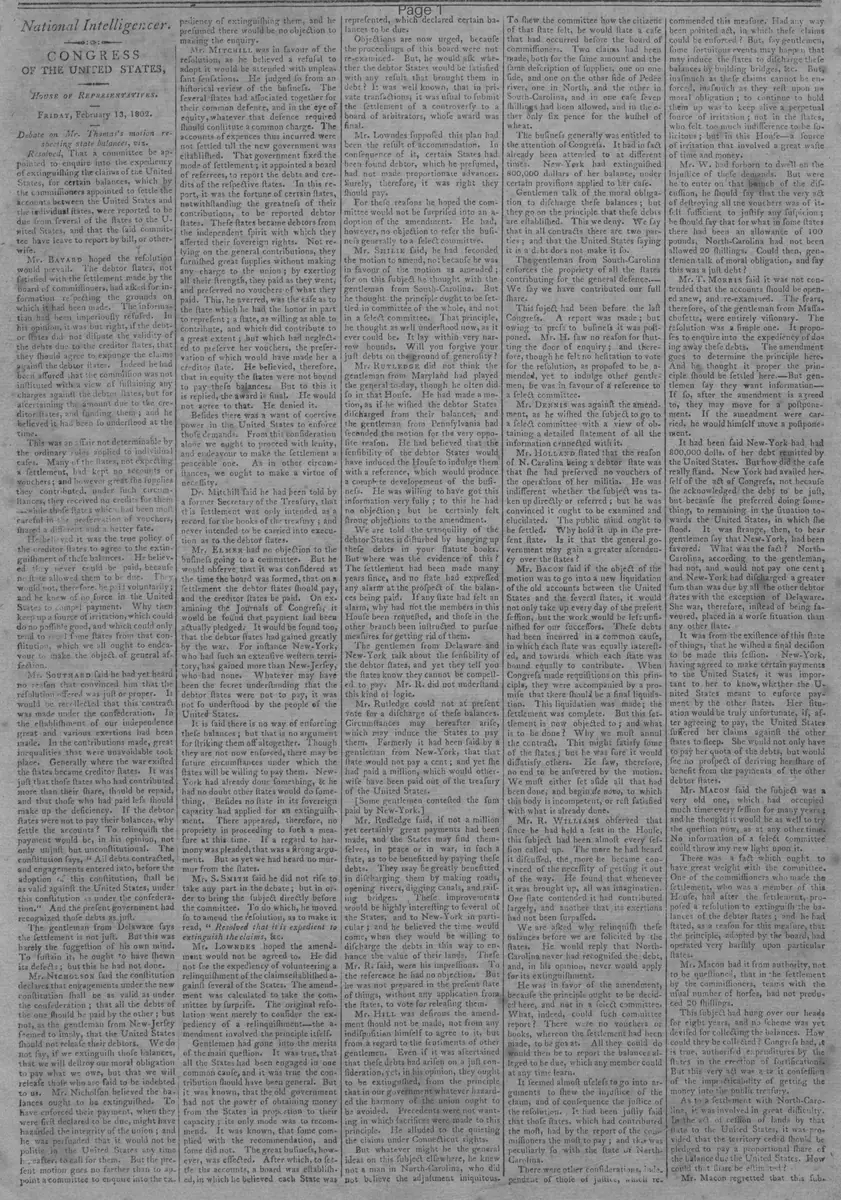
Merged-components note: These components form a continuous narrative of the congressional debate on state balances, spanning pages 1 and 2 in sequential reading order.
Clippings
1 of 2
OCR Quality
Full Text
:CONGRESS:
OF THE UNITED STATES.
HOUSE OF REPRESENTATIVES.
Friday, February 13, 1802.
Debate on Mr. Thomas's motion respecting state balances, viz.
Resolved, That a committee be appointed to enquire into the expediency of extinguishing the claims of the United States, for certain balances, which by the commissioners appointed to settle the accounts between the United States and the individual states, were reported to be due from several of the states to the United States, and that the said committee have leave to report by bill, or otherwise.
Mr. BAYARD hoped the resolution would prevail. The debtor states, not satisfied with the settlement made by the board of commissioners, had asked for information respecting the grounds on which it had been made. The information had been imperiously refused. In his opinion, it was but right, if the debtor states did not dispute the validity of the debts due to the creditor states, that they should agree to expunge the claims against the debtor states. Indeed he had been assured that the commission was not instituted with a view of sustaining any charges against the debtor states, but for ascertaining the amount due to the creditor states, and funding them; and he believed it had been so understood at the time.
This was an affair not determinable by the ordinary rules applied to individual cases. Many of the states, not expecting a settlement, had kept no accounts or vouchers; and however great the supplies they contributed, under such circumstances, they received no credits for them—while those states which had been most careful in the preservation of vouchers, shared a different and a better fate.
He believed it was the true policy of the creditor states to agree to the extinguishment of these balances. He believed they never could be paid, because no title allowed them to be due. They would not, therefore, be paid voluntarily; and he knew of no force in the United States to compel payment. Why then keep up a source of irritation, which could do no possible good, and which could only tend to alienate some states from that constitution, which we all ought to endeavour to make the object of general affection.
Mr. SOUTHARD said he had yet heard no reason that convinced him that the resolution offered was just or proper. It would be recollected that this contract was made under the confederation. In the establishment of our independence great and various exertions had been made. In the contributions made, great inequalities that were unavoidable took place. Generally where the war existed the states became creditor states. It was just that those states who had contributed more than their share, should be repaid, and that those who had paid less should make up the deficiency. If the debtor states were not to pay their balances, why settle the accounts? To relinquish the payment would be, in his opinion, not only unjust but unconstitutional. The constitution says, "All debts contracted, and engagements entered into, before the adoption of this constitution, shall be as valid against the United States, under this constitution as under the confederation." And the present government had recognized those debts as just.
The gentleman from Delaware says the settlement is not just. But this was barely the suggestion of his own mind. To sustain it, he ought to have shewn its defects; but this he had not done.
Mr. NICHOLSON said the constitution declares that engagements under the new constitution shall be as valid as under the confederation; that all the debts of the one should be paid by the other; but not, as the gentleman from New-Jersey seemed to imply, that the United States should not release their debtors. We do not say, if we extinguish those balances, that we will destroy our moral obligation to pay what we owe, but that we will release those who are said to be indebted to us. Mr. Nicholson believed the balances ought to be extinguished. To have enforced their payment, when they were first declared to be due, might have hazarded the integrity of the union; and he was persuaded that it would not be politic in the United States any time hereafter, to call on them. But the present motion goes no farther than to appoint a committee to enquire into the expediency of extinguishing them, and he presumed there would be no objection to making the enquiry.
Mr. MITCHILL was in favour of the resolution, as he believed a refusal to adopt it would be attended with unpleasant sensations. He judged so from an historical review of the business. The several states had associated together for their common defence, and in the eye of equity, whatever that defence required should constitute a common charge. The accounts of expenses thus incurred were not settled till the new government was established. That government fixed the mode of settlement; it appointed a board of referees, to report the debts and credits of the respective states. In this report, it was the fortune of certain states, notwithstanding the greatness of their contributions, to be reported debtor states. These states became debtors from the independent spirit with which they asserted their sovereign rights. Not relying on the general contributions, they furnished great supplies without making any charge to the union; by exerting all their strength, they paid as they went; and preserved no vouchers of what they paid. This, he averred, was the case as to the state which he had the honor in part to represent; a state, as willing as able to contribute, and which did contribute to a great extent; but which had neglected to preserve her vouchers, the preservation of which would have made her a creditor state. He believed, therefore, that in equity the states were not bound to pay these balances. But to this it is replied, the award is final. He would not agree to that. He denied it. Besides there was a want of coercive power in the United States to enforce those demands. From this consideration alone we ought to proceed with lenity, and endeavour to make the settlement a peaceable one. As in other circumstances, we ought to make a virtue of necessity.
Dr. MITCHILL said he had been told by a former Secretary of the Treasury, that this settlement was only intended as a record for the books of the treasury; and never intended to be carried into execution as to the debtor states.
Mr. ELMER had no objection to the business going to a committee. But he would observe that it was considered at the time the board was formed, that on a settlement the debtor states should pay, and the creditor states be paid. On examining the Journals of Congress it would be found that payment had been actually pledged: It would be found too, that the debtor states had gained greatly by the war. For instance New-York, who had such an extensive western territory, had gained more than New-Jersey, who had none. Whatever may have been the secret understanding that the debtor states were not to pay, it was not so understood by the people of the United States.
It is said there is no way of enforcing these balances; but that is no argument for striking them off altogether. Though they are not now enforced, there may be future circumstances under which the states will be willing to pay them. New-York had already done something, & he had no doubt other states would do something. Besides no state in its sovereign capacity had applied for an extinguishment. There appeared, therefore, no propriety in proceeding to such a measure at this time. If a regard to harmony was pleaded, that was a strong argument. But as yet we had heard no murmur from the states.
Mr. S. SMITH said he did not rise to take any part in the debate; but in order to bring the subject directly before the committee. To do which, he moved to amend the resolution, so as to make it read, "Resolved that it is expedient to extinguish the claims, &c."
Mr. LOWNDES hoped the amendment would not be agreed to. He did not see the expediency of volunteering a relinquishment of the claims established against several of the States. The amendment was calculated to take the committee by surprise. The original resolution went merely to consider the expediency of a relinquishment—the amendment involved the principle itself. Gentlemen had gone into the merits of the main question. It was true, that all the States had been engaged in one common cause, and it was true the contribution should have been general. But it was known, that the old government had not the power of obtaining money from the States in proportion to their capacity; its only mode was to recommend. It was known, that some complied with the recommendation, and some did not. The great business, however, was effected. After which, to settle the accounts, a board was established, in which he believed each State was represented, which declared certain balances to be due.
Objections are now urged, because the proceedings of this board were not re-examined. But, he would ask whether the debtor States would be satisfied with any result that brought them in debt? It was well known, that in private transactions; it was usual to submit the settlement of a Controversy to a board of arbitrators, whose award was final.
Mr. Lowndes supposed this plan had been the result of accommodation. In consequence of it, certain States had been found debtor, which he presumed, had not made proportionate advances. Surely, therefore, it was right they should pay.
For these reasons he hoped the committee would not be surprised into an adoption of the amendment. He had, however, no objection to refer the business generally to a select committee.
Mr. SMILIE said, he had seconded the motion to amend, not because he was in favour of the motion as amended; for on this subject he thought with the gentleman from South-Carolina. But he thought the principle ought to be settled in committee of the whole, and not in a select committee. That principle, he thought as well understood now, as it ever could be. It lay within very narrow bounds. Will you forgive your just debts on the ground of generosity?
Mr. RUTLEDGE did not think the gentleman from Maryland had played the general to-day, though he often did so in that House. He had made a motion, as if he wished the debtor States discharged from their balances, and the gentleman from Pennsylvania had seconded the motion for the very opposite reason. He had believed that the sensibility of the debtor States would have induced the House to indulge them with a reference, which would produce a complete development of the business. He was willing to have got this information very fully ; to this he had no objection; but he certainly felt strong objections to the amendment. We are told the tranquility of the debtor States is disturbed by hanging up these debts in your statute books. But where was the evidence of this ? The settlement had been made many years since, and no state had expressed any alarm at the prospect of the balances being paid. If any state had felt an alarm, why had not the members in this House been requested, and those in the other branch been instructed to pursue measures for getting rid of them. The gentlemen from Delaware and New-York talk about the sensibility of the debtor states, and yet they tell you the states know they cannot be compelled to pay. Mr. R. did not understand this kind of logic.
Mr. Rutledge could not at present vote for a discharge of these balances. Circumstances may hereafter arise, which may induce the States to pay them. Formerly it had been said by a gentleman from New-York, that that state would not pay a cent; and yet she had paid a million, which would otherwise have been paid out of the treasury of the United States.
[Some gentlemen contested the sum paid by New-York.]
Mr. Rutledge said, if not a million yet certainly great payments had been made, and the States may find themselves, in peace or in war, in such a state, as to be benefitted by paying these debts. They may be greatly benefitted in discharging them by making roads, opening rivers, digging canals, and raising bridges. These improvements would be highly interesting to several of the States, and to New-York in particular ; and he believed the time would come, when they would be willing to discharge the debts in this way to enhance the value of their lands. These Mr. R. said, were his impressions. To the reference he had no objection. But he was not prepared in the present state of things, without any application from the states, to vote for releasing them.
Mr. HILL was desirous the amendment should not be made, not from any indisposition himself to agree to it, but from a regard to the sentiments of other gentlemen. Even if it was ascertained that these debts had arisen on a just consideration, yet, in his opinion, they ought to be extinguished, from the principle that in our government whatever hazarded the harmony of the union ought to be avoided. Precedents were not wanting in which sacrifices were made to this principle. He alluded to the quieting the claims under Connecticut rights. But whatever might be the general ideas on this subject elsewhere, he knew not a man in North-Carolina, who did not believe the adjustment iniquitous.
To shew the committee how the citizens of that state felt, he would state a case that had occurred before the board of commissioners, Two claims had been made, both for the same amount and the same description of supplies, one on one side, and one on the other side of Pedee river, one in North, and the other in South-Carolina, and in one case seven shillings had been allowed, and in the other only six pence for the bushel of wheat.
The business generally was entitled to the attention of Congress. It had in fact already been attended to at different times. New. York had extinguished 800,000 dollars of her balance, under certain provisions applied to her case. Gentlemen talk of the moral obligation to discharge these balances; but they go on the principle that these debts are established. This we deny. We say that in all contracts there are two parties ; and that the United States saying it is a debt does not make it so.
The gentleman from South-Carolina enforces the propriety of all the states contributing for the general defence.— We say we have contributed our full share.
This subject had been before the last Congress. A report was made; but owing to press of business it was postponed. Mr. H. saw no reason for shutting the door of enquiry; and therefore, though he felt no hesitation to vote for the resolution, as proposed to be amended, yet to indulge other gentlemen, he was in favour of a reference to a select committee.
Mr. DENNIS was against the amendment, as he wished the subject to go to a select committee with a view of obtaining a detailed statement of all the information connected with it.
Mr. HOLLAND stated that the reason of N. Carolina being a debtor state was that she had preserved no vouchers of the operations of her militia. He was indifferent whether the subject was taken up directly or referred; but he was convinced it ought to be examined and elucidated. The public mind ought to be settled. Why hold it up in the present state. Is it that the general government may gain a greater ascendency over the states?
Mr. BACON said if the object of the motion was to go into a new liquidation of the old accounts between the United States and the several states, it would not only take up every day of the present session, but the work would be left unfinished for our successors. These debts had been incurred in a common cause, in which each state was equally interested, and towards which each state was bound equally to contribute. When Congress made requisitions on this principle, they were accompanied by a promise that there should be a final liquidation. This liquidation was made; the settlement was complete. But this settlement is now objected to; and what is to be done? Why we must annul the contract. This might satisfy some of the states ; but he was sure it would dissatisfy others. He saw, therefore, no end to be answered by the motion. We must either set aside all that had been done; and begin de novo, to which this body is incompetent, or rest satisfied with what is already done.
Mr. R. WILLIAMS observed that since he had held a seat in the House. this subject had been almost every session called up. The more he had heard it discussed, the more he became convinced of the necessity of getting it out of the way. He found that whenever it was brought up, all was imagination. One state contended it had contributed largely, and another that its exertions had not been surpassed.
We are asked why relinquish these balances before we are solicited by the states. He would reply that North-Carolina never had recognized the debt, and, in his opinion, never would apply for its extinguishment.
He was in favor of the amendment, because the principle ought to be decided here, and not in a select committee. What, indeed, could such committee report? There were no vouchers or books, whereon the settlement had been made, to be got at. All they could do would then be to report the balances alleged to be due, which any member could at any time learn.
It seemed almost useless to go into arguments to shew the injustice of the claim, and of consequence the justice of the resolution. It had been justly said that those states, which had contributed the most, had by the report of the commissioners the most to pay ; and this was peculiarly so with the state of North. Carolina.
There were other considerations, independent of those of justice, which recommended this measure. Had any way been pointed out, in which these claims could be enforced ? But, say gentlemen, some fortuitous events may happen that may induce the states to discharge these balances by building bridges, &c. But, inasmuch as these claims cannot be enforced, inasmuch as they rest upon no moral obligation : to continue to hold them up was to keep alive a perpetual source of irritation; not in the states, who felt, too much indifference to be solicitous; but in this House a source of irritation that involved a great waste of time and money.
Mr. W. had forborne to dwell on the injustice of these demands. But were he to enter on that branch of the discussion, he should say that the very act of destroying all the vouchers was of itself sufficient to justify any suspicion; he should say that for what in some states there had been an allowance of 100 pounds, North-Carolina had not been allowed 20 shillings. Could then, gentlemen talk of moral obligation, and say this was a just debt?
Mr. T. MORRIS said it was not contended that the accounts should be opened anew, and re-examined. The fears, therefore, of the gentleman from Massachusetts, were entirely visionary. The resolution was a simple one. It proposes to enquire into the expediency of doing away these debts. The amendment goes to determine the principle here. And he thought it proper the principle should be settled here. But gentlemen say they want information— If so, after the amendment is agreed to, they may move for a postponement. If the amendment were carried, he would himself move a postponement.
It had been said New-York had had 800,000 dolls. of her debt remitted by the United States. But how did the case really stand. New York had availed herself of the Act of Congress, not because she acknowledged the debt to be just, but because she preferred doing something, to remaining in the situation towards the United States, in which she stood. It was strange, then, to hear gentlemen say that New-York, had been favored: What was the fact? North-Carolina, according to the gentleman, had not, and would not pay one cent; and New-York had discharged a greater sum than was due by all the other debtor states with the exception of Delaware. She was, therefore, instead of being favored, placed in a worse situation than any other state.
It was from the existence of this state of things, that he wished a final decision to be made this session. New-York, having agreed to make certain payments to the United States, it was important to her to know, whether the United States meant to enforce payment by the other states. Her situation would be truly unfortunate, if, after agreeing to pay, the United States suffered her claims against the other states to sleep. She would not only have to pay her quota of the debts, but would see no prospect of deriving her share of benefit from the payments of the other debtor states.
Mr. MACON said the subject was a very old one, which had occupied much time every session for many years ; and he thought it would be as well to try the question now, as at any other time. No information of a select committee could throw any new light upon it.
There was a fact which ought to have great weight with the committee. One of the commissioners who made the settlement, who was a member of this House, had after the settlement, proposed a resolution to extinguish the balances of the debtor states ; and he had stated, as a reason for this measure, that the principle, adopted by the board, had operated very harshly upon particular states.
Mr. Macon had it from authority, not to be questioned, that in the settlement by the commissioners, teams with the usual number of horses, had not produced 20 shillings.
This subject had hung over our heads for eight years, and no scheme was yet devised for collecting the balances. How could they be collected? Congress had, it is true, authorized expenditures by the states in the erection of fortifications. But this very act was a tacit confession of the impracticability of getting the money into the public treasury.
As to a settlement with North-Carolina. it was involved in great difficulty. In the act of cession of lands by that state to the United States, it was provided that the territory ceded should be pledged to pay a proportional share of the balance due the United States. How could that share be estimated?.
Mr. [something] had been brought up. He called not himself have been for bringing it up, or he thought the claims of the United States not worth a rush. The truth was the states had all exerted themselves in one great and common cause; they had done their best; they had acted with great glory. As to the state which she represented, he would ask if the first blood that had been spilt, after that shed at Boston, was not in North-Carolina; and that was the blood of brother against brother. He desired not, however, to make comparisons, which were always unpleasant. But to shew that North-Carolina had no reason to shrink from an enquiry, which would vindicate that they had fully contributed her share in the common cause, without meaning to assert that she had done more than the other states. It then congress decide at once, and abandon the claims altogether, or devise some plan for collecting them, that we may know how we stand.
Mr. S. Smith said that when he proposed the amendment before the committee, he had assigned his reasons for it. He had observed that the debate went to the merits of the main question, and was apprehensive that, after spending the case in discussion, we should at last take a vote, not on it, but on an incidental point. His object, therefore, was to bring the specific proposition before the committee. I had also another motive, said general Smith. I wanted to save the time of the committee. Thus was my object. But the gentleman from South-Carolina attributes to me a different motive. He considers me as interested so far as relates to Maryland. But that gentleman, it will be recollected, constantly checks other gentlemen in ascribing any motives to him, though it is scarcely possible in the freedom of debate to avoid occasionally noticing the motives of gentlemen. He said, therefore, on this point be extremely cautious, while he will not suffer others to attribute motives to him, to refrain from attributing motives to them. The truth, however, was that Maryland, though nominally a debtor state, was really a creditor state, and therefore whatever interest he had from his relation to that state, would produce an effect the opposite of that ascribed to him.
The gentleman from South-Carolina is also pleased to call me a general; he adds, however, that I have not on this, as on other occasions, played the general. I will tell that gentleman in reply, that in Congress I never think of playing the general. My object is always to go directly to the point; and though I am always disposed to give that gentleman credit every good thing he says, yet I cannot do on this occasion. as I recollect to have found the very same thing in a newspaper a day or two ago.
This question is of no importance te Maryland. But it is very important to the United States. to come to a decision of it. He thought it proper the United States should relinquish these balances. It was all important. so far as it respected New-York, whom he thought much injured, because willing to comply with the law as Congress, she had paid liberally, while other states had paid nothing.
Why continue the debtor states? Will it pay a shilling into your treasury? No, it will only sour their minds towards the union. Were there any mode of enforcing the payment of the debt, I should be for it-But there is no chance of it.
I believe that every state in the union exerted itself in our common cause. I believe that no state exerted itself more than another. We all fought together like brothers. Where there was danger we appeared; and wherever the enemy was, we met them. There was not a field of battle in South-Carolina, where there were not to be found the blood and bones of Marylanders, and citizens of other states.
Mr. Rutledge said he was called up by the observations of the gentleman from North-Carolina, who asks, with some force and seems to place reliance upon the question, if gentlemen will not consent to review this settlement. He would answer, no. We cannot do it. The thing is impossible; the vouchers are destroyed; the materials for a new settlement do not exist. And they were properly destroyed. The settlement once made, they were useless.
The gentleman from Maryland, alluding to what I said respecting his being a general, says he cannot give me credit for my remark, as he had before seen it in a newspaper. Now, sir, I declare I never saw it in any newspaper; and I will assure that gentleman, I feel very sorry for it, as I think every article that relates to that gentleman well worthy my attention. Nay, I will seek for the newspaper. that I may see it. I do not, said Mr. Rutledge, when I have any thing to say, appear in the press, but address myself to this house.
Mr. Dana. I hope the amendment will not be agreed to. However gentlemen may be posed on a wholesale inter that enables them to decide on interesting questions without a moment's reflection, I confess I am not blessed with so happy an intuition. I do not know that I have ever been called upon to form an opinion on this subject. As to a recurrence of it to a committee. I think their investigation may be useful; and after we get that, we may take time to decide. But now the plan is changed, and we are called upon to decide at once the principle. This mode of transacting business may be called an economy of time. You may give it the name, bu it is not the substance. For my part, I desire to proceed according to our old plan, and go through the slow process of investigation. This is my way, and gentlemen may be assured that this mode of hurrying business is not the way to save time, but to lose it.
Mr. Bayard declared himself in favour of the amendment, and he could not think, notwithstanding the remarks of his honorable friend from Connecticut. that any gentleman in the house was unprepared to vote upon it. The subject had been frequently discussed, and he believed the house then as well prepared for a decision, as they would be for a century to come. It involved but a single principle ; and as to information, he could scarcely tell what information was wanted,
He felt much of the indifference of the gentleman from North-Carolina. He was sure the United States had neither the right, or the power to recover these balances : and he repeated it as his opinion, that it had not been the original intention that the debtor states should pay them. Will gentlemen recollect that the commission was instituted under the old confederation. Had Congress then a right to do any thing to bind the sovereignties of the independent states? All they could do, was to pass resolutions making requisitions ;. which the states might or might not comply with. They could appoint commissioners to settle the accounts: but could they impose the debts upon the states? No, they could not. It therefore never could have been contemplated that :hey would establish those debts. The only effect that could have been contemplated was that the creditor states might rest that on a settlement Congress would assume their balances.
Mr. Bayard said, though he thought, and others who had taken a view of the subject thought, that these balances never could or would be recovered, yet others did not hold the same opinion. He alluded to those who were not competent te the taking any enlarged and correa view of the question. The opinion entertained by this description of citizens, however unimportant it might be in o-ther states, was particularly detrimental to the state of Delaware. He believed that the apprehension that the balance allotted to Delaware would have to be paid, materially affected the value of pro-perty in that state.
Mr. B. went, at considerable length, into the general merits of the question, which, the room already devoted to the debate, prevents our further noticing.
Mr. Griswold said he wished the subject referred to a select committee, that it might be fully developed. The ideas of the gentleman from Delaware were certainly new, and which them-selves required enquiry, though he be-lieved the gentleman had overlo- ked e-veral of the acts of the present govern-ment. It would be found that in 1789, and in 1790, the board had been recog-nized. The acts of those years gave all the sanction to the measure that was pro-per to be given by the new government; and he had supposed that the settlement made was final and conclusive.
Mr. Griswold said he had been here-tofore inclined not to discharge the states from the payment of these balances.--- Yet he felt much disposed to attend to the ideas of gentlemen. It appeared that the prospect of a recovery was nearly desperate. He still, however, wished the whole subject to be investigated by a select committee, whose report would en-able the house to arrive at a proper de-cision.
On the the question being put, the a-mendment was lost--Yeas, 41--Nays, 46.
When the original resolution or re-ferring to a select committee the consi-deration of the expediency of extinguish-ing the balances was carried. Yeas, 54.
What sub-type of article is it?
What themes does it cover?
What keywords are associated?
What entities or persons were involved?
Where did it happen?
Story Details
Key Persons
Location
House Of Representatives, United States
Event Date
Friday, February 13, 1802
Story Details
Debate on motion to appoint committee inquiring into expediency of extinguishing U.S. claims against debtor states based on commissioners' Revolutionary War account settlements. Arguments cover equity, lack of vouchers, constitutional validity, enforcement impossibility, and union harmony. Amendment declaring extinguishment expedient fails (41-46); original resolution passes (54 yeas).