Thank you for visiting SNEWPapers!
Sign up free
Editorial
April 26, 1796
Gazette Of The United States
Philadelphia, Philadelphia County, Pennsylvania
What is this article about?
An anonymous letter in the N.Y. Minerva criticizes Edward Livingston's congressional proposal for the U.S. to compensate merchants for losses from British depredations during wartime trade. It argues against the U.S. acting as insurers, questions motives amid treaty opposition, and urges focus on other appropriations like western defense.
Clipping
OCR Quality
95%
Excellent
Full Text
From the N. Y. Minerva.
Mr. Edward Livingston,
Sir,
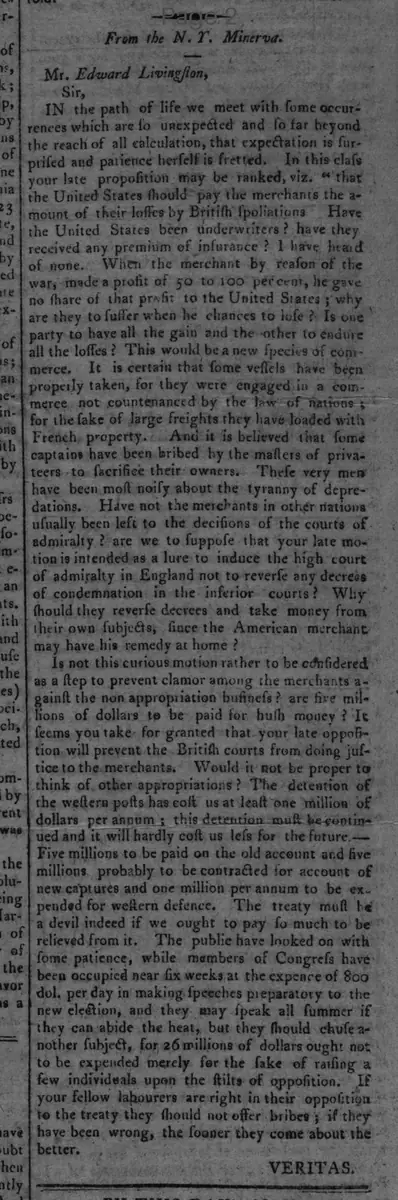
IN the path of life we meet with some occurrences which are so unexpected and so far beyond the reach of all calculation, that expectation is surprised and patience herself is fretted. In this class your late proposition may be ranked, viz. "that the United States should pay the merchants the amount of their losses by British depredations Have the United States been underwriters? have they received any premium of insurance? I have heard of none. When the merchant by reason of the war, made a profit of 20 to 100 percent, he gave no share of that profit to the United States; why are they to suffer when he chances to lose? Is one party to have all the gain and the other to endure all the losses? This would be a new species of commerce. It is certain that some vessels have been properly taken, for they were engaged in a commerce not countenanced by the law of nations; for the sake of large freights they have loaded with French property. And it is believed that some captains have been bribed by the masters of privateers to sacrifice their owners. These very men have been most noisy about the tyranny of depredations. Have not the merchants in other nations usually been left to the decisions of the courts of admiralty? are we to suppose that your late motion is intended as a lure to induce the high court of admiralty in England not to reverse any decrees of condemnation in the inferior courts? Why should they reverse decrees and take money from their own subjects, since the American merchant may have his remedy at home?
Is not this curious motion rather to be considered as a step to prevent clamor among the merchants against the non appropriation business? are five millions of dollars to be paid for hush money? It seems you take for granted that your late opposition will prevent the British courts from doing justice to the merchants. Would it not be proper to think of other appropriations? The detention of the western posts has cost us at least one million of dollars per annum; this detention must be continued and it will hardly cost us less for the future. -- Five millions to be paid on the old account and five millions probably to be contracted for account of new captures and one million per annum to be expended for western defence. The treaty must be a devil indeed if we ought to pay so much to be relieved from it. The public have looked on with some patience, while members of Congress have been occupied near six weeks at the expense of 800 dol. per day in making speeches preparatory to the new election, and they may speak all summer if they can abide the heat, but they should choose another subject, for 26 millions of dollars ought not to be expended merely for the sake of raising a few individuals upon the tilts of opposition. If your fellow labourers are right in their opposition to the treaty they should not offer bribes; if they have been wrong, the sooner they come about the better.
VERITAS.
Mr. Edward Livingston,
Sir,
IN the path of life we meet with some occurrences which are so unexpected and so far beyond the reach of all calculation, that expectation is surprised and patience herself is fretted. In this class your late proposition may be ranked, viz. "that the United States should pay the merchants the amount of their losses by British depredations Have the United States been underwriters? have they received any premium of insurance? I have heard of none. When the merchant by reason of the war, made a profit of 20 to 100 percent, he gave no share of that profit to the United States; why are they to suffer when he chances to lose? Is one party to have all the gain and the other to endure all the losses? This would be a new species of commerce. It is certain that some vessels have been properly taken, for they were engaged in a commerce not countenanced by the law of nations; for the sake of large freights they have loaded with French property. And it is believed that some captains have been bribed by the masters of privateers to sacrifice their owners. These very men have been most noisy about the tyranny of depredations. Have not the merchants in other nations usually been left to the decisions of the courts of admiralty? are we to suppose that your late motion is intended as a lure to induce the high court of admiralty in England not to reverse any decrees of condemnation in the inferior courts? Why should they reverse decrees and take money from their own subjects, since the American merchant may have his remedy at home?
Is not this curious motion rather to be considered as a step to prevent clamor among the merchants against the non appropriation business? are five millions of dollars to be paid for hush money? It seems you take for granted that your late opposition will prevent the British courts from doing justice to the merchants. Would it not be proper to think of other appropriations? The detention of the western posts has cost us at least one million of dollars per annum; this detention must be continued and it will hardly cost us less for the future. -- Five millions to be paid on the old account and five millions probably to be contracted for account of new captures and one million per annum to be expended for western defence. The treaty must be a devil indeed if we ought to pay so much to be relieved from it. The public have looked on with some patience, while members of Congress have been occupied near six weeks at the expense of 800 dol. per day in making speeches preparatory to the new election, and they may speak all summer if they can abide the heat, but they should choose another subject, for 26 millions of dollars ought not to be expended merely for the sake of raising a few individuals upon the tilts of opposition. If your fellow labourers are right in their opposition to the treaty they should not offer bribes; if they have been wrong, the sooner they come about the better.
VERITAS.
What sub-type of article is it?
Foreign Affairs
Economic Policy
Partisan Politics
What keywords are associated?
British Depredations
Merchant Losses
Congressional Proposal
Jay Treaty Opposition
Western Posts
Public Appropriations
What entities or persons were involved?
Edward Livingston
United States
British
Merchants
Congress
Editorial Details
Primary Topic
Criticism Of Proposal To Compensate Merchants For British Depredations
Stance / Tone
Strongly Critical And Oppositional
Key Figures
Edward Livingston
United States
British
Merchants
Congress
Key Arguments
United States Not Acting As Underwriters Without Premiums
Merchants Profited From War Without Sharing Gains
Some Vessels Engaged In Illegal Trade With French Property
Captains Possibly Bribed To Sacrifice Owners
Proposal As Hush Money To Quiet Merchant Clamor
Better Appropriations For Western Posts Defense
Opposition To Treaty Should Not Involve Bribes
Congressional Debates Wasting Public Funds