Thank you for visiting SNEWPapers!
Sign up free
Alexandria Gazette, Commercial And Political
Alexandria, Virginia
What is this article about?
Late foreign intelligence from England, received in Newport on May 23, 1813, via brig from Liverpool. Covers shipping news, British expedition to America with 2000 marines, suspension of prisoner exchanges, Liverpool petitions, trade licenses to America, Russian proclamation to Saxons, ultimatum to Denmark, Swedish troops in Pomerania, Prussian abolition of Continental System, naval arrivals, and European military victories including defeats of French forces at Luneburg and Kalitsch, plus rumors of Austrian alliance against France.
Merged-components note: These components form a single continuous article on late foreign intelligence.
Clipping
OCR Quality
Full Text
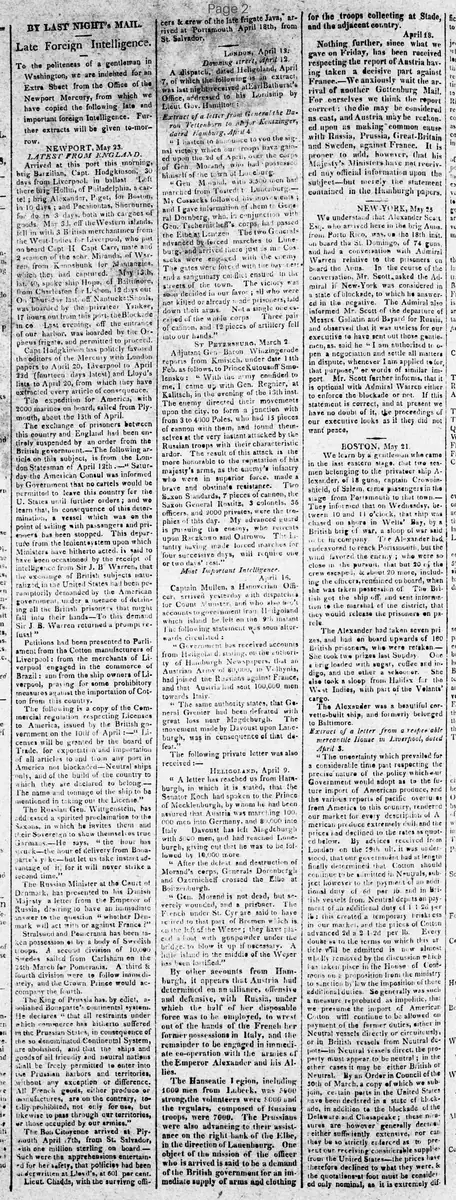
Late Foreign Intelligence
To the politeness of a gentleman in Washington, we are indebted for an Extra Sheet from the Office of the Newport Mercury, from which we have copied the following late and important foreign Intelligence. Further extracts will be given to-morrow.
NEWPORT. May 23
LATEST FROM ENGLAND.
Arrived at this port this morning, brig Brazilian, Capt. Hodgkinson, 30 days from Liverpool, in ballast. Left there brig Hollin, of Philadelphia, a cargo; brig Alexander, Pigot, for Boston, in 10 days; and Pocahontas, Sherburne, for do. in 3 days, both with cargoes of goods. May 31, off the Western islands, fell in with 3 British merchantmen from the West-Indies for Liverpool, who put on board Capt. H. Capt. Carr, mate and 2 seamen of the schr. Miranda, of Warren, from Kennebunk for Martinique, which they had captured. May 13th, lat. 40, spoke ship Hope, of Baltimore, from Charleston for Lisbon, 12 days out. On Thursday last, off Nantucket Shoals, was boarded by the privateer Yankee, 17 hours out from this port, the Blockade in co. Last evening, off the entrance of our harbor, was boarded by the Orpheus frigate, and permitted to proceed.
Capt. Hodgkinson has politely favored the editors of the Mercury with London papers to April 20, Liverpool to April 29th (fourteen days latest) and Lloyd's lists to April 20, from which they have extracted every article of consequence.
The expedition for America, with 2000 marines on board, sailed from Plymouth, about the 15th of April.
The exchange of prisoners between this country and England had been entirely suspended by an order from the British government. The following article on this subject, is from the London Statesman of April 12th. "Saturday the American Consul was informed by Government that no cartels would be permitted to leave this country for the U. States until further orders; and we learn that, in consequence of this determination, a vessel which was on the point of sailing with passengers and prisoners has been stopped. This departure from the lenient system upon which Ministers have hitherto acted, is said to have been occasioned by the receipt of intelligence from Sir J. B. Warren, that the exchange of British subjects naturalized in the United States had been peremptorily demanded by the American government, under a menace of detaining all the British prisoners that might fall into their hands--To this demand Sir J. B. Warren returned a prompt refusal."
Petitions had been presented to Parliament from the Cotton manufacturers of Liverpool: from the merchants of Liverpool engaged in the commerce of Brazil: and from the ship owners of Liverpool, praying for some prohibitory measures against the importation of Cotton from this country.
The following is a copy of the Commercial regulation respecting Licenses to America, issued by the British government on the 10th of April: "Licenses will be granted by the board of Trade, for exportation and importation of all articles to and from any port in America not blockaded--Neutral ships only, and of the build of the country to which they are declared to belong--The name and tonnage of the ship to be mentioned in taking out the License."
The Russian Gen. Wittgenstein, has addressed a spirited proclamation to the Saxons, in which he invites them and their Sovereign to shew themselves true Germans.--He says, "the hour has struck--the hour of delivery from Bonaparte's yoke--but let us take instant advantage of it, for it will never strike a second time."
The Russian Minister at the Court of Denmark, has presented to his Danish Majesty a letter from the Emperor of Russia, desiring to have an immediate answer to the question "whether Denmark will act with or against France?"
Stralsund and Pomerania has been taken possession of by a body of Swedish troops. A second division of 10,000 Swedes sailed from Carlscrona on the 24th March for Pomerania. A third & fourth division were to follow immediately, and the Crown Prince would accompany the fourth.
The King of Prussia has, by edict, abolished Bonaparte's continental system. He declares "that all restraints under which commerce has hitherto suffered in the Prussian States, in consequence of the so denominated Continental System, are abolished, and that the ships and goods of all friendly and neutral nations shall be freely permitted to enter into the Prussian harbors and territories, without any exception or difference. All French goods, either produce or manufactures, are on the contrary, totally prohibited, not only for use, but likewise to pass through our territories, or those occupied by our armies."
The Bon Citoyenne arrived at Plymouth April 7th, from St. Salvador, with one million sterling on board.--Such were the apprehensions entertained for her safety, that policies had been underwritten at Lloyd's, at 60l per cent.
Lieut. Chadds, with the surviving officers & crew of the late frigate Java, arrived at Portsmouth April 18th, from St. Salvador.
London April 13:
A dispatch, dated Heligoland, April 7, of which the following is an extract, was last night received at Earl Bathurst's Office, addressed to his Lordship by Lieut. Gov. Hamilton:
Extract of a letter from General the Baron Tettenborn to Major Kenizinger, dated Hamburg, April 4.
"I hasten to announce to you the signal victory which our troops have gained upon the 3d of April, over the corps of Gen. Morand, who had possessed himself of the town of Luneborg.
"Gen. Morand, with 3500 men had marched from Tostedt to Luneburg.--and I gave information of them to General Tettenborn. My Cossacks followed his movements; Gen.-Tschernicheff's corps, had passed the Elbe at Lenzen. The two Generals advanced by forced marches to Luneburg, and arrived there just as in Cossacks were engaged with the enemy. The gates were forced with the bayonet; and a sanguinary conflict ensued in the streets of the town. The victory was soon decided in our favor; all who were not killed or already made prisoners, laid down their arms. Not a single one escaped of the whole corps. Three pair of cannon, and 12 pieces of artillery fell into our hands."
ST. PETERSBURG, March 2.
Adjutant Gen.-Baron Winzingerode reports from Kmitch, under date 11th Feb. as follows, to Prince Kutuzoff Smolensko: "With the army confided to me, I came up with Gen. Regnier, at Kalitsch, in the evening of the 13th inst. The enemy directed their movements upon the city, to form a junction with from 3 to 4000 Poles, who had 15 pieces of cannon with them, and found themselves at the very instant attacked by the Russian troops with their characteristic ardor. The result of this attack is the more honorable to the reputation of his majesty's arms, as the enemy's infantry who were in superior force, made a brave and obstinate resistance. Two Saxon Standards, 7 pieces of cannon, the Saxon General Rostitz, 3 colonels, 36 officers, and 2000 privates, were the trophies of this day. My advanced guard is pursuing the enemy, who retreats upon Raczkowo and Ostrowo. The infantry having made forced marches for four successive days, will require one or two days' rest."
Most Important Intelligence.
April 16.
Captain Mullen, a Hanoverian Officer, arrived yesterday with dispatches for Count Munster, and who also bro't accounts to government from Heligoland which island he left on the 9th instant. The following statement was soon afterwards circulated:
"Government has received accounts from Heligoland, stating, on the authority of Hamburgh Newspapers, that an Austrian Army of 80,000, in Volhynia, had joined the Russians against France, and that Austria had sent 100,000 men towards Italy.
"The same authority states, that Gen. Grevier had been defeated with great loss near Magdeburgh. The movement made by Davoust upon Luneburgh, was in consequence of that defeat."
The following private letter was also received:--
HELIGOLAND, April 9.
"A letter has reached us from Hamburg, in which it is stated, that the Senator Koch had spoken to the Prince of Mecklenburgh, by whom he had been assured that Austria was marching 100,000 men into Germany, and 80,000 into Italy.
Davoust has left Magdeburgh with 5000 men, and had reached Luneburgh, giving out that he was to be followed by 10,000 more.
"After the defeat and destruction of Morand's corps, Generals Dorenberg and Tettenchef crossed the Elbe at Boitzenburgh.
"Gen. Morand is not dead, but severely wounded, and a prisoner. The French under St. Cyr are said to have retired to that part of Bremen which is on the left of the Weser; they have placed a boat with gunpowder under the bridge, to blow it up if necessary. A little island in the middle of the Weser has been fortified."
By other accounts from Hamburg, it appears that Austria had determined on an alliance, offensive and defensive, with Russia, under which the half of her disposable force was to be employed, to wrest out of the hands of the French her former possessions in Italy, and the remainder to be engaged in immediate co-operation with the armies of the Emperor Alexander and his Allies.
The Hanseatic Legion, including 1000 men from Lubeck, was 5000 strong, the volunteers were 5000 and the regulars, composed of Russian troops, were 7000. The Prussians were also advancing to their assistance on the right bank of the Elbe, in the direction of Lauenbourg. One object of the mission of the officer who is arrived is said to be a demand of the British government for an immediate supply of arms and clothing and the adjacent country.
Nothing further, since what we gave on Friday, has been received respecting the report of Austria having taken a decisive part against France.--We anxiously wait the arrival of another Gottenburg Mail.
For ourselves we think the report correct: the die may be considered as cast, and Austria may be reckoned upon as making common cause with Russia, Prussia, Great-Britain and Sweden, against France. It is proper to add, however, that his Majesty's Ministers have not received any official information upon the subject--but merely the statement contained in the Hamburgh papers.
What sub-type of article is it?
What keywords are associated?
What entities or persons were involved?
Where did it happen?
Foreign News Details
Primary Location
England
Event Date
April 1813
Key Persons
Outcome
british expedition to america sailed with 2000 marines; prisoner exchanges suspended; prussian edict abolishes continental system prohibiting french goods; swedish troops occupy stralsund and pomerania; russian ultimatum to denmark; victory at luneburg: 3500 french defeated, all captured or killed, 15 artillery pieces taken; victory at kalitsch: 2000 prisoners, 7 cannon, saxon general rostitz captured; rumors of austrian alliance with russia, 80,000 join in volhynia, 100,000 to italy; gen. grevier defeated near magdeburg.
Event Details
Compilation of intelligence from London papers to April 20 and Liverpool to April 29, including maritime arrivals and captures at sea, sailing of British expedition to America, suspension of US-UK prisoner exchanges due to demands over naturalized British subjects, Liverpool petitions against cotton imports, British trade license regulations for neutral ships to unblockaded American ports, Russian proclamation urging Saxons to rise against Bonaparte, Russian demand for Denmark to choose side against France, Swedish reinforcements to Pomerania, Prussian abolition of Continental System allowing neutral trade while banning French goods, arrival of Bon Citoyenne with 1 million sterling, survivors from frigate Java, detailed reports of allied victory over French Gen. Morand at Luneburg on April 3 with total defeat of 3500 men, Russian victory over Gen. Regnier and Poles at Kalitsch on Feb 13 with 2000 prisoners, and dispatches confirming Austrian military moves joining Russia against France including defeats of French forces.