Thank you for visiting SNEWPapers!
Sign up free
Story
April 8, 1923
Laredo Weekly Times
Laredo, Webb County, Texas
What is this article about?
Governor Neff of Texas vetoes a legislative bill to cancel textbook contracts, defending the sanctity of agreements made by authorized state agents and warning against legislative overreach into judicial functions.
Clipping
OCR Quality
98%
Excellent
Full Text
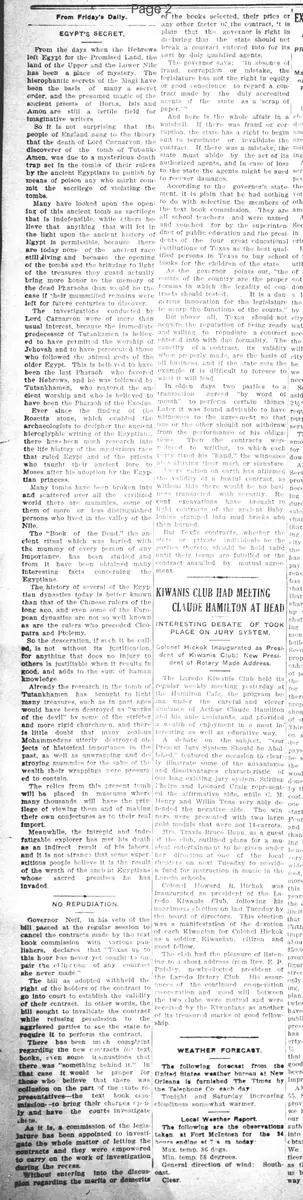
NO REPUDIATION.
Governor Neff, in his veto of the bill passed at the regular session to cancel the contracts made by the text book commission with various publishers, declares that "Texas up to this hour has never yet sought to impair the obligation of any contract she never made."
The bill as adopted withheld the right of the holders of the contract to go into court to establish the validity of their contract. In other words, the bill sought to invalidate the contract while refusing permission to the aggrieved parties to sue the state to require it to perform the contract.
There has been much complaint regarding the new contracts for text books, with some insinuations that there was "something behind it." In that case it would be proper for those who believe that there was collusion on the part of the state representatives--the text book commission--to bring their charges fully and have the courts investigate them.
As it is, a commission of the legislature has been appointed to investigate contracts and they were empowered to carry on the work of investigation during the recess.
Without entering into the discussion regarding the merits or demerits of the books selected, their price or any other factor of the contract, it is plain that the governor is right in declaring that the state should not break a contract entered into for its part by duly qualified agents.
The governor says: "In absence of fraud, corruption or mistake, the legislature has not the right in equity or good conscience to regard a contract made by the duly accredited agents of the state as a 'scrap of paper.'"
And here is the whole affair in a nutshell. If there was fraud or corruption, the state has a right to begin suit to terminate or invalidate the contract. If there was a mistake, the state must abide by the act of its authorized agents, and in case of loss to the state the agents might be sued to recover damages.
According to the governor's statement, it is plain that he had nothing to do with selecting the members of the text book commission. They are all school teachers and were named and vouched for by the superintendent of public education and the presidents of the four great educational institutions of Texas as the best qualified persons in Texas to buy school books for the children of the state.
As the governor points out, "the courts of the country are the proper forums in which the legality of contracts should be tested. . . It is a dangerous innovation for the legislature to usurp the functions of the courts."
But above all, Texas should not acquire the reputation of being ready and willing to repudiate a contract entered into with due formality. The sanctity of a contract, its validity when properly made, are the basis of all business, and if the state sets the example it is difficult to foresee to what it will lead.
In olden days two parties to a transaction agreed "by word of mouth" to perform certain things. Later it was found advisable to have witnesses to the agreement so that one or the other should not withdraw from the performance of his obligations. Then the contracts were reduced to writing, to which each party fixed his "hand," the witnesses affixing their mark or signature.
Every nation on earth has affirmed the validity of a lawful contract, as without this there would be no business transacted with security. Recent excavations have brought to light contracts of the ancient Babylonians stamped into mud bricks and then burned.
But Texas contracts, whether the state or private individuals be the parties thereto, should be held valid until their terms are fulfilled or the contract annulled by mutual agreement.
Governor Neff, in his veto of the bill passed at the regular session to cancel the contracts made by the text book commission with various publishers, declares that "Texas up to this hour has never yet sought to impair the obligation of any contract she never made."
The bill as adopted withheld the right of the holders of the contract to go into court to establish the validity of their contract. In other words, the bill sought to invalidate the contract while refusing permission to the aggrieved parties to sue the state to require it to perform the contract.
There has been much complaint regarding the new contracts for text books, with some insinuations that there was "something behind it." In that case it would be proper for those who believe that there was collusion on the part of the state representatives--the text book commission--to bring their charges fully and have the courts investigate them.
As it is, a commission of the legislature has been appointed to investigate contracts and they were empowered to carry on the work of investigation during the recess.
Without entering into the discussion regarding the merits or demerits of the books selected, their price or any other factor of the contract, it is plain that the governor is right in declaring that the state should not break a contract entered into for its part by duly qualified agents.
The governor says: "In absence of fraud, corruption or mistake, the legislature has not the right in equity or good conscience to regard a contract made by the duly accredited agents of the state as a 'scrap of paper.'"
And here is the whole affair in a nutshell. If there was fraud or corruption, the state has a right to begin suit to terminate or invalidate the contract. If there was a mistake, the state must abide by the act of its authorized agents, and in case of loss to the state the agents might be sued to recover damages.
According to the governor's statement, it is plain that he had nothing to do with selecting the members of the text book commission. They are all school teachers and were named and vouched for by the superintendent of public education and the presidents of the four great educational institutions of Texas as the best qualified persons in Texas to buy school books for the children of the state.
As the governor points out, "the courts of the country are the proper forums in which the legality of contracts should be tested. . . It is a dangerous innovation for the legislature to usurp the functions of the courts."
But above all, Texas should not acquire the reputation of being ready and willing to repudiate a contract entered into with due formality. The sanctity of a contract, its validity when properly made, are the basis of all business, and if the state sets the example it is difficult to foresee to what it will lead.
In olden days two parties to a transaction agreed "by word of mouth" to perform certain things. Later it was found advisable to have witnesses to the agreement so that one or the other should not withdraw from the performance of his obligations. Then the contracts were reduced to writing, to which each party fixed his "hand," the witnesses affixing their mark or signature.
Every nation on earth has affirmed the validity of a lawful contract, as without this there would be no business transacted with security. Recent excavations have brought to light contracts of the ancient Babylonians stamped into mud bricks and then burned.
But Texas contracts, whether the state or private individuals be the parties thereto, should be held valid until their terms are fulfilled or the contract annulled by mutual agreement.
What sub-type of article is it?
Historical Event
What themes does it cover?
Justice
Moral Virtue
What keywords are associated?
Governor Veto
Textbook Contracts
Contract Validity
Texas Legislature
State Agents
What entities or persons were involved?
Governor Neff
Text Book Commission
Superintendent Of Public Education
Where did it happen?
Texas
Story Details
Key Persons
Governor Neff
Text Book Commission
Superintendent Of Public Education
Location
Texas
Story Details
Governor Neff vetoes a bill to cancel textbook contracts, arguing that the state should not impair valid contracts made by its agents without fraud or corruption, and that courts should handle disputes.