Thank you for visiting SNEWPapers!
Sign up free
Editorial
March 19, 1852
The Athens Post
Athens, Mcminn County, Tennessee
What is this article about?
Editorial highlights two key bills on public lands: Andrew Johnson's homestead bill and William Churchwell's proposal granting 100 million acres to states for common school education, praising the latter for promoting public benefit through education.
Clipping
OCR Quality
95%
Excellent
Full Text
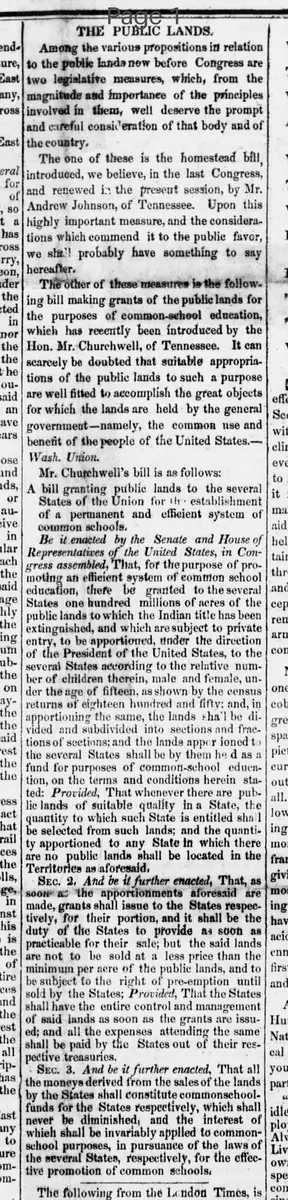
THE PUBLIC LANDS.
Among the various propositions in relation to the public lands now before Congress are two legislative measures, which, from the magnitude and importance of the principles involved in them, well deserve the prompt and careful consideration of that body and of the country.
The one of these is the homestead bill introduced, we believe, in the last Congress, and renewed in the present session, by Mr. Andrew Johnson, of Tennessee. Upon this highly important measure, and the considerations which commend it to the public favor we shall probably have something to say hereafter.
The other of these measures is the following bill making grants of the public lands for the purposes of common-school education, which has recently been introduced by the Hon. Mr. Churchwell, of Tennessee. It can scarcely be doubted that suitable appropriations of the public lands to such a purpose are well fitted to accomplish the great objects for which the lands are held by the general government-namely, the common use and benefit of the people of the United States.— Wash. Union.
Mr. Churchwell's bill is as follows:
A bill granting public lands to the several States of the Union for the establishment of a permanent and efficient system of common schools.
Be it enacted by the Senate and House of Representatives of the United States, in Congress assembled, That, for the purpose of promoting an efficient system of common school education, there be granted to the several States one hundred millions of acres of the public lands to which the Indian title has been extinguished, and which are subject to private entry, to be apportioned, under the direction of the President of the United States, to the several States according to the relative number of children therein, male and female, under the age of fifteen, as shown by the census returns of eighteen hundred and fifty: and, in apportioning the same, the lands shall be divided and subdivided into sections and fractions of sections: and the lands apportioned to the several States shall be by them held as a fund for purposes of common-school education, on the terms and conditions herein stated: Provided, That whenever there are public lands of suitable quality in a State, the quantity to which such State is entitled shall be selected from such lands; and the quantity apportioned to any State in which there are no public lands shall be located in the Territories as aforesaid.
Sec. 2. And be it further enacted, That, as soon as the apportionments aforesaid are made, grants shall issue to the States respectively, for their portion, and it shall be the duty of the States to provide as soon as practicable for their sale; but the said lands are not to be sold at a less price than the minimum per acre of the public lands, and to be subject to the right of pre-emption until sold by the States: Provided, That the States shall have the entire control and management of said lands as soon as the grants are issued: and all the expenses attending the same shall be paid by the States out of their respective treasuries.
Sec. 3. And be it further enacted, That all the moneys derived from the sales of the lands by the States shall constitute common school funds for the States respectively, which shall never be diminished, and the interest of which shall be invariably applied to common-school purposes, in pursuance of the laws of the several States, respectively, for the effective promotion of common schools.
Among the various propositions in relation to the public lands now before Congress are two legislative measures, which, from the magnitude and importance of the principles involved in them, well deserve the prompt and careful consideration of that body and of the country.
The one of these is the homestead bill introduced, we believe, in the last Congress, and renewed in the present session, by Mr. Andrew Johnson, of Tennessee. Upon this highly important measure, and the considerations which commend it to the public favor we shall probably have something to say hereafter.
The other of these measures is the following bill making grants of the public lands for the purposes of common-school education, which has recently been introduced by the Hon. Mr. Churchwell, of Tennessee. It can scarcely be doubted that suitable appropriations of the public lands to such a purpose are well fitted to accomplish the great objects for which the lands are held by the general government-namely, the common use and benefit of the people of the United States.— Wash. Union.
Mr. Churchwell's bill is as follows:
A bill granting public lands to the several States of the Union for the establishment of a permanent and efficient system of common schools.
Be it enacted by the Senate and House of Representatives of the United States, in Congress assembled, That, for the purpose of promoting an efficient system of common school education, there be granted to the several States one hundred millions of acres of the public lands to which the Indian title has been extinguished, and which are subject to private entry, to be apportioned, under the direction of the President of the United States, to the several States according to the relative number of children therein, male and female, under the age of fifteen, as shown by the census returns of eighteen hundred and fifty: and, in apportioning the same, the lands shall be divided and subdivided into sections and fractions of sections: and the lands apportioned to the several States shall be by them held as a fund for purposes of common-school education, on the terms and conditions herein stated: Provided, That whenever there are public lands of suitable quality in a State, the quantity to which such State is entitled shall be selected from such lands; and the quantity apportioned to any State in which there are no public lands shall be located in the Territories as aforesaid.
Sec. 2. And be it further enacted, That, as soon as the apportionments aforesaid are made, grants shall issue to the States respectively, for their portion, and it shall be the duty of the States to provide as soon as practicable for their sale; but the said lands are not to be sold at a less price than the minimum per acre of the public lands, and to be subject to the right of pre-emption until sold by the States: Provided, That the States shall have the entire control and management of said lands as soon as the grants are issued: and all the expenses attending the same shall be paid by the States out of their respective treasuries.
Sec. 3. And be it further enacted, That all the moneys derived from the sales of the lands by the States shall constitute common school funds for the States respectively, which shall never be diminished, and the interest of which shall be invariably applied to common-school purposes, in pursuance of the laws of the several States, respectively, for the effective promotion of common schools.
What sub-type of article is it?
Education
Economic Policy
What keywords are associated?
Public Lands
Homestead Bill
Common Schools
Education Funding
Land Grants
Andrew Johnson
Churchwell Bill
What entities or persons were involved?
Andrew Johnson
Mr. Churchwell
Congress
President Of The United States
States
Editorial Details
Primary Topic
Granting Public Lands For Common School Education
Stance / Tone
Supportive Of Land Grants For Education
Key Figures
Andrew Johnson
Mr. Churchwell
Congress
President Of The United States
States
Key Arguments
Public Lands Held For Common Use And Benefit Of The People
Homestead Bill By Andrew Johnson Deserves Consideration
Churchwell's Bill Grants 100 Million Acres For Common Schools
Apportionment Based On Number Of Children Under 15 Per 1850 Census
Lands To Be Sold At Minimum Price, Proceeds Form Permanent School Funds
Interest From Funds Applied To Common School Purposes