Thank you for visiting SNEWPapers!
Sign up free
Watertown Republican
Watertown, Jefferson County, Dodge County, Wisconsin
What is this article about?
Detailed report on the Wisconsin State Fair's exhibits of poultry, fruit, vegetables, sheep, and horses; strong attendance, weather improvements, races, and election of agricultural society officers including John L. Mitchell as president.
Clipping
OCR Quality
Full Text
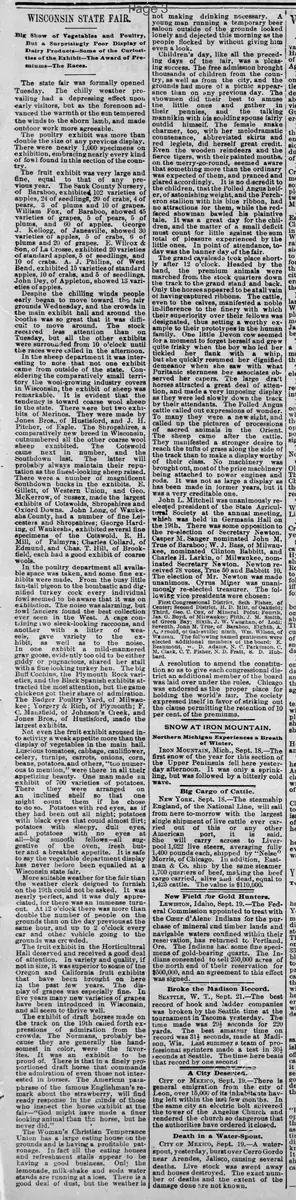
Big Show of Vegetables and Poultry, But a Surprisingly Poor Display of Dairy Products—Some of the Curiosities of the Exhibit—The Award of Premiums—The Races.
The state fair was formally opened Tuesday. The chilly weather prevailing had a depressing effect upon early visitors, but as the forenoon advanced the warmth of the sun tempered the winds to the shorn lamb, and made outdoor work more agreeable.
The poultry exhibit was more than double the size of any previous display. There were nearly 1,000 specimens on exhibition, embracing nearly every kind of fowl found in this section of the country.
The fruit exhibit was very large and fine, equal to that of any previous year. The Sauk County Nursery, of Baraboo, exhibited 102 varieties of apples, 24 of seedlings, 20 of crabs, 4 of pears, 3 of plums and 10 of grapes. William Fox, of Baraboo, showed 45 varieties of grapes, 5 of pears, 5 of plums, and 60 of apples. George J. Kellogg, of Janesville, showed 30 varieties of apples, 5 of crabs, 6 of plums and 20 of grapes. E. Wilcox & Son, of La Crosse, exhibited 20 varieties of standard apples, 5 of seedlings, and 10 of crabs. A. J. Philips, of West Bend, exhibited 15 varieties of standard apples, 10 of crabs, and 5 of seedlings. John Dey, of Appleton, showed 13 varieties of apples.
Despite the chilling winds people early began to move toward the fair grounds Wednesday, and the crowds in the main exhibit hall and around the booths was so great that it was difficult to move around. The stock received less attention than on Tuesday, but all the other exhibits were surrounded from 10 o'clock until the races were called in the afternoon.
In the sheep department it was interesting to note that not one exhibit came from outside of the state. Considering the comparatively small territory the wool-growing industry covers in Wisconsin, the exhibit of sheep was remarkable. It is evident that the tendency is toward coarse wool sheep in the state. There were but two exhibits of Merinos. They were made by Jones Bros., of Hustisford, and J. H. Pitcher, of Eagle. The Shropshires, a comparatively new breed in Wisconsin, outnumbered all the other coarse wool sheep exhibited. The Cotswold came next in number, and the Southdown last. The latter will probably always maintain their reputation as the finest-looking sheep raised. There were a number of magnificent Southdown bucks in the exhibits. E. Gillett, of Western Union, and Geo. McKerrow, of Sussex, made the largest exhibits of Cotswolds. Shropshires and Oxford Downs. John Long, of Waukesha County, had a number of fine Leicesters and Shropshires; George Harding, of Waukesha, exhibited several fine specimens of the Cotswold. R. H. Mill, of Palmyra; Charles Collard, of Edmund, and Chas. T. Hill, of Brookfield, each had a good exhibit of coarse wools.
In the poultry department all available space was taken, and some fine exhibits were made. From the busy little fan-tail pigeon to the bombastic and dignified turkey cock every individual fowl seemed to be aware that it was on exhibition. The noise was alarming, but fowl fanciers found the best collection ever seen in the West. A cage containing two sleek-looking raccoons, and another with a litter of weasels, gave variety to the exhibit, as well as to the noise.
In one exhibit a mild-mannered gray goose, evidently too old to be either giddy or pugnacious, shared her stall with a fine looking turkey hen. The big Buff Cochins, the Plymouth Rock varieties, and the Black Spanish exhibits attracted the most attention, but the game chickens got their share of admiration. The Badger Poultry Yard, of Milwaukee; Yorgery & Rich, of Plymouth; F. C. Mansfield, of Johnson's Creek, and Jones Bros., of Hustisford, made the largest exhibits.
Not even the fruit exhibit aroused into activity a weak appetite more than the display of vegetables in the main hall. Luscious tomatoes, cabbage, cauliflower, celery, turnips, carrots, onions, corn, beans, potatoes, and others, too numerous to mention, were there in all their appetizing beauty. One man made an exhibit of 700 varieties of potatoes. There they were arranged on an inclined shelf so that one might count them if he chose to do so. Potatoes with red eyes, as if they had been out all night; potatoes with black eyes that could almost flirt; potatoes with sleepy, dull eyes, and potatoes with no eyes at all—big smooth fellows—all suggestive of the oven, fresh butter and a breakfast appetite. It is safe to say the vegetable department display has never before been equalled at a Wisconsin state fair.
More suitable weather for the fair than the weather clerk deigned to furnish on the 19th could not be asked. It was nearly perfect, and it was duly appreciated, for there was an immense turn-out. At 12 o'clock there was more than double the number of people on the grounds than on the day previous at the same hour, and up to 2 o'clock every car and other vehicle going to the grounds was crowded.
The fruit exhibit in the Horticultural Hall deserved and received a good deal of attention. In variety and quality, if not in size, it was superior to some of the Oregon and California fruit exhibits that have been brought on here in the past few years. The display of grapes was especially fine. In five years many new varieties of grapes have been introduced in Wisconsin, and all seem to thrive well.
The exhibit of draft horses made on the track on the 19th called forth expressions of admiration from the crowds. The Normans, probably because they are generally the handsomest in color, were the favorites. It was an exhibit to be proud of. There is that in a finely proportioned draft horse that commands the admiration of even those not interested in horses. The American paraphrase of the famous Englishman's remark about the strawberry, will find ready response in the minds of those who inspect the horse exhibit at the fair—'God might have made a finer looking animal than the horse, but he never did.'
The Woman's Christian Temperance Union has a large eating house on the grounds and is having a profitable patronage. In fact all the eating houses and refreshment stalls appear to be having a good business. Only the lemonade, milk-shake and soda water stands are running at a loss. There is a good deal of dust, but the weather is not making drinking necessary. A young man running a temporary beer saloon outside of the grounds looked lonely and dejected this morning as the people flocked by without giving him even a look.
Children's day, like all the preceding days of the fair, was a pleasing success. The free admission brought thousands of children from the country, as well as from the city, and the grounds had more of a picnic appearance than on any previous day. The showmen did their best to amuse the little ones and gather in their pennies, and the talking mannikin with his scolding spouse fairly outdid himself. The female snake charmer, too, with her melodramatic countenance, abbreviated skirts and red leglets, did herself great credit. Even the wooden reindeers and the fierce tigers, with their painted mouths, on the merry-go-round, seemed aware that something more than the ordinary was expected of them, and pranced and glared accordingly. It is no discredit to the children, that the Polled Angus heifer, of astonishing weight, and the Percheron stallion with his blue ribbon, had no attractions for them, while the red-faced showman bawled his plaintive tale. It was a great day for the children, and the matter of a small deficit must count for little against the sum total of pleasure experienced by the little ones. In point of attendance, to-day was the banner day of the fair.
The grand cavalcade took place shortly after 12 o'clock. Headed by the band, the premium animals were marched from the stock quarters down the track to the grand stand and back. Only the horses appeared to be at all vain of having captured ribbons. The cattle, even to the calves, manifested a noble indifference to the finery with which their superiority over their fellows was designated, thus setting a worthy example to their prototypes in the human family. One little Devon cow seemed for a moment to forget herself and grew quite frisky when the boy who led her tickled her flank with a whip, but she quickly resumed her dignified demeanor when she saw with what Puritanic sternness her associates observed her capers. The large draft horses attracted a great deal of attention, and made a very imposing display as they were led slowly down the track by their attendants. The Polled Angus cattle called out expressions of wonder. To many they were a new sight, and called up the pictures of processions of sacred animals in the Orient. The sheep came after the cattle. They manifested a stronger desire to reach the tufts of grass along the side of the track than to make a display worthy of their class. No machinery was brought out, most of the prize machinery being attached to power engines and rods. It was not as large a display as has been made in former years, but it was a very creditable one.
John L. Mitchell was unanimously re-elected president of the State Agricultural Society at the annual meeting, which was held in Germania Hall on the 19th. There was some opposition to the re-election of Secretary Newton. Casper M. Sanger nominated John M. True of Baraboo; W. J. Bass, of Milwaukee, nominated Clinton Babbitt, and Charles H. Larkin, of Milwaukee, nominated Secretary Newton. Newton received 78 votes, True 50 and Babbitt 10. The election of Mr. Newton was made unanimous. Cyrus Miner was unanimously re-elected treasurer. The following vice presidents were chosen: First Congressional District, Seth Fisher, of Center; Second District, H. D. Hitt, of Oaktield; Third, Geo. C. Cox, of Mineral Point; Fourth, Jas. G. Boyd, of Milwaukee; Fifth, J. M. Smith, of Green Bay; Sixth, J. W. Vaughan, of Lodi; Seventh, John M. True, of Baraboo, Eighth, A. A. Arnold, of Galesville; ninth, Wm. Wilson, of Wausau. The following named gentlemen were elected additional members of the board: E. Beaumont, W. D. Adams, N. C. Parkinson, C. M. Clark, T. Fisher, N. D. Fratt, S. D. Hubbard.
A resolution to amend the constitution so as to give each congressional district an additional member of the board was laid over under the rules. Chicago was endorsed as the proper place for holding the world's fair. The society expressed itself in favor of striking out the clause permitting the retention of 10 per cent. of the premiums.
What sub-type of article is it?
What themes does it cover?
What keywords are associated?
What entities or persons were involved?
Where did it happen?
Story Details
Key Persons
Location
Wisconsin State Fair Grounds
Event Date
Opened Tuesday, On The 19th
Story Details
The Wisconsin State Fair featured large exhibits of poultry, fruit, vegetables, sheep, and draft horses, with good attendance despite initial chilly weather; highlights included diverse apple varieties, fine Shropshires, and impressive vegetable displays; society officers were elected, with John L. Mitchell re-elected president and Secretary Newton confirmed.