Thank you for visiting SNEWPapers!
Sign up free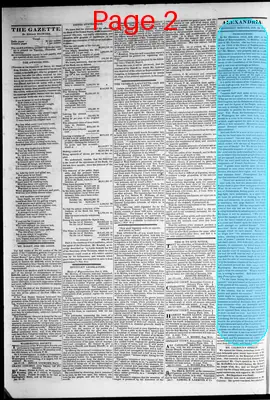
Editorial
January 15, 1834
Alexandria Gazette
Alexandria, Alexandria County, District Of Columbia
What is this article about?
Editorial from Alexandria Gazette condemns political proscription as a violation of the First Amendment, referencing Mr. Fletcher's dismissal by the House Clerk, Philadelphia watchmen firings, and Jacksonian spoils system, arguing it undermines liberty regardless of party.
Clipping

OCR Quality
98%
Excellent
Full Text
ALEXANDRIA:
WEDNESDAY MORNING, JAN. 15, 1834.
PROSCRIPTION!
In the discussion which took place in the House of Representatives, on Monday, on the case of Mr. Fletcher, who has been proscribed by the Clerk of the House of Representatives a man dressed up "with a little brief authority," Mr. Mercer, very properly, and as a sufficient answer to all that has been and can be said in favor of proscription in this country, called for the reading of the 1st Art. of the Amendments to the Constitution of the United States, and it was read accordingly as follows:
"Congress shall make no law respecting an establishment of religion, or prohibiting the free exercise thereof; or abridging the freedom of speech or of the press; or the right of the people peaceably to assemble and to petition the Government for a redress of grievances."
It is under this clause of the Constitution, and on this high ground, that the odious—hateful—abominable system of PROSCRIPTION should ever be opposed.
Congress itself shall make no law abridging the freedom of speech! But what do we see? What are we not called on to see all around us? Not Congress, but the Subalterns of the Government and the Agents of the People, undertake not only to abridge the freedom of speech, but absolutely to prohibit the free exercise of opinion! Yes! From the Government Chambers at Washington the edict went forth, that it should be a crime to be punished, to do, or say, or think, aught against the men at the head of affairs or their measures! Monstrous abuse of power! Detested exercise of an unrighteous determination!
And can there be a man in this country who can lay his hand upon his heart and approve of such a course? Can any man, calling himself a republican, say one word in favor of a course which strikes with the axe of despotism at the very root of liberty? No! We do not believe it. The miserable trammels of party may shackle the mind and the understanding for a time; but we do believe that the honest people of this country are opposed, heart and soul, to Proscription
Why! the word itself calls up ideas of Russian vengeance—of French Jacobinism. Proscription! It grates most harshly upon the ear accustomed to hear every where the accents of freemen who know their rights, and, knowing, dare maintain them! Proscription! Let the day that introduced it amongst us . Stand aye accursed in the calendar."
And look, too, how this abominable doctrine works—how it goes—how contagious even it is What do we now see? The City Administration of Philadelphia. feeling power and forgetting right, have undertaken, in a spirit which we must be pardoned for thinking was both mean and erroneous, to proscribe forty or fifty watchmen, with large families! O! Shame where is thy blush? Did the respectable authorities of that city not see how they were degrading themselves by adopting such a measure
We know it will be answered, "We did but follow the example of our opponents: they urged on the blood hounds of party to their prey and rioted and feasted upon the distresses they made amongst our political friends." True—most true! Never shall we forget the scenes through which we have passed. Never shall we forget how "the miserable sycophants of power, crawling in their own slime to the foot stool of power," crawled from there into honest men's places, who were sent, often almost destitute, to commence the world anew—their children crying for bread. Never shall we forget, that the voice of complaint was met by the jeer and the scoff: that the wail of poverty was responded to by the coarse laugh of the parasite: that the note of remonstrance was drowned by the heartless clamors of the heartless crew that clustered around the little great men at Washington. But what then! Principle—Principle is what we contend for. What is wrong in one, is wrong in another. And there is no making Proscription right!
"To the victor belong the spoils of the vanquished," was proclaimed as the maxim of one of the parties of this country; and it was openly avowed, upon the election of a Chief Magistrate of this country, that he would "reward his friends and punish his enemies." Such sentiments might be appropriate, as coming from soldiers of fortune, fighting for pay: Coming from statesmen as political doctrines, they are worse than erroneous—they are detestable and destructive. They sound the knell of civil liberty
As we opposed them when first avowed, so do we now—so shall we ever. Let them be practised upon by any party, and that party deserts, in so doing, the holy cause of liberty—does violence to the principles of freedom, and opposes the provisions and spirit of the Constitution.
There is no excuse for Proscription. Party purposes can afford not the slightest apology for it.—Those who use it, use it as wicked men always use usurped power—for the oppression of innocence, and the prostration of virtue. It is an instrument of tyranny: we would wrest it for ever from all hands, and break it into pieces.
WEDNESDAY MORNING, JAN. 15, 1834.
PROSCRIPTION!
In the discussion which took place in the House of Representatives, on Monday, on the case of Mr. Fletcher, who has been proscribed by the Clerk of the House of Representatives a man dressed up "with a little brief authority," Mr. Mercer, very properly, and as a sufficient answer to all that has been and can be said in favor of proscription in this country, called for the reading of the 1st Art. of the Amendments to the Constitution of the United States, and it was read accordingly as follows:
"Congress shall make no law respecting an establishment of religion, or prohibiting the free exercise thereof; or abridging the freedom of speech or of the press; or the right of the people peaceably to assemble and to petition the Government for a redress of grievances."
It is under this clause of the Constitution, and on this high ground, that the odious—hateful—abominable system of PROSCRIPTION should ever be opposed.
Congress itself shall make no law abridging the freedom of speech! But what do we see? What are we not called on to see all around us? Not Congress, but the Subalterns of the Government and the Agents of the People, undertake not only to abridge the freedom of speech, but absolutely to prohibit the free exercise of opinion! Yes! From the Government Chambers at Washington the edict went forth, that it should be a crime to be punished, to do, or say, or think, aught against the men at the head of affairs or their measures! Monstrous abuse of power! Detested exercise of an unrighteous determination!
And can there be a man in this country who can lay his hand upon his heart and approve of such a course? Can any man, calling himself a republican, say one word in favor of a course which strikes with the axe of despotism at the very root of liberty? No! We do not believe it. The miserable trammels of party may shackle the mind and the understanding for a time; but we do believe that the honest people of this country are opposed, heart and soul, to Proscription
Why! the word itself calls up ideas of Russian vengeance—of French Jacobinism. Proscription! It grates most harshly upon the ear accustomed to hear every where the accents of freemen who know their rights, and, knowing, dare maintain them! Proscription! Let the day that introduced it amongst us . Stand aye accursed in the calendar."
And look, too, how this abominable doctrine works—how it goes—how contagious even it is What do we now see? The City Administration of Philadelphia. feeling power and forgetting right, have undertaken, in a spirit which we must be pardoned for thinking was both mean and erroneous, to proscribe forty or fifty watchmen, with large families! O! Shame where is thy blush? Did the respectable authorities of that city not see how they were degrading themselves by adopting such a measure
We know it will be answered, "We did but follow the example of our opponents: they urged on the blood hounds of party to their prey and rioted and feasted upon the distresses they made amongst our political friends." True—most true! Never shall we forget the scenes through which we have passed. Never shall we forget how "the miserable sycophants of power, crawling in their own slime to the foot stool of power," crawled from there into honest men's places, who were sent, often almost destitute, to commence the world anew—their children crying for bread. Never shall we forget, that the voice of complaint was met by the jeer and the scoff: that the wail of poverty was responded to by the coarse laugh of the parasite: that the note of remonstrance was drowned by the heartless clamors of the heartless crew that clustered around the little great men at Washington. But what then! Principle—Principle is what we contend for. What is wrong in one, is wrong in another. And there is no making Proscription right!
"To the victor belong the spoils of the vanquished," was proclaimed as the maxim of one of the parties of this country; and it was openly avowed, upon the election of a Chief Magistrate of this country, that he would "reward his friends and punish his enemies." Such sentiments might be appropriate, as coming from soldiers of fortune, fighting for pay: Coming from statesmen as political doctrines, they are worse than erroneous—they are detestable and destructive. They sound the knell of civil liberty
As we opposed them when first avowed, so do we now—so shall we ever. Let them be practised upon by any party, and that party deserts, in so doing, the holy cause of liberty—does violence to the principles of freedom, and opposes the provisions and spirit of the Constitution.
There is no excuse for Proscription. Party purposes can afford not the slightest apology for it.—Those who use it, use it as wicked men always use usurped power—for the oppression of innocence, and the prostration of virtue. It is an instrument of tyranny: we would wrest it for ever from all hands, and break it into pieces.
What sub-type of article is it?
Constitutional
Partisan Politics
What keywords are associated?
Proscription
Freedom Of Speech
Constitutional Rights
Partisan Politics
Spoils System
First Amendment
What entities or persons were involved?
Mr. Fletcher
Mr. Mercer
Clerk Of The House Of Representatives
City Administration Of Philadelphia
Chief Magistrate
Editorial Details
Primary Topic
Opposition To Political Proscription
Stance / Tone
Strongly Anti Proscription, Defending Constitutional Freedoms
Key Figures
Mr. Fletcher
Mr. Mercer
Clerk Of The House Of Representatives
City Administration Of Philadelphia
Chief Magistrate
Key Arguments
Proscription Violates The First Amendment's Protection Of Free Speech And Opinion.
Government Subalterns And Agents Prohibit Free Exercise Of Opinion Against Leaders.
No Republican Can Approve Proscription As It Strikes At Liberty's Root.
Proscription Evokes Russian Vengeance And French Jacobinism, Unfit For Freemen.
Philadelphia's Proscription Of Watchmen Degrades Authorities.
Retaliatory Proscription Is Wrong; Principle Demands Opposition To It Universally.
Spoils System Maxim 'To The Victor Belong The Spoils' Destroys Civil Liberty.
Proscription Has No Excuse And Is An Instrument Of Tyranny.