Thank you for visiting SNEWPapers!
Sign up free
The Ottawa Free Trader
Ottawa, La Salle County County, Illinois
What is this article about?
Agricultural advice on storing potatoes in outdoor heaps covered with thick straw and minimal earth to protect from frost, dryness, and rot, based on successful experiments showing minimal losses compared to cellar storage or traditional burial methods.
Clipping
OCR Quality
Full Text
Keeping Potatoes Sound.
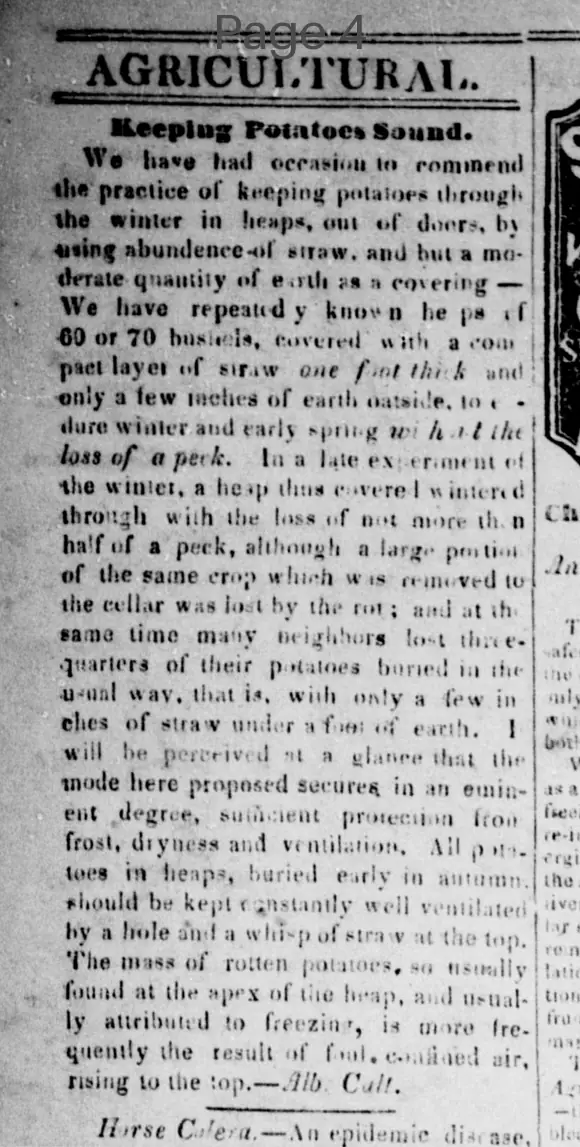
We have had occasion to commend the practice of keeping potatoes through the winter in heaps, out of doors, by using abundance of straw, and but a moderate quantity of earth as a covering. We have repeatedly known heaps of 60 or 70 bushels, covered with a compact layer of straw one foot thick, and only a few inches of earth outside, to endure winter and early spring without the loss of a peck. In a late experiment of the winter, a heap thus covered wintered through with the loss of not more than half of a peck, although a large portion of the same crop which was confined to the cellar was lost by the rot; and at the same time many neighbors lost three-quarters of their potatoes buried in the usual way, that is, with only a few inches of straw under a foot of earth. It will be perceived at a glance that the mode here proposed secures in an eminent degree, such entire protection from frost, dryness and ventilation. All potatoes in heaps, buried early in autumn, should be kept constantly well ventilated by a hole and a whip of straw at the top. The mass of rotten potatoes, so unusually found at the apex of the heap, and usually attributed to freezing, is more frequently the result of foul, confined air, rising to the top.—Alb. Cult.
What sub-type of article is it?
What keywords are associated?
Domestic News Details
Outcome
heaps of 60-70 bushels endured winter and early spring with loss of not more than half a peck; cellar storage lost large portion to rot; neighbors lost three-quarters in traditional burial.
Event Details
Practice of keeping potatoes in outdoor heaps covered with one foot of straw and few inches of earth provides protection from frost, dryness, and ensures ventilation via hole and straw whip at top to prevent rot from confined air.