Thank you for visiting SNEWPapers!
Sign up free
Story
February 6, 1945
The Daily Bulletin
Dayton, Montgomery County, Ohio
What is this article about?
Army officials praised 1,700 Negro women from Harlem for responding to a recruitment drive for Picatinny Arsenal in Dover, New Jersey, at a testimonial luncheon in New York on Feb. 6.
Clipping
OCR Quality
100%
Excellent
Full Text
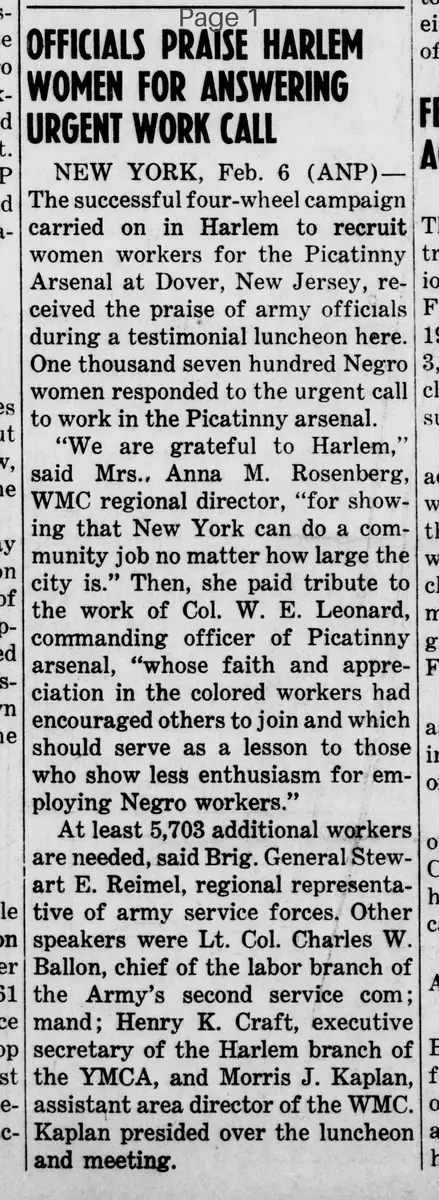
OFFICIALS PRAISE HARLEM WOMEN FOR ANSWERING URGENT WORK CALL
NEW YORK, Feb. 6 (ANP)—The successful four-wheel campaign carried on in Harlem to recruit women workers for the Picatinny Arsenal at Dover, New Jersey, received the praise of army officials during a testimonial luncheon here.
One thousand seven hundred Negro women responded to the urgent call to work in the Picatinny arsenal.
"We are grateful to Harlem," said Mrs. Anna M. Rosenberg, WMC regional director, "for showing that New York can do a community job no matter how large the city is." Then, she paid tribute to the work of Col. W. E. Leonard, commanding officer of Picatinny arsenal, "whose faith and appreciation in the colored workers had encouraged others to join and which should serve as a lesson to those who show less enthusiasm for employing Negro workers."
At least 5,703 additional workers are needed, said Brig. General Stewart E. Reimel, regional representative of army service forces. Other speakers were Lt. Col. Charles W. Ballon, chief of the labor branch of the Army's second service command; Henry K. Craft, executive secretary of the Harlem branch of the YMCA, and Morris J. Kaplan, assistant area director of the WMC.
Kaplan presided over the luncheon and meeting.
NEW YORK, Feb. 6 (ANP)—The successful four-wheel campaign carried on in Harlem to recruit women workers for the Picatinny Arsenal at Dover, New Jersey, received the praise of army officials during a testimonial luncheon here.
One thousand seven hundred Negro women responded to the urgent call to work in the Picatinny arsenal.
"We are grateful to Harlem," said Mrs. Anna M. Rosenberg, WMC regional director, "for showing that New York can do a community job no matter how large the city is." Then, she paid tribute to the work of Col. W. E. Leonard, commanding officer of Picatinny arsenal, "whose faith and appreciation in the colored workers had encouraged others to join and which should serve as a lesson to those who show less enthusiasm for employing Negro workers."
At least 5,703 additional workers are needed, said Brig. General Stewart E. Reimel, regional representative of army service forces. Other speakers were Lt. Col. Charles W. Ballon, chief of the labor branch of the Army's second service command; Henry K. Craft, executive secretary of the Harlem branch of the YMCA, and Morris J. Kaplan, assistant area director of the WMC.
Kaplan presided over the luncheon and meeting.
What sub-type of article is it?
Historical Event
Personal Triumph
What themes does it cover?
Triumph
Justice
What keywords are associated?
Harlem Recruitment
Negro Women Workers
Picatinny Arsenal
Army Praise
Testimonial Luncheon
What entities or persons were involved?
Mrs. Anna M. Rosenberg
Col. W. E. Leonard
Brig. General Stewart E. Reimel
Lt. Col. Charles W. Ballon
Henry K. Craft
Morris J. Kaplan
Where did it happen?
Harlem, New York; Picatinny Arsenal, Dover, New Jersey
Story Details
Key Persons
Mrs. Anna M. Rosenberg
Col. W. E. Leonard
Brig. General Stewart E. Reimel
Lt. Col. Charles W. Ballon
Henry K. Craft
Morris J. Kaplan
Location
Harlem, New York; Picatinny Arsenal, Dover, New Jersey
Event Date
Feb. 6
Story Details
A successful recruitment campaign in Harlem led to 1,700 Negro women joining the Picatinny Arsenal workforce, earning praise from army officials at a testimonial luncheon. Speakers highlighted community effort, the commander's support for colored workers, and the need for 5,703 more workers.