Thank you for visiting SNEWPapers!
Sign up free
Story
April 22, 1835
Morning Star
Limerick, York County, Maine
What is this article about?
Historical explanation of the Sanhedrim, a Jewish judicial council with 72 members including chief priests, elders, and scribes, instituted during the Maccabees era, referenced in the New Testament, with details on its structure, proceedings, and powers limited by Romans.
Clipping
OCR Quality
98%
Excellent
Full Text
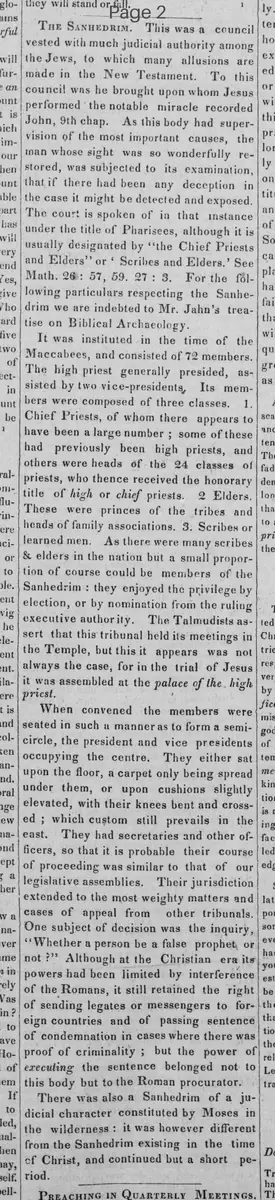
The Sanhedrim. This was a council vested with much judicial authority among the Jews, to which many allusions are made in the New Testament. To this council was he brought upon whom Jesus performed the notable miracle recorded John, 9th chap. As this body had supervision of the most important causes, the man whose sight was so wonderfully restored, was subjected to its examination, that if there had been any deception in the case it might be detected and exposed. The court is spoken of in that instance under the title of Pharisees, although it is usually designated by "the Chief Priests and Elders" or 'Scribes and Elders.' See Math. 26:57. 59. 27:3. For the following particulars respecting the Sanhedrim we are indebted to Mr. Jahn's treatise on Biblical Archaeology.
It was instituted in the time of the Maccabees, and consisted of 72 members. The high priest generally presided, assisted by two vice-presidents. Its members were composed of three classes. 1. Chief Priests, of whom there appears to have been a large number; some of these had previously been high priests, and others were heads of the 24 classes of priests, who thence received the honorary title of high or chief priests. 2 Elders. These were princes of the tribes and heads of family associations. 3. Scribes or learned men. As there were many scribes & elders in the nation but a small proportion of course could be members of the Sanhedrim: they enjoyed the privilege by election, or by nomination from the ruling executive authority. The Talmudists assert that this tribunal held its meetings in the Temple, but this it appears was not always the case, for in the trial of Jesus it was assembled at the palace of the high priest.
When convened the members were seated in such a manner as to form a semi-circle, the president and vice presidents occupying the centre. They either sat upon the floor, a carpet only being spread under them, or upon cushions slightly elevated, with their knees bent and crossed; which custom still prevails in the east. They had secretaries and other officers, so that it is probable their course of proceeding was similar to that of our legislative assemblies. Their jurisdiction extended to the most weighty matters and cases of appeal from other tribunals.
One subject of decision was the inquiry, "Whether a person be a false prophet or not?" Although at the Christian era its powers had been limited by interference of the Romans, it still retained the right of sending legates or messengers to foreign countries and of passing sentence of condemnation in cases where there was proof of criminality; but the power of executing the sentence belonged not to this body but to the Roman procurator.
There was also a Sanhedrim of a judicial character constituted by Moses in the wilderness: it was however different from the Sanhedrim existing in the time of Christ, and continued but a short period.
It was instituted in the time of the Maccabees, and consisted of 72 members. The high priest generally presided, assisted by two vice-presidents. Its members were composed of three classes. 1. Chief Priests, of whom there appears to have been a large number; some of these had previously been high priests, and others were heads of the 24 classes of priests, who thence received the honorary title of high or chief priests. 2 Elders. These were princes of the tribes and heads of family associations. 3. Scribes or learned men. As there were many scribes & elders in the nation but a small proportion of course could be members of the Sanhedrim: they enjoyed the privilege by election, or by nomination from the ruling executive authority. The Talmudists assert that this tribunal held its meetings in the Temple, but this it appears was not always the case, for in the trial of Jesus it was assembled at the palace of the high priest.
When convened the members were seated in such a manner as to form a semi-circle, the president and vice presidents occupying the centre. They either sat upon the floor, a carpet only being spread under them, or upon cushions slightly elevated, with their knees bent and crossed; which custom still prevails in the east. They had secretaries and other officers, so that it is probable their course of proceeding was similar to that of our legislative assemblies. Their jurisdiction extended to the most weighty matters and cases of appeal from other tribunals.
One subject of decision was the inquiry, "Whether a person be a false prophet or not?" Although at the Christian era its powers had been limited by interference of the Romans, it still retained the right of sending legates or messengers to foreign countries and of passing sentence of condemnation in cases where there was proof of criminality; but the power of executing the sentence belonged not to this body but to the Roman procurator.
There was also a Sanhedrim of a judicial character constituted by Moses in the wilderness: it was however different from the Sanhedrim existing in the time of Christ, and continued but a short period.
What sub-type of article is it?
Historical Event
What themes does it cover?
Justice
What keywords are associated?
Sanhedrim
Jewish Council
Biblical Archaeology
Chief Priests
Elders
Scribes
Maccabees
Roman Interference
What entities or persons were involved?
Jesus
Moses
Where did it happen?
Temple, Palace Of The High Priest, Wilderness
Story Details
Key Persons
Jesus
Moses
Location
Temple, Palace Of The High Priest, Wilderness
Event Date
Time Of The Maccabees, Christian Era, Time Of Moses
Story Details
Description of the Sanhedrim as a 72-member Jewish council with judicial authority, its composition, meetings, jurisdiction, biblical references including the miracle in John 9 and Jesus' trial, and distinction from Moses' earlier council.