Thank you for visiting SNEWPapers!
Sign up free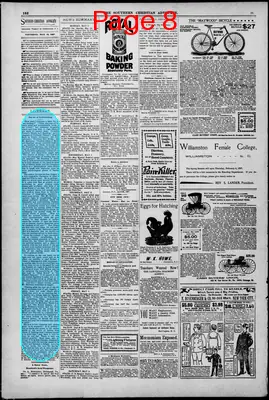
Literary
May 13, 1897
Southern Christian Advocate
Charleston, Charleston County, South Carolina
What is this article about?
An essay reviewing works on reading, praising Frederic Harrison's 'The Choice of Books' for its guidance on cultivating taste for classics over ephemeral literature. It urges persistent reading of great authors like Homer, Shakespeare, and Milton to develop intellectual appreciation, quoting Harrison on testing literary taste.
Clipping

OCR Quality
95%
Excellent
Full Text
LITERARY
The Art of Good Reading.
"How shall I cultivate a taste for the best reading?" "What are some of the really great and indispensable books of the world?" are questions frequently asked, and from time to time attempts are made to answer them. President Porter's "Books and Reading," several chapters of Professor Phelps's "English Style in Public Discourse," Sir John Lubbock's "Hundred Best Books," and Mr. Matthews' "Professorships of Books and Reading" are all excellent treatises.
I am inclined to think, however, that Mr. Frederic Harrison, the well-known English positivist philosopher, has given us, in his little eighteenmo volume of one hundred and sixty-three pages upon "The Choice of Books," the best work upon the principles of reading that has yet appeared. Mr. Harrison is widely read in both ancient and modern authors, he is fully abreast of the times in methods of literary study, and his recognized ability as a philosophical critic entitles him to speak with authority upon the more psychological phases of literary taste.
The author devotes his first chapter to a very suggestive discussion of what to read and how to read. He is, perhaps, a little too severe upon current literature. It is quite true that at present we are producing no great poetical master pieces, and, probably, very little of the prose fiction of our time will find readers a century hence, yet enough creditable work is being done in both these branches of imaginative literature to merit some notice. But Mr. Harrison is entirely right in complaining that the almost exclusive attention which this illimitable and ever-swelling literature of the hour, all of it ephemeral and much of it wretchedly trivial and trashy, receives from the reading public is vitiating our taste, debilitating our minds, and weakening our mental relish for the eternal works of genius. "Who now reads the ancient writers?" he asks, "who systematically reads the great writers, be they ancient or modern, whom the consent of ages has marked out as classics-typical, immortal, peculiar teachers of our race?" Few, indeed, are they who read them, we may safely say, in answer to Mr. Harrison's queries.
Nor is it desirable that we should confine our reading entirely to those authors "whom the consent of ages has marked out as classics;" nevertheless, if we covet the highest pleasures of the intellectual life, the fullest development of our spiritual natures, and a close communion with the best minds of the ages in their most exalted moments, it is simply imperative that we spend a fair portion of our reading hours with the world's greatest books.
To confess, on the one hand, our delight over the latest novel, and, on the other, our inability to read Homer or Dante or Shakespeare with enjoyment is to confess that we are in a very bad way. Even when we are in the mood for reading Rossetti we ought to be able to make ourselves at home with Milton and feel for ourselves the superiority of "Paradise Lost" to "Eden Bower" or "The Blessed Damozel." If we cannot do this, our mental digestion is sadly out of order, and it behooves us to purge our intellectual system and to live more cleanly. Just here I cannot forbear quoting Mr. Harrison somewhat at length:
"Putting aside the iced air of the difficult mountain tops of epic, tragedy, or psalm, there are some simple pieces which may serve as an unerring test of a healthy or a vicious taste for imaginative work. If the 'Cid,' the Vita Nuova, the 'Canterbury Tales,' Shakespeare's 'Sonnets,' and 'Lycidas' pall on a man; if he care not for Mallory's 'Morte d'Arthur' and The Faerie Queene;' if he think 'Robinson Crusoe' and the 'Vicar of Wakefield' books for the young; if he thrill not with The Ode to the West Wind' and 'The Ode to a Grecian Urn;' if he have no stomach for 'Christabel' or the 'Lines written on the Wye above Tintern Abbey,' he should fall on his knees and pray for a cleanlier and quieter spirit-"
But how is this "cleanlier and quieter spirit" to be acquired? If at present I find no charm and solace in the master spirits of the world of letters, what course of training must I subject myself to in order that I may have a love for them by and by? There is only one method possible. Read them, and, although it be at first irksome, continue to read them until the exercise ceases to be a labor and becomes a delight. Love for the best books, like love for the best music and the best art, is, with the most of us, not a natural gift, but a faculty to be acquired by persistent effort. Mr. Harrison finely says: "The art of right reading is as long and difficult to learn as the art of right living."-Professor W. C. Kitchin, Ph.D., in N. Y. Advocate.
The Art of Good Reading.
"How shall I cultivate a taste for the best reading?" "What are some of the really great and indispensable books of the world?" are questions frequently asked, and from time to time attempts are made to answer them. President Porter's "Books and Reading," several chapters of Professor Phelps's "English Style in Public Discourse," Sir John Lubbock's "Hundred Best Books," and Mr. Matthews' "Professorships of Books and Reading" are all excellent treatises.
I am inclined to think, however, that Mr. Frederic Harrison, the well-known English positivist philosopher, has given us, in his little eighteenmo volume of one hundred and sixty-three pages upon "The Choice of Books," the best work upon the principles of reading that has yet appeared. Mr. Harrison is widely read in both ancient and modern authors, he is fully abreast of the times in methods of literary study, and his recognized ability as a philosophical critic entitles him to speak with authority upon the more psychological phases of literary taste.
The author devotes his first chapter to a very suggestive discussion of what to read and how to read. He is, perhaps, a little too severe upon current literature. It is quite true that at present we are producing no great poetical master pieces, and, probably, very little of the prose fiction of our time will find readers a century hence, yet enough creditable work is being done in both these branches of imaginative literature to merit some notice. But Mr. Harrison is entirely right in complaining that the almost exclusive attention which this illimitable and ever-swelling literature of the hour, all of it ephemeral and much of it wretchedly trivial and trashy, receives from the reading public is vitiating our taste, debilitating our minds, and weakening our mental relish for the eternal works of genius. "Who now reads the ancient writers?" he asks, "who systematically reads the great writers, be they ancient or modern, whom the consent of ages has marked out as classics-typical, immortal, peculiar teachers of our race?" Few, indeed, are they who read them, we may safely say, in answer to Mr. Harrison's queries.
Nor is it desirable that we should confine our reading entirely to those authors "whom the consent of ages has marked out as classics;" nevertheless, if we covet the highest pleasures of the intellectual life, the fullest development of our spiritual natures, and a close communion with the best minds of the ages in their most exalted moments, it is simply imperative that we spend a fair portion of our reading hours with the world's greatest books.
To confess, on the one hand, our delight over the latest novel, and, on the other, our inability to read Homer or Dante or Shakespeare with enjoyment is to confess that we are in a very bad way. Even when we are in the mood for reading Rossetti we ought to be able to make ourselves at home with Milton and feel for ourselves the superiority of "Paradise Lost" to "Eden Bower" or "The Blessed Damozel." If we cannot do this, our mental digestion is sadly out of order, and it behooves us to purge our intellectual system and to live more cleanly. Just here I cannot forbear quoting Mr. Harrison somewhat at length:
"Putting aside the iced air of the difficult mountain tops of epic, tragedy, or psalm, there are some simple pieces which may serve as an unerring test of a healthy or a vicious taste for imaginative work. If the 'Cid,' the Vita Nuova, the 'Canterbury Tales,' Shakespeare's 'Sonnets,' and 'Lycidas' pall on a man; if he care not for Mallory's 'Morte d'Arthur' and The Faerie Queene;' if he think 'Robinson Crusoe' and the 'Vicar of Wakefield' books for the young; if he thrill not with The Ode to the West Wind' and 'The Ode to a Grecian Urn;' if he have no stomach for 'Christabel' or the 'Lines written on the Wye above Tintern Abbey,' he should fall on his knees and pray for a cleanlier and quieter spirit-"
But how is this "cleanlier and quieter spirit" to be acquired? If at present I find no charm and solace in the master spirits of the world of letters, what course of training must I subject myself to in order that I may have a love for them by and by? There is only one method possible. Read them, and, although it be at first irksome, continue to read them until the exercise ceases to be a labor and becomes a delight. Love for the best books, like love for the best music and the best art, is, with the most of us, not a natural gift, but a faculty to be acquired by persistent effort. Mr. Harrison finely says: "The art of right reading is as long and difficult to learn as the art of right living."-Professor W. C. Kitchin, Ph.D., in N. Y. Advocate.
What sub-type of article is it?
Essay
What themes does it cover?
Moral Virtue
What keywords are associated?
Good Reading
Classics
Literary Taste
Frederic Harrison
Choice Of Books
Intellectual Development
Ephemeral Literature
What entities or persons were involved?
Professor W. C. Kitchin, Ph.D., In N. Y. Advocate.
Literary Details
Title
The Art Of Good Reading.
Author
Professor W. C. Kitchin, Ph.D., In N. Y. Advocate.
Subject
Cultivating Taste For The Best Reading And Indispensable Books.
Key Lines
"How Shall I Cultivate A Taste For The Best Reading?" "What Are Some Of The Really Great And Indispensable Books Of The World?" Are Questions Frequently Asked, And From Time To Time Attempts Are Made To Answer Them.
"Who Now Reads The Ancient Writers?" He Asks, "Who Systematically Reads The Great Writers, Be They Ancient Or Modern, Whom The Consent Of Ages Has Marked Out As Classics Typical, Immortal, Peculiar Teachers Of Our Race?"
"Putting Aside The Iced Air Of The Difficult Mountain Tops Of Epic, Tragedy, Or Psalm, There Are Some Simple Pieces Which May Serve As An Unerring Test Of A Healthy Or A Vicious Taste For Imaginative Work. If The 'Cid,' The Vita Nuova, The 'Canterbury Tales,' Shakespeare's 'Sonnets,' And 'Lycidas' Pall On A Man; If He Care Not For Mallory's 'Morte D'arthur' And The Faerie Queene;' If He Think 'Robinson Crusoe' And The 'Vicar Of Wakefield' Books For The Young; If He Thrill Not With The Ode To The West Wind' And 'The Ode To A Grecian Urn;' If He Have No Stomach For 'Christabel' Or The 'Lines Written On The Wye Above Tintern Abbey,' He Should Fall On His Knees And Pray For A Cleanlier And Quieter Spirit "
"The Art Of Right Reading Is As Long And Difficult To Learn As The Art Of Right Living."