Thank you for visiting SNEWPapers!
Sign up free
Literary
January 4, 1822
The Rhode Island American, And General Advertiser
Providence, Providence County, Rhode Island
What is this article about?
This essay critiques passive approaches to religion, emphasizing the need for active faith, gradual piety, and combining prayer with moral action, drawing on Christian principles to advocate practical virtue over mere doctrine or enthusiasm.
Clipping
OCR Quality
95%
Excellent
Full Text
[SELECTED FOR THE AMERICAN.]
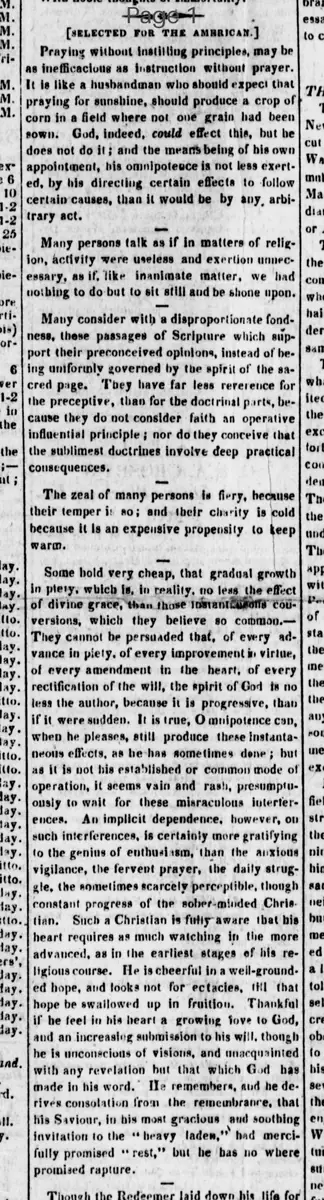
Praying without instilling principles, may be
as inefficacious as instruction without prayer.
It is like a husbandman who should expect that
praying for sunshine, should produce a crop of
corn in a field where not one grain had been
sown. God, indeed, could effect this, but he
does not do it; and the means being of his own
appointment, his omnipotence is not less exerted,
by his directing certain effects to follow
certain causes, than it would be by any, arbitrary act.
Many persons talk as if in matters of religion,
activity were useless and exertion unnecessary,
as if, like inanimate matter, we had
nothing to do but to sit still and be shone upon.
Many consider with a disproportionate fondness,
those passages of Scripture which support
their preconceived opinions, instead of being
uniformly governed by the spirit of the sacred page.
They have far less reverence for
the preceptive, than for the doctrinal parts, because
they do not consider faith an operative
influential principle; nor do they conceive that
the sublimest doctrines involve deep practical
consequences.
The zeal of many persons is fiery, because
their temper is so; and their charity is cold
because it is an expensive propensity to keep
warm.
Some hold very cheap, that gradual growth
in piety, which is, in reality, no less the effect
of divine grace, than those instantaneous conversions,
which they believe so common.
They cannot be persuaded that, of every advance
in piety, of every improvement in virtue,
of every amendment in the heart, of every
rectification of the will, the spirit of God is no
less the author, because it is progressive, than
if it were sudden. It is true, Omnipotence can,
when he pleases, still produce these instantaneous
effects, as he has sometimes done; but
as it is not his established or common mode of
operation, it seems vain and rash, presumptuously
to wait for these miraculous interferences.
An implicit dependence, however, on
such interferences, is certainly more gratifying
to the genius of enthusiasm, than the anxious
vigilance, the fervent prayer, the daily struggle,
the sometimes scarcely perceptible, though
constant progress of the sober-minded Christian.
Such a Christian is fully aware that his
heart requires as much watching in the more
advanced, as in the earliest stages of his religious
course. He is cheerful in a well-grounded
hope, and looks not for ecstasies, till that
hope be swallowed up in fruition. Thankful
if he feel in his heart a growing love to God,
and an increasing submission to his will, though
he is unconscious of visions, and unacquainted
with any revelation but that which God has
made in his word. He remembers, and he derives
consolation from the remembrance, that
his Saviour, in his most gracious and soothing
invitation to the "heavy laden," had mercifully
promised "rest," but he has nowhere
promised rapture.
Though the Redeemer laid down his life for
all people, nations, and languages, some will
only lay down their money for a very limited
number of a very limited class. To be religious
is not claim sufficient on their bounty;
they must be religious in a particular way.
People are apt to bring themselves to believe
that their sympathy with the suffering is
an atonement for their not relieving it. They
endeavour to pacify their consciences by their
regrets.
The time which is redeemed from what is
wrong is of little value, if not dedicated to
what is right; and it is not enough that the
doctrines of the Gospel furnish a subject for
discussion, if they do not furnish a principle of
action.
Praying without instilling principles, may be
as inefficacious as instruction without prayer.
It is like a husbandman who should expect that
praying for sunshine, should produce a crop of
corn in a field where not one grain had been
sown. God, indeed, could effect this, but he
does not do it; and the means being of his own
appointment, his omnipotence is not less exerted,
by his directing certain effects to follow
certain causes, than it would be by any, arbitrary act.
Many persons talk as if in matters of religion,
activity were useless and exertion unnecessary,
as if, like inanimate matter, we had
nothing to do but to sit still and be shone upon.
Many consider with a disproportionate fondness,
those passages of Scripture which support
their preconceived opinions, instead of being
uniformly governed by the spirit of the sacred page.
They have far less reverence for
the preceptive, than for the doctrinal parts, because
they do not consider faith an operative
influential principle; nor do they conceive that
the sublimest doctrines involve deep practical
consequences.
The zeal of many persons is fiery, because
their temper is so; and their charity is cold
because it is an expensive propensity to keep
warm.
Some hold very cheap, that gradual growth
in piety, which is, in reality, no less the effect
of divine grace, than those instantaneous conversions,
which they believe so common.
They cannot be persuaded that, of every advance
in piety, of every improvement in virtue,
of every amendment in the heart, of every
rectification of the will, the spirit of God is no
less the author, because it is progressive, than
if it were sudden. It is true, Omnipotence can,
when he pleases, still produce these instantaneous
effects, as he has sometimes done; but
as it is not his established or common mode of
operation, it seems vain and rash, presumptuously
to wait for these miraculous interferences.
An implicit dependence, however, on
such interferences, is certainly more gratifying
to the genius of enthusiasm, than the anxious
vigilance, the fervent prayer, the daily struggle,
the sometimes scarcely perceptible, though
constant progress of the sober-minded Christian.
Such a Christian is fully aware that his
heart requires as much watching in the more
advanced, as in the earliest stages of his religious
course. He is cheerful in a well-grounded
hope, and looks not for ecstasies, till that
hope be swallowed up in fruition. Thankful
if he feel in his heart a growing love to God,
and an increasing submission to his will, though
he is unconscious of visions, and unacquainted
with any revelation but that which God has
made in his word. He remembers, and he derives
consolation from the remembrance, that
his Saviour, in his most gracious and soothing
invitation to the "heavy laden," had mercifully
promised "rest," but he has nowhere
promised rapture.
Though the Redeemer laid down his life for
all people, nations, and languages, some will
only lay down their money for a very limited
number of a very limited class. To be religious
is not claim sufficient on their bounty;
they must be religious in a particular way.
People are apt to bring themselves to believe
that their sympathy with the suffering is
an atonement for their not relieving it. They
endeavour to pacify their consciences by their
regrets.
The time which is redeemed from what is
wrong is of little value, if not dedicated to
what is right; and it is not enough that the
doctrines of the Gospel furnish a subject for
discussion, if they do not furnish a principle of
action.
What sub-type of article is it?
Essay
What themes does it cover?
Religious
Moral Virtue
What keywords are associated?
Religious Reflection
Christian Piety
Faith And Action
Gradual Growth
Moral Instruction
Literary Details
Form / Style
Prose Reflection On Christian Practice
Key Lines
Praying Without Instilling Principles, May Be As Inefficacious As Instruction Without Prayer.
Many Persons Talk As If In Matters Of Religion, Activity Were Useless And Exertion Unnecessary, As If, Like Inanimate Matter, We Had Nothing To Do But To Sit Still And Be Shone Upon.
The Zeal Of Many Persons Is Fiery, Because Their Temper Is So; And Their Charity Is Cold Because It Is An Expensive Propensity To Keep Warm.
Such A Christian Is Fully Aware That His Heart Requires As Much Watching In The More Advanced, As In The Earliest Stages Of His Religious Course.
The Time Which Is Redeemed From What Is Wrong Is Of Little Value, If Not Dedicated To What Is Right; And It Is Not Enough That The Doctrines Of The Gospel Furnish A Subject For Discussion, If They Do Not Furnish A Principle Of Action.