Thank you for visiting SNEWPapers!
Sign up free
Martinsburgh Gazette
Martinsburg, Berkeley County, West Virginia
What is this article about?
In 1746 near Edinburgh, Rev. Mr. Moncrief is robbed by desperate linen draper Saunders Maitland. The minister counsels him mercifully. Maitland reforms, sails to India, prospers through honest work, and after 12 years returns to restore the stolen stipend with interest, fulfilling the minister's prayers.
Clipping
OCR Quality
Full Text
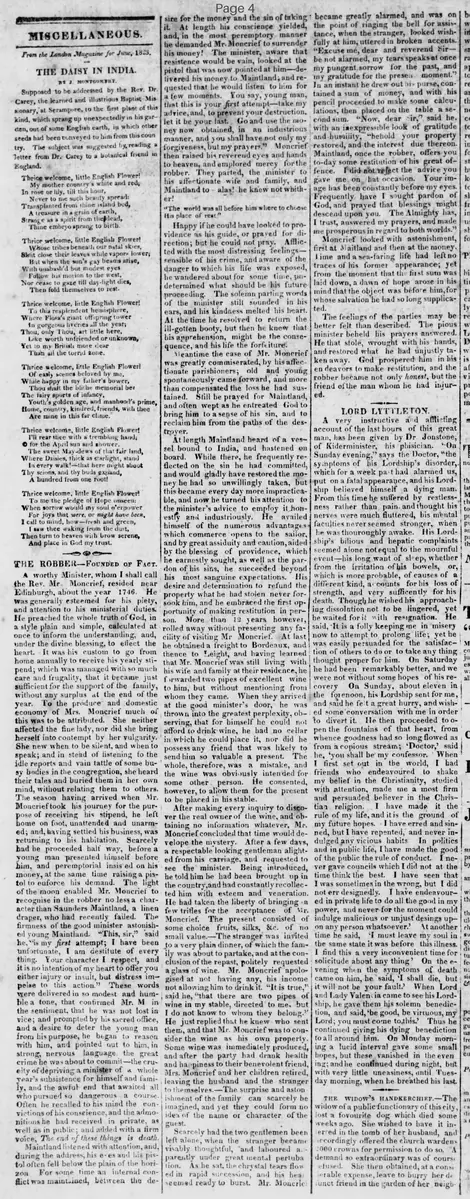
A worthy Minister, whom I shall call the Rev. Mr. Moncrief, resided near Edinburgh, about the year 1746. He was generally esteemed for his piety, and attention to his ministerial duties. He preached the whole truth of God, in a style plain and simple, calculated at once to inform the understanding, and, under the divine blessing, to affect the heart. It was his custom to go from home annually to receive his yearly stipend; which was managed with so much care and frugality, that it became just sufficient for the support of the family, without any surplus at the end of the year. To the produce and domestic economy of Mrs. Moncrief much of this was to be attributed. She neither affected the fine lady, nor did she bring herself into contempt by her vulgarity. She knew when to be silent, and when to speak; and instead of listening to the idle reports and vain tattle of some busy bodies in the congregation, she heard their tales and buried them in her own mind, without relating them to others.
The season having arrived when Mr. Moncrief took his journey for the purpose of receiving his stipend, he left home on foot, unattended and unarmed; and, having settled his business, was returning to his habitation. Scarcely had he proceeded half way, before a young man presented himself before him, and peremptorily insisted on his money, at the same time raising a pistol to enforce his demand. The light of the moon enabled Mr. Moncrief to recognise in the robber no less a character than Saunders Maitland, a linen draper, who had recently failed. The firmness of the good minister astonished young Maitland. "This, sir," said he, "is my first attempt; I have been unfortunate, I am destitute of everything. Your character I respect, and it is no intention of my heart to offer you either injury or insult, but distress impels me to this action." These words were delivered in so modest and humble a tone, that confirmed Mr. M. in the sentiment, that he was not lost in vice; and prompted by his sacred office, and a desire to deter the young man from his purpose, he began to reason with him, and pointed out to him, in strong, nervous language, the great crime he was about to commit—the cruelty of depriving a minister of a whole year's subsistence for himself and family, and the awful end that awaited all who pursued so dangerous a course. Often he recalled to his mind the convictions of his conscience, and the admonitions he had received in private, as well as in public; and added, with a firm voice, "The end of these things is death."
Maitland listened with attention, and, during the address, his eyes and his pistol often fell below the plane of the horizon. For some time an internal conflict was maintained, between the desire for the money and the sin of taking it. At length his conscience yielded, and, in the most peremptory manner he demanded Mr. Moncrief to surrender his money! The minister, aware that resistance would be vain, looked at the pistol that was now pointed at him—delivered his money to Maitland; and requested that he would listen to him for a few moments. "You say, young man, that this is your first attempt—take my advice, and, to prevent your destruction, let it be your last. Go and use the money now obtained, in an industrious manner, and you shall have not only my forgiveness, but my prayers." Moncrief then raised his reverend eyes and hands to heaven, and implored mercy for the robber. They parted, the minister to his affectionate wife and family, and Maitland to—alas! he knew not whither!
"The world was all before him where to choose
His place of rest"
Happy if he could have looked to Providence as his guide, or prayed for direction; but he could not pray. Afflicted with the most distressing feelings—sensible of his crime, and aware of the danger to which his life was exposed, he wandered about for some time, undetermined what should be his future proceeding. The solemn parting words of the minister still sounded in his ears, and his kindness melted his heart. At the time he resolved to return the ill-gotten booty, but then he knew that his apprehension might be the consequence, and his life the forfeit.
Meantime the case of Mr. Moncrief was greatly commiserated, by his affectionate parishioners; old and young spontaneously came forward, and more than compensated the loss he had sustained. Still he prayed for Maitland, and often wept as he entreated God to bring him to a sense of his sin, and to reclaim him from the paths of the destroyer.
At length Maitland heard of a vessel bound to India; and hastened on board. While there, he frequently reflected on the sin he had committed, and would gladly have restored the money he had so unwillingly taken, but this became every day more impracticable, and now he turned his attention to the minister's advice to employ it honestly and industriously. He availed himself of the numerous advantages which commerce opens to the sailor, and by great assiduity and caution, aided by the blessing of Providence, which he earnestly sought, as well as the pardon of his sins, he succeeded beyond his most sanguine expectations. His desire and determination to refund the property he had stolen never forsook him, and he embraced the first opportunity of making restitution in person. More than 12 years however, rolled away without presenting any facility of visiting Mr. Moncrief. At last he obtained a freight to Bordeaux, and thence to Leith, and having learned that Mr. Moncrief was still living with his wife and family at their residence, he forwarded two pipes of excellent wine to him, but without mentioning from whom they came. When they arrived at the good minister's door, he was thrown into the greatest perplexity, observing, that for himself he could not afford to drink wine, he had no cellar in which he could place it, nor did he possess any friend that was likely to send him so valuable a present. The whole, therefore, was a mistake, and the wine was obviously intended for some other person. He consented, however, to allow them for the present to be placed in his stable.
After making every inquiry to discover the real owner of the wine, and obtaining no information whatever, Mr. Moncrief concluded that time would develop the mystery. After a few days, a respectable looking gentleman alighted from his carriage, and requested to see the minister. Being introduced, he told him he had been brought up in the country, and had constantly recollected him with esteem and veneration. He had taken the liberty of bringing a few trifles for the acceptance of Mr. Moncrief. The present consisted of some choice fruits, silks, &c. of no small value. The stranger was invited to a very plain dinner, of which the family was about to partake, and at the conclusion of the repast, politely requested a glass of wine. Mr. Moncrief apologised at not having any, his income not allowing him to drink it. "It is true," said he, "that there are two pipes of wine in my stable, directed to me, but I do not know to whom they belong." He just replied that he knew who sent them, and that Mr. Moncrief was to consider the wine as his own property. Some wine was immediately produced, and after the party had drank health and happiness to their benevolent friend, Mrs. Moncrief and her children retired, leaving the husband and the stranger to themselves. The surprise and astonishment of the family can scarcely be imagined, and yet they could form no idea of the name or character of the guest.
Scarcely had the two gentlemen been left alone, when the stranger became visibly thoughtful, and laboured apparently under great mental perturbation. As he sat, the crystal tears flowed in rapid succession, and his heart seemed ready to burst. Mr. Moncrief was on the point of ringing the bell for assistance, when the stranger, looking wishfully at him, uttered in broken accents, "Excuse me, dear and reverend Sir—be not alarmed, my tears speak at once my pungent sorrow for the past, and my gratitude for the present moment." In an instant he drew out his purse, containing a sum of money, and with his pencil proceeded to make some calculations, then placed on the table a second sum. "Now, dear sir," said he, with an inexpressible look of gratitude and humility, "behold your property restored, and the interest due thereon. Maitland, once the robber, offers you to-day some restitution of his great offence. I did not reject the advice you gave me on that occasion. Your image has been constantly before my eyes. Frequently have I sought pardon of God, and prayed that blessings might descend upon you. The Almighty has, I trust, answered my prayers, and made me prosperous in regard to both worlds."
Moncrief looked with astonishment, first at Maitland and then at the money. Time and a sea-faring life had left no traces of his former appearance; yet from the moment that the first sum was laid down, a dawn of hope arose in his mind that the object was before him, for whose salvation he had so long supplicated. The feelings of the parties may be better felt than described. The pious minister beheld his prayers answered. He that stole, wrought with his hands, and restored what he had unjustly taken away. God prospered him in his endeavors to make restitution, and the robber became not only honest, but the friend of the man whom he had injured.
What sub-type of article is it?
What themes does it cover?
What keywords are associated?
What entities or persons were involved?
Where did it happen?
Story Details
Key Persons
Location
Near Edinburgh
Event Date
About The Year 1746
Story Details
Rev. Moncrief is robbed by desperate Saunders Maitland while returning with his stipend. Moncrief counsels him on sin and offers prayers. Parishioners compensate the loss. Maitland sails to India, prospers honestly, and after over 12 years returns anonymously with gifts, then reveals himself and restores the money with interest.