Thank you for visiting SNEWPapers!
Sign up free
The Greenville Times
Greenville, Washington County, Mississippi
What is this article about?
A New York Sun correspondent speculates on how a European war might affect American agriculture, focusing on unprofitable cotton production in the South versus profitable Northern and Western crops like wheat and corn. Southern planters face distress and debt, while Northern farmers benefit from higher grain prices.
Clipping
OCR Quality
Full Text
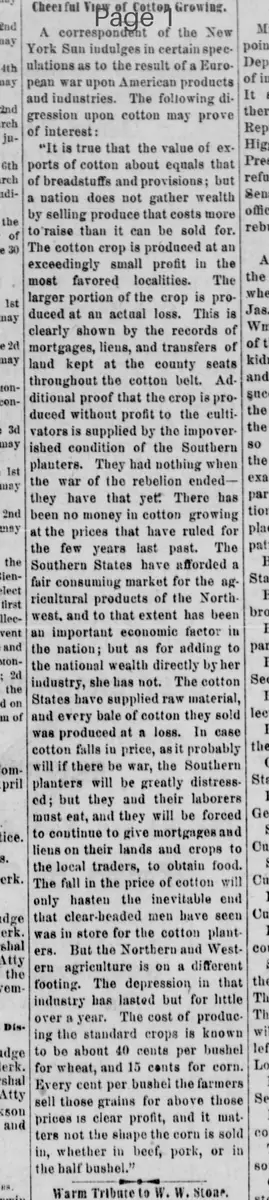
"It is true that the value of exports of cotton about equals that of breadstuffs and provisions; but a nation does not gather wealth by selling produce that costs more to raise than it can be sold for. The cotton crop is produced at an exceedingly small profit in the most favored localities. The larger portion of the crop is produced at an actual loss. This is clearly shown by the records of mortgages, liens, and transfers of land kept at the county seats throughout the cotton belt. Additional proof that the crop is produced without profit to the cultivators is supplied by the impoverished condition of the Southern planters. They had nothing when the war of the rebellion ended—they have that yet. There has been no money in cotton growing at the prices that have ruled for the few years last past. The Southern States have afforded a fair consuming market for the agricultural products of the Northwest, and to that extent has been an important economic factor in the nation; but as for adding to the national wealth directly by her industry, she has not. The cotton States have supplied raw material, and every bale of cotton they sold was produced at a loss. In case cotton falls in price, as it probably will if there be war, the Southern planters will be greatly distressed; but they and their laborers must eat, and they will be forced to continue to give mortgages and liens on their lands and crops to the local traders, to obtain food. The fall in the price of cotton will only hasten the inevitable end that clear-headed men have seen was in store for the cotton planters.
But the Northern and Western agriculture is on a different footing. The depression in that industry has lasted but for little over a year. The cost of producing the standard crops is known to be about 40 cents per bushel for wheat, and 15 cents for corn. Every cent per bushel the farmers sell those grains for above those prices is clear profit, and it matters not the shape the corn is sold in, whether in beef, pork, or in the half bushel."
What sub-type of article is it?
What themes does it cover?
What keywords are associated?
Where did it happen?
Story Details
Location
Southern States, Cotton Belt; Northern And Western United States
Event Date
Few Years Last Past, Post War Of The Rebellion
Story Details
Speculation on European war's impact: Cotton production in South is unprofitable, leading to debt and distress if prices fall; contrasts with profitable Northern/Western grain farming where sales above production costs yield profit.