Thank you for visiting SNEWPapers!
Sign up free
Daily National Intelligencer
Washington, District Of Columbia
What is this article about?
Paris reports confirm political motives in the assassination of Duke de Berri by Louvel, with broader royal plots revealed. King vows protection; chambers react with addresses, rejected impeachment proposal, and trial ordonnance.
Merged-components note: Continuation of the article on events in France across columns.
Clipping
OCR Quality
Full Text
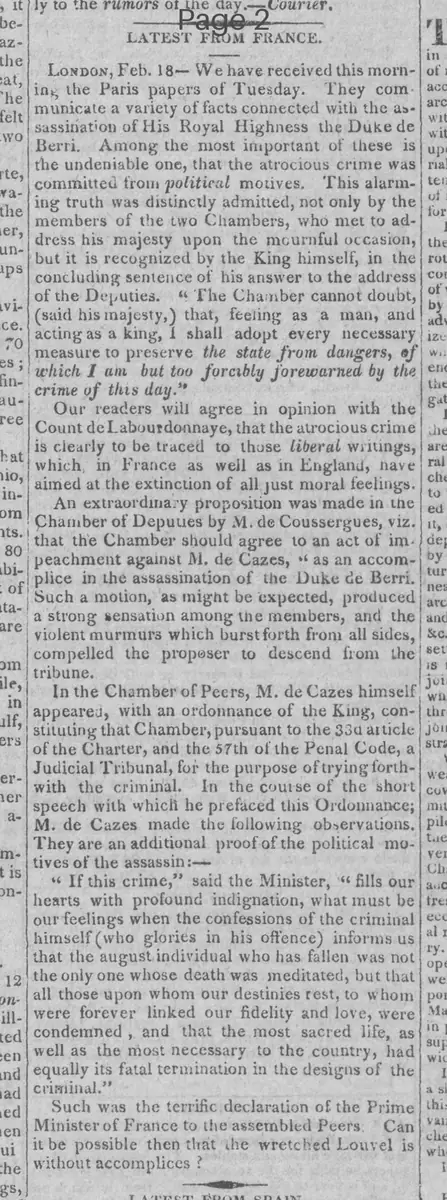
London, Feb. 18— We have received this morning the Paris papers of Tuesday. They communicate a variety of facts connected with the assassination of His Royal Highness the Duke de Berri. Among the most important of these is the undeniable one, that the atrocious crime was committed from political motives. This alarming truth was distinctly admitted, not only by the members of the two Chambers, who met to address his majesty upon the mournful occasion, but it is recognized by the King himself, in the concluding sentence of his answer to the address of the Deputies. " The Chamber cannot doubt, (said his majesty,) that, feeling as a man, and acting as a king, I shall adopt every necessary measure to preserve the state from dangers, of which I am but too forcibly forewarned by the crime of this day."
Our readers will agree in opinion with the Count de Labourdonnaye, that the atrocious crime is clearly to be traced to those liberal writings, which, in France as well as in England, have aimed at the extinction of all just moral feelings.
An extraordinary proposition was made in the Chamber of Deputies by M. de Coussergues, viz. that the Chamber should agree to an act of impeachment against M. de Cazes, "as an accomplice in the assassination of the Duke de Berri." Such a motion, as might be expected, produced a strong sensation among the members, and the violent murmurs which burst forth from all sides, compelled the proposer to descend from the tribune.
In the Chamber of Peers, M. de Cazes himself appeared, with an ordonnance of the King, constituting that Chamber, pursuant to the 33d article of the Charter, and the 57th of the Penal Code, a Judicial Tribunal, for the purpose of trying forthwith the criminal. In the course of the short speech with which he prefaced this Ordonnance; M. de Cazes made the following observations. They are an additional proof of the political motives of the assassin:--
" If this crime," said the Minister, " fills our hearts with profound indignation, what must be our feelings when the confessions of the criminal himself (who glories in his offence) informs us that the august individual who has fallen was not the only one whose death was meditated, but that all those upon whom our destinies rest, to whom were forever linked our fidelity and love, were condemned, and that the most sacred life, as well as the most necessary to the country, had equally its fatal termination in the designs of the criminal."
Such was the terrific declaration of the Prime Minister of France to the assembled Peers Can it be possible then that the wretched Louvel is without accomplices
What sub-type of article is it?
What keywords are associated?
What entities or persons were involved?
Where did it happen?
Foreign News Details
Primary Location
Paris
Event Date
Tuesday
Key Persons
Outcome
assassination of the duke de berri; political motives confirmed; broader plots against royals revealed; proposal to impeach m. de cazes rejected
Event Details
The Duke de Berri was assassinated by Louvel for political motives, as admitted in addresses to the King and speeches in the Chambers. The King vowed to protect the state. Liberal writings blamed. M. de Coussergues proposed impeaching M. de Cazes as accomplice, causing uproar. M. de Cazes presented ordonnance to try the criminal in the Chamber of Peers, revealing plots against multiple royals.