Thank you for visiting SNEWPapers!
Sign up free
Letter to Editor
July 12, 1832
Lynchburg Virginian
Lynchburg, Virginia
What is this article about?
A letter responding to a toast accusing nullification advocates of treason at a public dinner, defending the doctrine as aligned with states' rights under the Constitution and supported by figures like Jefferson and Madison. Signed Hamilton.
Clipping
OCR Quality
70%
Good
Full Text
COMMUNICATIONS.
"Nullification is treason, and he who advocates it is a traitor to his country's dearest rights"
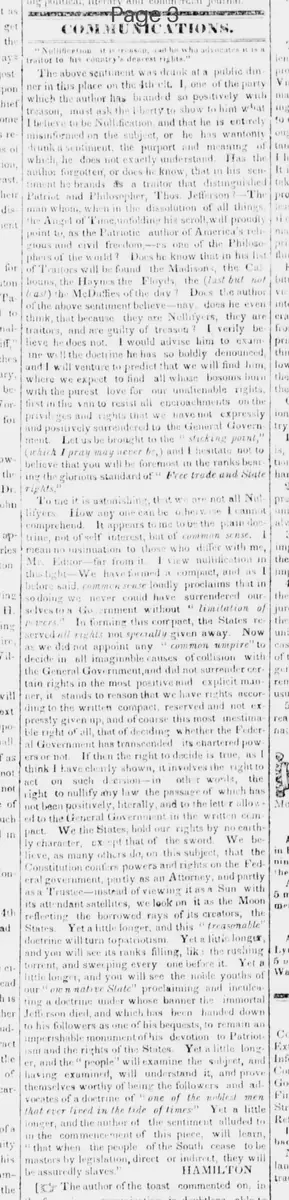
The above sentiment was drunk at a public dinner in this place on the 4th ult. I, one of the party which the author has branded so positively with treason, must ask the author to show to him what I believe to be Nullification and that he is entirely misinformed on the subject, or he has wantonly funk a sentiment, the purport and meaning of which, he does not exactly understand. Has the author forgotten, or does he know, that in his sentiment he brands as a traitor that distinguished Patriot and Philosopher, Thomas Jefferson? That man whom, when in the dissolution of all things the Angel of Time unfolding his scroll, will proudly point to, as the patriotic author of America's religious and civil freedom -- one of the Philosophers of the world? Does he know that in his list of Traitors will be found the Madison, the Calhouns, the Haynes, the Floyds, the (list but not last) the McDuffies of the day? Does the author of the above sentiment believe -- nay, does he even think, that because they are Nullifiers, they are traitors, and are guilty of treason? I verily believe he does not. I would advise him to examine well the doctrine he has so boldly denounced and I will venture to predict that he will find it, where we expect to find all whose bosoms burn with the purest love for our unalienable rights. First in the van to resist all encroachments on the privileges and rights that we have not expressly and positively surrendered to the General Government. Let us be brought to the sticking point," (which I pray may never be,) and I hesitate not to believe that you will be foremost in the ranks bearing the glorious standard of "Free trade and State rights!" To me it is astonishing that we are not all Nullifiers. How any one can be otherwise I cannot comprehend. It appears to me to be the plain dictate, not of self interest, but of common sense. I mean no insinuation to those who differ with me. Far from it. I view nullification in this light: We have formed a compact, and as I before said common sense loudly proclaims that in so doing we never could have surrendered ourselves to a government without "limitation of powers." In forming this compact, the States reserved all rights not specially given away. Now as we did not appoint any "common umpire" to decide in all imaginable causes of collision with the General Government, and did not surrender certain rights in the most positive and explicit manner, it stands to reason that we have rights according to the written compact, reserved and not expressly given up, and of course this most inestimable right of all, that of deciding whether the Federal Government has transcended its chartered powers or not. If then the right to decide is true, as I think I have clearly shown, it involves the right to act on such decision -- in other words, the right to nullify any law the passage of which has not been positively, literally, and to the letter allowed to the General Government in the written compact. We the States, hold our rights by no earthly charter, except that of the sword. We believe, as many others do, on this subject, that the Constitution confers powers and rights on the Federal government, partly as an Attorney, and partly as a Trustee -- instead of viewing it as a Sun with its attendant satellites, we look on it as the Moon reflecting the borrowed rays of its creators, the States. Yet a little longer, and this "treasonable doctrine" will turn to patriotism. Yet a little longer, and you will see its ranks filling, like the rushing torrent, and sweeping every one before it. Yet a little longer, and you will see the noble youths of our "own native State" proclaiming and inculcating a doctrine under whose banner the immortal Jefferson died, and which has been handed down to his followers as one of his bequests, to remain an imperishable monument of his devotion to Patriotism and the rights of the States. Yet a little longer, and the "people" will examine the subject, and having examined, will understand it, and prove themselves worthy of being the followers and advocates of a doctrine of "one of the noblest men that ever lived in the tide of times." Yet a little longer, and the author of the sentiment alluded to in the commencement of this piece, will learn, that when the people of the South cease to be masters by legislation, direct or indirect, they will be assuredly slaves.
HAMILTON
"Nullification is treason, and he who advocates it is a traitor to his country's dearest rights"
The above sentiment was drunk at a public dinner in this place on the 4th ult. I, one of the party which the author has branded so positively with treason, must ask the author to show to him what I believe to be Nullification and that he is entirely misinformed on the subject, or he has wantonly funk a sentiment, the purport and meaning of which, he does not exactly understand. Has the author forgotten, or does he know, that in his sentiment he brands as a traitor that distinguished Patriot and Philosopher, Thomas Jefferson? That man whom, when in the dissolution of all things the Angel of Time unfolding his scroll, will proudly point to, as the patriotic author of America's religious and civil freedom -- one of the Philosophers of the world? Does he know that in his list of Traitors will be found the Madison, the Calhouns, the Haynes, the Floyds, the (list but not last) the McDuffies of the day? Does the author of the above sentiment believe -- nay, does he even think, that because they are Nullifiers, they are traitors, and are guilty of treason? I verily believe he does not. I would advise him to examine well the doctrine he has so boldly denounced and I will venture to predict that he will find it, where we expect to find all whose bosoms burn with the purest love for our unalienable rights. First in the van to resist all encroachments on the privileges and rights that we have not expressly and positively surrendered to the General Government. Let us be brought to the sticking point," (which I pray may never be,) and I hesitate not to believe that you will be foremost in the ranks bearing the glorious standard of "Free trade and State rights!" To me it is astonishing that we are not all Nullifiers. How any one can be otherwise I cannot comprehend. It appears to me to be the plain dictate, not of self interest, but of common sense. I mean no insinuation to those who differ with me. Far from it. I view nullification in this light: We have formed a compact, and as I before said common sense loudly proclaims that in so doing we never could have surrendered ourselves to a government without "limitation of powers." In forming this compact, the States reserved all rights not specially given away. Now as we did not appoint any "common umpire" to decide in all imaginable causes of collision with the General Government, and did not surrender certain rights in the most positive and explicit manner, it stands to reason that we have rights according to the written compact, reserved and not expressly given up, and of course this most inestimable right of all, that of deciding whether the Federal Government has transcended its chartered powers or not. If then the right to decide is true, as I think I have clearly shown, it involves the right to act on such decision -- in other words, the right to nullify any law the passage of which has not been positively, literally, and to the letter allowed to the General Government in the written compact. We the States, hold our rights by no earthly charter, except that of the sword. We believe, as many others do, on this subject, that the Constitution confers powers and rights on the Federal government, partly as an Attorney, and partly as a Trustee -- instead of viewing it as a Sun with its attendant satellites, we look on it as the Moon reflecting the borrowed rays of its creators, the States. Yet a little longer, and this "treasonable doctrine" will turn to patriotism. Yet a little longer, and you will see its ranks filling, like the rushing torrent, and sweeping every one before it. Yet a little longer, and you will see the noble youths of our "own native State" proclaiming and inculcating a doctrine under whose banner the immortal Jefferson died, and which has been handed down to his followers as one of his bequests, to remain an imperishable monument of his devotion to Patriotism and the rights of the States. Yet a little longer, and the "people" will examine the subject, and having examined, will understand it, and prove themselves worthy of being the followers and advocates of a doctrine of "one of the noblest men that ever lived in the tide of times." Yet a little longer, and the author of the sentiment alluded to in the commencement of this piece, will learn, that when the people of the South cease to be masters by legislation, direct or indirect, they will be assuredly slaves.
HAMILTON
What sub-type of article is it?
Persuasive
Political
Philosophical
What themes does it cover?
Constitutional Rights
Politics
What keywords are associated?
Nullification
States Rights
Thomas Jefferson
Federal Government
Treason
Constitution
Free Trade
What entities or persons were involved?
Hamilton
Letter to Editor Details
Author
Hamilton
Main Argument
the letter defends nullification as a legitimate state's right to resist federal overreach, not treason, arguing that the constitution reserves powers to states and references jefferson, madison, and others as supporters of this doctrine.
Notable Details
Quotes A Toast Branding Nullification Advocates As Traitors From A Public Dinner On The 4th Ult.
References Thomas Jefferson As The Patriot Author Of America's Religious And Civil Freedom.
Mentions Madison, Calhoun, Hayne, Floyd, Mcduffie As Nullifiers.
Emphasizes 'Free Trade And State Rights' As A Glorious Standard.