Thank you for visiting SNEWPapers!
Sign up free
The Daily Green Mountain Freeman
Montpelier, Washington County, Vermont
What is this article about?
Civil War captain's reflective anecdotes from 1862 near Corinth, MS, about soldiers' deep longing for their mothers amid battle hardships, a dying man's final wish, a profane soldier's remorse, and the comforting influence of maternal letters and prayers.
Merged-components note: Dateline provides location and date context for the soldier's letter/story, sequential reading order indicates connection.
Clipping
OCR Quality
Full Text
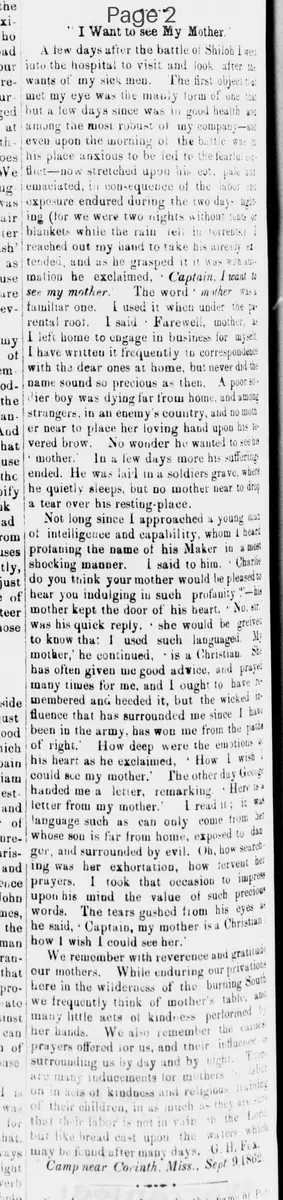
A few days after the battle of Shiloh I sent into the hospital to visit and look after the wants of my sick men. The first object that met my eye was the manly form of one that but a few days since was in good health and among the most robust of my company—one even upon the morning of the battle was in his place anxious to be led to the fearfullest conflict—now stretched upon his cot, pale and emaciated, in consequence of the labor and exposure endured during the two days' fighting (for we were two nights without tents or blankets while the rain fell in torrents). I reached out my hand to take his already extended, and as he grasped it with emotion he exclaimed, "Captain, I want to see my mother." The word mother was a familiar one. I used it when under the parental roof. I said: "Farewell, mother," as I left home to engage in business for myself. I have written it frequently in correspondence with the dear ones at home, but never did the name sound so precious as then. A poor soldier boy was dying far from home, and among strangers, in an enemy's country, and no mother near to place her loving hand upon his fevered brow. No wonder he wanted to see his "mother." In a few days more his suffering ended. He was laid in a soldier's grave, where he quietly sleeps, but no mother near to drop a tear over his resting-place.
Not long since I approached a young man of intelligence and capability, whom I hear profaning the name of his Maker in a most shocking manner.
I said to him, "Charlie, do you think your mother would be pleased to hear you indulging in such profanity?"—His mother kept the door of his heart. "No, sir," was his quick reply, "she would be grieved to know that I used such language. My mother," he continued, "is a Christian. She has often given me good advice, and prayed many times for me, and I ought to have remembered and heeded it, but the wicked influence that has surrounded me since I have been in the army, has won me from the path of right." How deep were the emotions of his heart as he exclaimed, "How I wish I could see my mother." The other day George handed me a letter, remarking "Here is a letter from my mother." I read it; it was language such as can only come from a heart whose son is far from home, exposed to danger, and surrounded by evil. Oh, how searching was her exhortation, how fervent her prayers. I took that occasion to impress upon his mind the value of such precious words. The tears gushed from his eyes as he said, "Captain, my mother is a Christian—how I wish I could see her."
We remember with reverence and gratitude those in the wilderness of the burning South our mothers. While enduring our privations we frequently think of mother's table, and many little acts of kindness performed by her hands. We also remember the earnest prayers offered for us, and their influence surrounding us by day and by night. There are many inducements for mothers to send acts of kindness and religious talismans to their children, in as much as they feel that it is like bread cast upon the waters which will be found after many days.
Camp near Corinth, Miss., Sept. 9, 1862.
What sub-type of article is it?
What themes does it cover?
What keywords are associated?
What entities or persons were involved?
Where did it happen?
Story Details
Key Persons
Location
Camp Near Corinth, Miss.
Event Date
A Few Days After The Battle Of Shiloh, 1862; Sept. 9, 1862
Story Details
A captain recounts wartime anecdotes of soldiers longing for their mothers: a dying soldier after Shiloh, a profane young man reminded of his Christian mother's influence via letter, and general reflections on maternal kindness and prayers amid army hardships.