Thank you for visiting SNEWPapers!
Sign up free
The Helena Independent
Helena, Lewis And Clark County, Montana
What is this article about?
The Montana State Board of Land Commissioners reports on appeals for school land indemnity involving hundreds of thousands of acres, land selections and appraisals in four counties totaling 187,971 acres valued at $1,495,299, financial receipts of $84,437 as of Dec. 1, 1892, and recommends leasing state lands to generate revenue.
Clipping
OCR Quality
Full Text
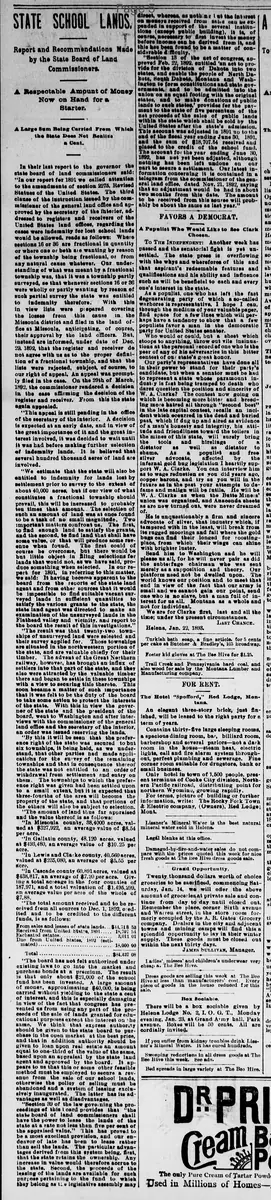
A Respectable Amount of Money Now on Hand for a Starter.
A Large Sum Being Carried From Which the State Does Not Realize Cent.
In their last report to the governor the state board of land commissioners said:
'In our report for 1891 we called attention to the amendments of section 2275, Revised Statutes of the United States. The third clause of the instruction issued by the commissioner of the general land office and approved by the secretary of the interior, addressed to registers and receivers of the United States land offices, regarding the cases where indemnity for lost school lands would be allowed, reads as follows: Where sections 16 or 36 are fractional in quantity or where one or both are wanting by reason of the township being fractional, or from any natural cause whatever, Our understanding of what was meant by fractional township was, that it was a township partly surveyed, so that whenever sections 16 or 36 were wholly or partly wanting by reason of such partial survey the state was entitled to indemnity therefore. With this in view lists were prepared covering the losses from this cause in the Missoula district and filed in the land office at Missoula, anticipating, of course, their approval by the land officers. But, as we are informed, under date of Dec. 29, 1892, that the register and receiver do not agree with us as to the proper definition of fractional township, and that the lists were rejected, subject, of course, to our right of appeal. An appeal was promptly filed in the case. On the 29th of March, 1892, the commissioner rendered a decision in the case affirming the decision of the register and receiver. From this the state again appealed.
This appeal is still pending in the office of the secretary of the interior. Decision is expected at an early date, and in view of the great importance of it and the great interest involved, it was decided to wait until it was had before making further selection of indemnity lands. It is believed that several hundred thousand acres of land are involved.
We estimate that the state will also be entitled to indemnity for lands lost by settlement prior to survey to the extent of about 40,000 acres, but if our view of what constitutes a fractional township should prevail, this will be increased to probably ten times that amount. The selection of such an amount of land was at once found to be a task of no small magnitude. Two important matters confront us. The first, to find enough land to satisfy the grants, and the second, to find land that shall have some value, or that will produce some revenue when found. The first could of course be overcome, but there would be but little object in filing selections for land that would not, as we have said, produce something when selected. In our report for 1891, in referring to this matter, we said: It having become apparent to the board from the reports of the state land agent and from other sources that it would be impossible to find suitable vacant surveyed lands in sufficient quantities to satisfy the various grants to the state, the state land agent was directed to make an examination of the unsurveyed lands in the Flathead valley and vicinity, and report to the board the result of this investigation.'
The result was that twenty-two townships of unsurveyed land were selected and their survey applied for. Those townships are situated in the northwestern portion of the state, and are valuable chiefly for their timber. The advent of the Great Northern railway, however, has brought an influx of settlers into that part of the state, and they also were attracted by the valuable timber there and began to settle in these townships with a view to securing title thereto. This soon became a matter of such importance that it was felt to be the duty of the board to take some action to protect the interests of the state. With this in view the governor of the state and the president of the board, went to Washington and after interviews with the commissioner of the general land office and the secretary of the interior, an order was issued reserving the lands.
By this it will be seen that the preference right of the state was secured to but six townships, it being held, as we understand, that other parties had made applications for the survey of the remaining townships and that in consequence thereof the state was not entitled to an order of withdrawal from settlement and entry on them. The townships to which the preference right was given had been settled upon to a small extent, but it is expected that three-fourths of the area will become the property of the state, and that portions of the others will also be subject to selection.
The amount of land thus far appraised and the value thereof is as follows:
In Missoula county, 38,400 acres, valued $27,922, an average value of $0.54 per acre.
In Gallatin county, 48,120 acres, valued at $493,480, an average value of 10.25 per acre.
In Lewis and Clarke county, 40,560 acres, valued at $235,080, an average of $5.55 per acre.
In Cascade county 60,891 acres, valued at $488,817, an average of 7.20 per acre. Giving a total acreage in the four counties of 187,971, and a total valuation of $1,495,299, an average value per acre of the whole of $7.88.
The total amount received and to be received from all sources to Dec. 1, 1892, credited and to be credited to the different funds, is as follows:
From sales and leases of state lands..$14,718 53
Received from United States, 1891.....18,707 54
Escheated estates. 8,011 01
Due from United States, 1892 (estimated) 18,000 00
Total $84,437 08
The board has not felt authorized under existing laws to go into the market and purchase bonds at a premium. The result is that only about $21,000 of the school fund has been invested. A large amount of money, approximating 40,000, is being carried without yielding to the state a cent of interest, and this is especially damaging in view of the fact that congress has prevented us from using any part of the proceeds of the sale of lands granted for educational purposes except the interest on the same. We think that express authority should be given to the state board to purchase in the open market at the best price, and that in addition authority should be given to loan upon real estate an amount equal to one-third of the value of the same, based upon an appraisal by the state land agent and approved by the board. It appears to us that this or some other feasible method must be employed to secure a revenue from the sale of our school lands, otherwise the policy of selling must be abandoned and a system of leasing exclusively inaugurated. The latter has its advantages as well as disadvantages.
Section 39 of the law governing the proceedings of this board provides that 'the state board of land commissioners shall have the power to lease the lands of the state at a rate not less than five per cent of the appraised value.' This has proved to be a most excellent provision, and our endeavor of late has been to lease rather than sell the lands. The particular advantages derived from this system being, first, that the state retains the ownership. Any increase in value would therefore accrue to the state. Second, the proceeds of the leasing of the land are available for such purposes pertaining to the fund to which they belong as the legislative assembly may direct, whereas, as nothing but the interest on moneys received from sales can be expended in support of the several institutions (except public building), it is, of course, necessary to first invest the money before income can be derived from it, and this has been found to be a matter of considerable difficulty.
Section 18 of the act of congress, approved Feb. 22, 1889, entitled 'an act to provide for the division of Dakota into two states, and to enable the people of North Dakota, South Dakota, Montana and Washington to form constitutions and state governments, and to be admitted into the union on an equal footing with the original states, and to make donations of public lands to such states,' provides for the payment to the state of five per centum of the net proceeds of the sales of public lands within the state which shall be sold by the United States after the state's admission. This account was adjusted in 1891 up to the end of the fiscal year ending June 30, 1891, and the sum of $18,707.54 received and placed to the credit of the school fund. The account for the year ending June 30, 1892, has not yet been adjusted, although nothing has been left undone on our part to secure a settlement. Our latest information concerning it is contained in a telegram from the commissioner of the general land office, dated Nov. 21, 1892, saying that an adjustment would be had in about two months from this date. The amount to be received from this source will probably be about the same as last year.
What sub-type of article is it?
What keywords are associated?
What entities or persons were involved?
Where did it happen?
Domestic News Details
Primary Location
Montana
Event Date
1892
Key Persons
Outcome
land appraisals total 187,971 acres valued at $1,495,299; financial receipts total $84,437.08 as of dec. 1, 1892; pending appeal on indemnity for several hundred thousand acres; recommendation to lease rather than sell lands.
Event Details
The State Board of Land Commissioners reports on appeals regarding indemnity for lost school lands due to fractional townships and pre-survey settlements, potentially involving up to 400,000 acres. They detail selections of unsurveyed lands in Flathead valley, reservations secured for six townships, appraisals in Missoula, Gallatin, Lewis and Clarke, and Cascade counties, financial receipts from sales, leases, U.S. payments, and escheated estates, and advocate for leasing lands and investing funds to generate revenue for educational purposes.