Thank you for visiting SNEWPapers!
Sign up free
Letter to Editor
November 30, 1759
The Virginia Gazette
Richmond, Williamsburg, Richmond County, Virginia
What is this article about?
A letter speculates that a high-ranking British officer under Prince Ferdinand exhibited cowardice or disaffection during a victory over the French, potentially amounting to mutiny. It reflects on the providential nature of the win aiding Prussia in the ongoing war against a coalition.
Clipping
OCR Quality
98%
Excellent
Full Text
From the British Chronicle.
To the PRINTER.
SIR,
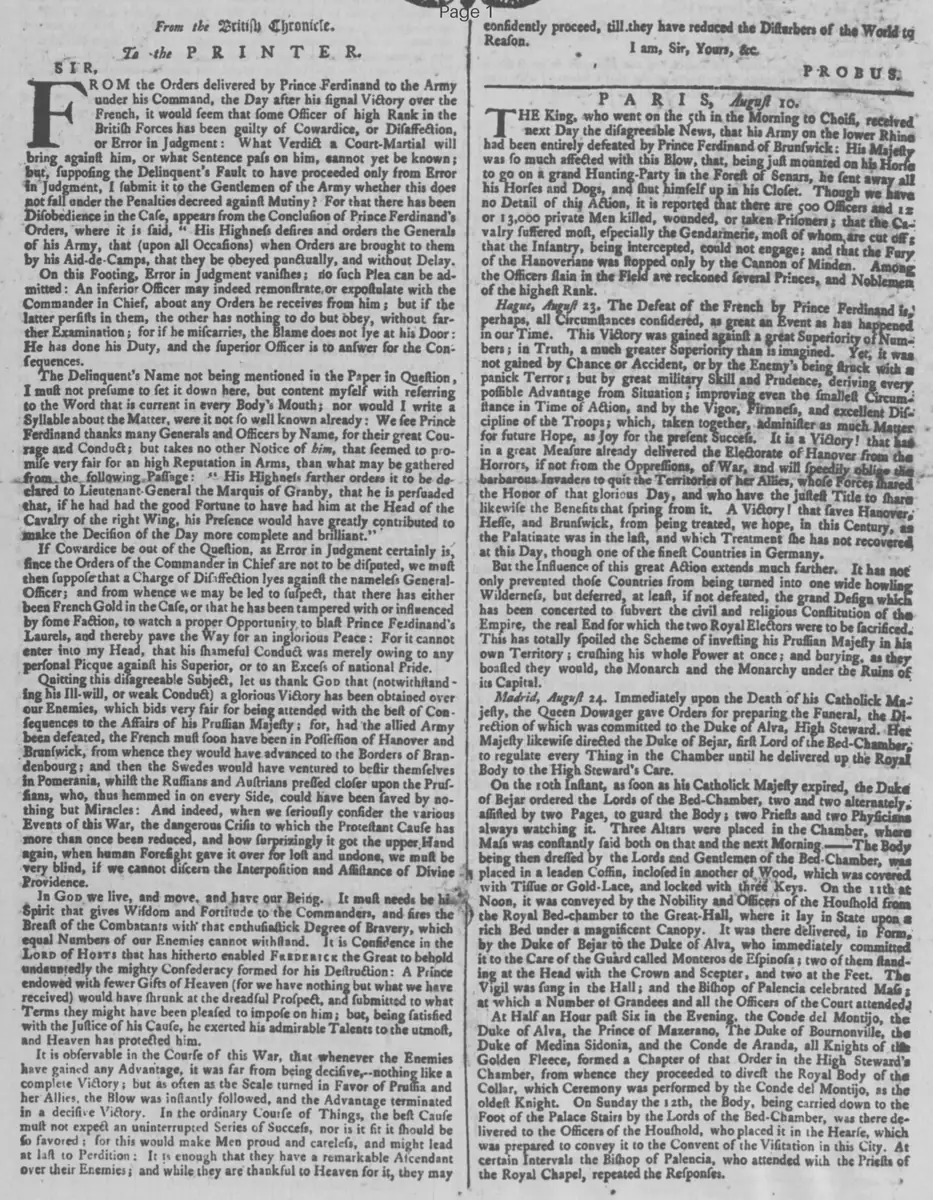
From the Orders delivered by Prince Ferdinand to the Army under his Command, the Day after his signal Victory over the French, it would seem that some Officer of high Rank in the British Forces has been guilty of Cowardice, or Disaffection, or Error in Judgment: What Verdict a Court-Martial will bring against him, or what Sentence pass on him, cannot yet be known; but, supposing the Delinquent's Fault to have proceeded only from Error in Judgment, I submit it to the Gentlemen of the Army whether this does not fall under the Penalties decreed against Mutiny? For that there has been Disobedience in the Case, appears from the Conclusion of Prince Ferdinand's Orders, where it is said, "His Highness desires and orders the Generals of his Army, that (upon all Occasions) when Orders are brought to them by his Aid-de-Camps, that they be obeyed punctually, and without Delay."
On this Footing, Error in Judgment vanishes; no such Plea can be admitted: An inferior Officer may indeed remonstrate, or expostulate with the Commander in Chief, about any Orders he receives from him; but if the latter persists in them, the other has nothing to do but obey, without further Examination; for if he miscarries, the Blame does not lie at his Door: He has done his Duty, and the superior Officer is to answer for the Consequences.
The Delinquent's Name not being mentioned in the Paper in Question, I must not presume to set it down here, but content myself with referring to the Word that is current in every Body's Mouth; nor would I write a Syllable about the Matter, were it not so well known already: We see Prince Ferdinand thanks many Generals and Officers by Name, for their great Courage and Conduct; but takes no other Notice of him, that seemed to promise very fair for an high Reputation in Arms, than what may be gathered from the following Passage: "His Highness farther orders it to be declared to Lieutenant-General the Marquis of Granby, that he is persuaded that, if he had had the good Fortune to have had him at the Head of the Cavalry of the right Wing, his Presence would have greatly contributed to make the Decision of the Day more complete and brilliant."
If Cowardice be out of the Question, as Error in Judgment certainly is, since the Orders of the Commander in Chief are not to be disputed, we must then suppose that a Charge of Disaffection lies against the nameless General-Officer; and from whence we may be led to suspect, that there has either been French Gold in the Case, or that he has been tampered with or influenced by some Faction, to watch a proper Opportunity, to blast Prince Ferdinand's Laurels, and thereby pave the Way for an inglorious Peace: For it cannot enter into my Head, that his shameful Conduct was merely owing to any personal Pique against his Superior, or to an Excess of national Pride.
Quitting this disagreeable Subject, let us thank God that (notwithstanding his Ill-will, or weak Conduct) a glorious Victory has been obtained over our Enemies, which bids very fair for being attended with the best of Consequences to the Affairs of his Prussian Majesty: for, had the allied Army been defeated, the French must soon have been in Possession of Hanover and Brunswick, from whence they would have advanced to the Borders of Brandenburg; and then the Swedes would have ventured to bestir themselves in Pomerania, whilst the Russians and Austrians pressed closer upon the Prussians, who, thus hemmed in on every Side, could have been saved by nothing but Miracles: And indeed, when we seriously consider the various Events of this War, the dangerous Crisis to which the Protestant Cause has more than once been reduced, and how surprisingly it got the upper Hand again, when human Foresight gave it over for lost and undone, we must be very blind, if we cannot discern the Interposition and Assistance of Divine Providence.
In God we live, and move, and have our Being. It must needs be his Spirit that gives Wisdom and Fortitude to the Commanders, and fires the Breast of the Combatants with that enthusiastick Degree of Bravery, which equal Numbers of our Enemies cannot withstand. It is Confidence in the Lord of Hosts that has hitherto enabled Frederick the Great to behold undauntedly the mighty Confederacy formed for his Destruction: A Prince endowed with fewer Gifts of Heaven (for we have nothing but what we have received) would have shrunk at the dreadful Prospect, and submitted to what Terms they might have been pleased to impose on him; but, being satisfied with the Justice of his Cause, he exerted his admirable Talents to the utmost, and Heaven has protected him.
It is observable in the Course of this War, that whenever the Enemies have gained any Advantage, it was far from being decisive,--nothing like a complete Victory; but as often as the Scale turned in Favor of Prussia and her Allies, the Blow was instantly followed, and the Advantage terminated in a decisive Victory. In the ordinary Course of Things, the best Cause must not expect an uninterrupted Series of Success, nor is it fit it should be so favored; for this would make Men proud and careless, and might lead at last to Perdition: It is enough that they have a remarkable Ascendant over their Enemies; and while they are thankful to Heaven for it, they may confidently proceed, till they have reduced the Disturbers of the World to Reason.
I am, Sir, Yours, &c.
PROBUS.
To the PRINTER.
SIR,
From the Orders delivered by Prince Ferdinand to the Army under his Command, the Day after his signal Victory over the French, it would seem that some Officer of high Rank in the British Forces has been guilty of Cowardice, or Disaffection, or Error in Judgment: What Verdict a Court-Martial will bring against him, or what Sentence pass on him, cannot yet be known; but, supposing the Delinquent's Fault to have proceeded only from Error in Judgment, I submit it to the Gentlemen of the Army whether this does not fall under the Penalties decreed against Mutiny? For that there has been Disobedience in the Case, appears from the Conclusion of Prince Ferdinand's Orders, where it is said, "His Highness desires and orders the Generals of his Army, that (upon all Occasions) when Orders are brought to them by his Aid-de-Camps, that they be obeyed punctually, and without Delay."
On this Footing, Error in Judgment vanishes; no such Plea can be admitted: An inferior Officer may indeed remonstrate, or expostulate with the Commander in Chief, about any Orders he receives from him; but if the latter persists in them, the other has nothing to do but obey, without further Examination; for if he miscarries, the Blame does not lie at his Door: He has done his Duty, and the superior Officer is to answer for the Consequences.
The Delinquent's Name not being mentioned in the Paper in Question, I must not presume to set it down here, but content myself with referring to the Word that is current in every Body's Mouth; nor would I write a Syllable about the Matter, were it not so well known already: We see Prince Ferdinand thanks many Generals and Officers by Name, for their great Courage and Conduct; but takes no other Notice of him, that seemed to promise very fair for an high Reputation in Arms, than what may be gathered from the following Passage: "His Highness farther orders it to be declared to Lieutenant-General the Marquis of Granby, that he is persuaded that, if he had had the good Fortune to have had him at the Head of the Cavalry of the right Wing, his Presence would have greatly contributed to make the Decision of the Day more complete and brilliant."
If Cowardice be out of the Question, as Error in Judgment certainly is, since the Orders of the Commander in Chief are not to be disputed, we must then suppose that a Charge of Disaffection lies against the nameless General-Officer; and from whence we may be led to suspect, that there has either been French Gold in the Case, or that he has been tampered with or influenced by some Faction, to watch a proper Opportunity, to blast Prince Ferdinand's Laurels, and thereby pave the Way for an inglorious Peace: For it cannot enter into my Head, that his shameful Conduct was merely owing to any personal Pique against his Superior, or to an Excess of national Pride.
Quitting this disagreeable Subject, let us thank God that (notwithstanding his Ill-will, or weak Conduct) a glorious Victory has been obtained over our Enemies, which bids very fair for being attended with the best of Consequences to the Affairs of his Prussian Majesty: for, had the allied Army been defeated, the French must soon have been in Possession of Hanover and Brunswick, from whence they would have advanced to the Borders of Brandenburg; and then the Swedes would have ventured to bestir themselves in Pomerania, whilst the Russians and Austrians pressed closer upon the Prussians, who, thus hemmed in on every Side, could have been saved by nothing but Miracles: And indeed, when we seriously consider the various Events of this War, the dangerous Crisis to which the Protestant Cause has more than once been reduced, and how surprisingly it got the upper Hand again, when human Foresight gave it over for lost and undone, we must be very blind, if we cannot discern the Interposition and Assistance of Divine Providence.
In God we live, and move, and have our Being. It must needs be his Spirit that gives Wisdom and Fortitude to the Commanders, and fires the Breast of the Combatants with that enthusiastick Degree of Bravery, which equal Numbers of our Enemies cannot withstand. It is Confidence in the Lord of Hosts that has hitherto enabled Frederick the Great to behold undauntedly the mighty Confederacy formed for his Destruction: A Prince endowed with fewer Gifts of Heaven (for we have nothing but what we have received) would have shrunk at the dreadful Prospect, and submitted to what Terms they might have been pleased to impose on him; but, being satisfied with the Justice of his Cause, he exerted his admirable Talents to the utmost, and Heaven has protected him.
It is observable in the Course of this War, that whenever the Enemies have gained any Advantage, it was far from being decisive,--nothing like a complete Victory; but as often as the Scale turned in Favor of Prussia and her Allies, the Blow was instantly followed, and the Advantage terminated in a decisive Victory. In the ordinary Course of Things, the best Cause must not expect an uninterrupted Series of Success, nor is it fit it should be so favored; for this would make Men proud and careless, and might lead at last to Perdition: It is enough that they have a remarkable Ascendant over their Enemies; and while they are thankful to Heaven for it, they may confidently proceed, till they have reduced the Disturbers of the World to Reason.
I am, Sir, Yours, &c.
PROBUS.
What sub-type of article is it?
Persuasive
Reflective
Political
What themes does it cover?
Military War
Religion
Politics
What keywords are associated?
Prince Ferdinand
British Officer
Cowardice
Disaffection
Mutiny
Divine Providence
Prussia
Seven Years War
Frederick The Great
What entities or persons were involved?
Probus
The Printer
Letter to Editor Details
Author
Probus
Recipient
The Printer
Main Argument
a british officer's failure to obey orders during prince ferdinand's victory suggests disaffection or mutiny, possibly influenced by french interests, but the win demonstrates divine providence supporting prussia against its enemies.
Notable Details
Prince Ferdinand's Orders Emphasizing Punctual Obedience
Reference To Lieutenant General The Marquis Of Granby
Speculation On French Gold Or Factional Influence
Praise For Frederick The Great's Confidence In Divine Justice