Thank you for visiting SNEWPapers!
Sign up free
Letter to Editor
November 17, 1795
The New Hampshire Gazette
Portsmouth, Rockingham County, New Hampshire
What is this article about?
Bradshaw's letter to the Gazette rebuts a Republican's defenses of anti-Jay Treaty actions in Portsmouth, exposing inconsistencies, lack of evidence, and mob violence in town meetings, while defending the treaty and recommending supportive writings like 'Camillus'.
Clipping
OCR Quality
98%
Excellent
Full Text
FOR THE GAZETTE.
MR. MELCHER,
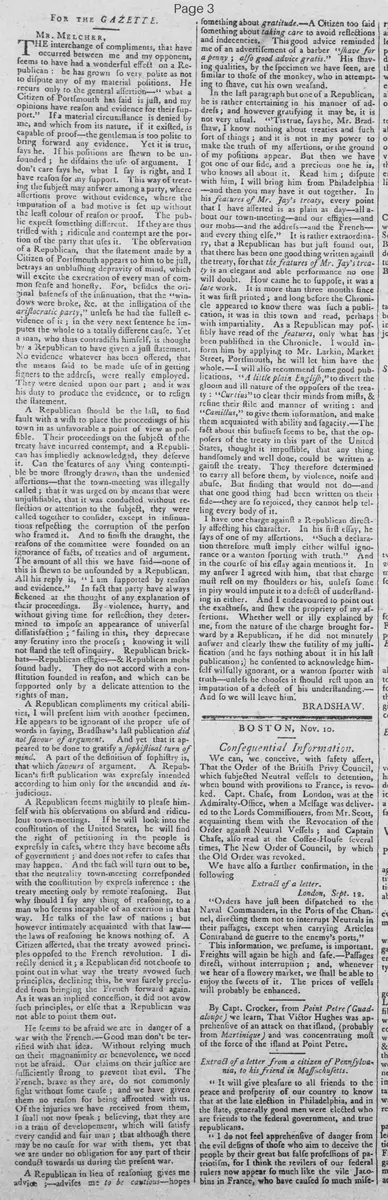
THE interchange of compliments, that have occurred between me and my opponent, seems to have had a wonderful effect on a Republican: he has grown so very polite as not to dispute any of my material positions. He recurs only to the general assertion--"what a Citizen of Portsmouth has said is just, and my opinions have reason and evidence for their support." If a material circumstance is denied by me, and which from its nature, if it existed, is capable of proof--the gentleman is too polite to bring forward any evidence. Yet it is true, says he. If his positions are shown to be unfounded; he disdains the use of argument. I don't care says he, what I say is right, and I have reason for my support. This way of treating the subject may answer among a party, where assertions prove without evidence, where the imputation of a bad motive is set up without the least colour of reason or proof. The public expects something different. If they are thus trifled with; ridicule and contempt are the portion of the party that uses it. The observation of a Republican, that the statement made by a Citizen of Portsmouth appears to him to be just, betrays an unblushing depravity of mind, which will excite the execration of every man of common sense and honesty. For, besides the original baseness of the insinuation, that the "windows were broke, &c. at the instigation of the aristocratic party," unless he had the fullest evidence of it: in the very next sentence he imputes the whole to a totally different cause. Yet a man, who thus contradicts himself, is thought by a Republican to have given a just statement. No evidence whatever has been offered, that the means said to be made use of in getting signers to the address, were really employed. They were denied upon our part; and it was his duty to produce the evidence, or to resign the statement.
A Republican should be the last, to find fault with a wish to place the proceedings of his town in as unfavorable a point of view as possible. Their proceedings on the subject of the treaty have incurred contempt, and a Republican has impliedly acknowledged, they deserve it. Can the features of any thing contemptible be more strongly drawn, than the undenied assertions--that the town-meeting was illegally called; that it was urged on by means that were unjustifiable, that it was conducted without reflection or attention to the subject, they were called together to consider, except in insinuations respecting the corruption of the person who framed it. And to finish the draught, the reasons of the committee were founded on an ignorance of facts, of treaties and of argument. The amount of all this we have said--none of this is shown to be unfounded by a Republican. All his reply is, "I am supported by reason and evidence." In fact that party have always sickened at the thought of any explanation of their proceedings. By violence, hurry, and without giving time for reflection, they determined to impose an appearance of universal dissatisfaction; failing in this, they deprecate any scrutiny into the process; knowing it will not stand the test of inquiry. Republican brick-bats--Republican effigies--& Republican mobs sound badly. They do not accord with a constitution founded in reason, and which can be supported only by a delicate attention to the rights of man.
A Republican compliments my critical abilities, I will present him with another specimen. He appears to be ignorant of the proper use of words in saying, Bradshaw's last publication did not savour of argument. And yet that it appeared to be done to gratify a sophistical turn of mind. A part of the definition of sophistry is, that which savours of argument. A Republican's first publication was expressly intended according to him only for the uncandid and injudicious.
A Republican seems mightily to please himself with his observations on absurd and ridiculous town-meetings. If he will look into the constitution of the United States, he will find the right of petitioning in the people is expressly in cases, where they have become acts of government; and does not refer to cases that may happen. And the fact will turn out to be, that the neutrality town-meeting corresponded with the constitution by express inference: the treaty meeting only by remote reasoning. But why should I say any thing of reasoning, to a man who seems incapable of an exertion in that way. He talks of the law of nations; but however intimately acquainted with that law--the laws of reasoning he knows nothing of. A Citizen asserted, that the treaty avowed principles opposed to the French revolution. I directly denied it; a Republican did not choose to point out in what way the treaty avowed such principles, declining this, he was surely precluded from bringing the French forward again. As it was an implied concession, it did not avow such principles, or else that a Republican was not able to point them out.
He seems to be afraid we are in danger of a war with the French.--Good man don't be terrified with that idea. Without relying much on their magnanimity or benevolence, we need not be afraid. Our claims on their justice are sufficiently strong to prevent that evil. The French, brave as they are, do not commonly fight without some cause; and we have given them no reason for being affronted with us. Of the injuries we have received from them, I shall not now speak; believing, that they are in a train of development, which will satisfy every candid and fair man; that although there may be no cause for war with them, yet that we are under no obligation for any part of their conduct towards us during the present war.
A Republican in lieu of reasoning gives me advice; advises me to be cautious--hopes something about gratitude,--A Citizen too said something about taking care to avoid reflections and indecencies. This good advice reminded me of an advertisement of a barber "I have for a penny; also good advice gratis." His shaving qualities, by the specimen we have seen, are similar to those of the monkey, who in attempting to shave, cut his own weasand.
In the last paragraph but one of a Republican, he is rather entertaining in his manner of address; and however gratifying it may be, it is not very usual. "'Tis true, says he, Mr. Bradshaw, I know nothing about treaties and such sort of things: and it is not in my power to make the truth of my assertions, or the ground of my positions appear. But then we have got one on our side, and a precious one he is, who knows all about it. Read him; dispute with him, I will bring him from Philadelphia--and then you may have it out together. In his features of Mr. Jay's treaty, every point that I have asserted is as plain as day--all about our town-meeting--and our effigies--and our mobs--and the address--and the French--and every thing else," It is rather extraordinary, that a Republican has but just found out, that there has been one good thing written against the treaty, for that the features of Mr. Jay's treaty is an elegant and able performance no one will doubt. How came he to suppose, it was a late work. It is more than three months since it was first printed; and long before the Chronicle appeared to know there was such a publication, it was in this town and read, perhaps with impartiality. As a Republican may possibly have read of the features, only what has been published in the Chronicle. I would inform him by applying to Mr. Larkin, Market Street, Portsmouth, he will let him have the whole.--I will also recommend some good publications. "A little plain English," to divert the gloom and ill nature of the opposers of the treaty: "Curtius" to clear their minds from mists, & refine their style and manner of writing: and "Camillus," to give them information, and make them acquainted with ability and sagacity.--The fact about this business seems to be, that the opposers of the treaty in this part of the United States, thought it impossible, that any thing handsomely and well done, could be written against the treaty. They therefore determined to carry all before them, by violence, noise and abuse. But finding that would not do--and that one good thing had been written on their side---they are so rejoiced, they cannot help telling every body of it.
I have one charge against a Republican directly affecting his character. In his first essay, he says of one of my assertions. "Such a declaration therefore must imply either wilful ignorance or a wanton sporting with truth." And in the course of his essay again mentions it. In my answer I agreed with him, that that charge must rest on my shoulders or his, unless some in pity would impute it to a defect of understanding in either. And I endeavoured to point out the exactness, and shew the propriety of my assertions. Whether well or ill explained by me, from the nature of the charge brought forward by a Republican, if he did not minutely answer and clearly shew the futility of my justification (and he says nothing about it in his last publication;) he consented to acknowledge himself wilfully ignorant, or a wanton porter with truth--unless he chooses it should rest upon an imputation of a defect of his understanding.-- And so we will leave him.
BRADSHAW.
MR. MELCHER,
THE interchange of compliments, that have occurred between me and my opponent, seems to have had a wonderful effect on a Republican: he has grown so very polite as not to dispute any of my material positions. He recurs only to the general assertion--"what a Citizen of Portsmouth has said is just, and my opinions have reason and evidence for their support." If a material circumstance is denied by me, and which from its nature, if it existed, is capable of proof--the gentleman is too polite to bring forward any evidence. Yet it is true, says he. If his positions are shown to be unfounded; he disdains the use of argument. I don't care says he, what I say is right, and I have reason for my support. This way of treating the subject may answer among a party, where assertions prove without evidence, where the imputation of a bad motive is set up without the least colour of reason or proof. The public expects something different. If they are thus trifled with; ridicule and contempt are the portion of the party that uses it. The observation of a Republican, that the statement made by a Citizen of Portsmouth appears to him to be just, betrays an unblushing depravity of mind, which will excite the execration of every man of common sense and honesty. For, besides the original baseness of the insinuation, that the "windows were broke, &c. at the instigation of the aristocratic party," unless he had the fullest evidence of it: in the very next sentence he imputes the whole to a totally different cause. Yet a man, who thus contradicts himself, is thought by a Republican to have given a just statement. No evidence whatever has been offered, that the means said to be made use of in getting signers to the address, were really employed. They were denied upon our part; and it was his duty to produce the evidence, or to resign the statement.
A Republican should be the last, to find fault with a wish to place the proceedings of his town in as unfavorable a point of view as possible. Their proceedings on the subject of the treaty have incurred contempt, and a Republican has impliedly acknowledged, they deserve it. Can the features of any thing contemptible be more strongly drawn, than the undenied assertions--that the town-meeting was illegally called; that it was urged on by means that were unjustifiable, that it was conducted without reflection or attention to the subject, they were called together to consider, except in insinuations respecting the corruption of the person who framed it. And to finish the draught, the reasons of the committee were founded on an ignorance of facts, of treaties and of argument. The amount of all this we have said--none of this is shown to be unfounded by a Republican. All his reply is, "I am supported by reason and evidence." In fact that party have always sickened at the thought of any explanation of their proceedings. By violence, hurry, and without giving time for reflection, they determined to impose an appearance of universal dissatisfaction; failing in this, they deprecate any scrutiny into the process; knowing it will not stand the test of inquiry. Republican brick-bats--Republican effigies--& Republican mobs sound badly. They do not accord with a constitution founded in reason, and which can be supported only by a delicate attention to the rights of man.
A Republican compliments my critical abilities, I will present him with another specimen. He appears to be ignorant of the proper use of words in saying, Bradshaw's last publication did not savour of argument. And yet that it appeared to be done to gratify a sophistical turn of mind. A part of the definition of sophistry is, that which savours of argument. A Republican's first publication was expressly intended according to him only for the uncandid and injudicious.
A Republican seems mightily to please himself with his observations on absurd and ridiculous town-meetings. If he will look into the constitution of the United States, he will find the right of petitioning in the people is expressly in cases, where they have become acts of government; and does not refer to cases that may happen. And the fact will turn out to be, that the neutrality town-meeting corresponded with the constitution by express inference: the treaty meeting only by remote reasoning. But why should I say any thing of reasoning, to a man who seems incapable of an exertion in that way. He talks of the law of nations; but however intimately acquainted with that law--the laws of reasoning he knows nothing of. A Citizen asserted, that the treaty avowed principles opposed to the French revolution. I directly denied it; a Republican did not choose to point out in what way the treaty avowed such principles, declining this, he was surely precluded from bringing the French forward again. As it was an implied concession, it did not avow such principles, or else that a Republican was not able to point them out.
He seems to be afraid we are in danger of a war with the French.--Good man don't be terrified with that idea. Without relying much on their magnanimity or benevolence, we need not be afraid. Our claims on their justice are sufficiently strong to prevent that evil. The French, brave as they are, do not commonly fight without some cause; and we have given them no reason for being affronted with us. Of the injuries we have received from them, I shall not now speak; believing, that they are in a train of development, which will satisfy every candid and fair man; that although there may be no cause for war with them, yet that we are under no obligation for any part of their conduct towards us during the present war.
A Republican in lieu of reasoning gives me advice; advises me to be cautious--hopes something about gratitude,--A Citizen too said something about taking care to avoid reflections and indecencies. This good advice reminded me of an advertisement of a barber "I have for a penny; also good advice gratis." His shaving qualities, by the specimen we have seen, are similar to those of the monkey, who in attempting to shave, cut his own weasand.
In the last paragraph but one of a Republican, he is rather entertaining in his manner of address; and however gratifying it may be, it is not very usual. "'Tis true, says he, Mr. Bradshaw, I know nothing about treaties and such sort of things: and it is not in my power to make the truth of my assertions, or the ground of my positions appear. But then we have got one on our side, and a precious one he is, who knows all about it. Read him; dispute with him, I will bring him from Philadelphia--and then you may have it out together. In his features of Mr. Jay's treaty, every point that I have asserted is as plain as day--all about our town-meeting--and our effigies--and our mobs--and the address--and the French--and every thing else," It is rather extraordinary, that a Republican has but just found out, that there has been one good thing written against the treaty, for that the features of Mr. Jay's treaty is an elegant and able performance no one will doubt. How came he to suppose, it was a late work. It is more than three months since it was first printed; and long before the Chronicle appeared to know there was such a publication, it was in this town and read, perhaps with impartiality. As a Republican may possibly have read of the features, only what has been published in the Chronicle. I would inform him by applying to Mr. Larkin, Market Street, Portsmouth, he will let him have the whole.--I will also recommend some good publications. "A little plain English," to divert the gloom and ill nature of the opposers of the treaty: "Curtius" to clear their minds from mists, & refine their style and manner of writing: and "Camillus," to give them information, and make them acquainted with ability and sagacity.--The fact about this business seems to be, that the opposers of the treaty in this part of the United States, thought it impossible, that any thing handsomely and well done, could be written against the treaty. They therefore determined to carry all before them, by violence, noise and abuse. But finding that would not do--and that one good thing had been written on their side---they are so rejoiced, they cannot help telling every body of it.
I have one charge against a Republican directly affecting his character. In his first essay, he says of one of my assertions. "Such a declaration therefore must imply either wilful ignorance or a wanton sporting with truth." And in the course of his essay again mentions it. In my answer I agreed with him, that that charge must rest on my shoulders or his, unless some in pity would impute it to a defect of understanding in either. And I endeavoured to point out the exactness, and shew the propriety of my assertions. Whether well or ill explained by me, from the nature of the charge brought forward by a Republican, if he did not minutely answer and clearly shew the futility of my justification (and he says nothing about it in his last publication;) he consented to acknowledge himself wilfully ignorant, or a wanton porter with truth--unless he chooses it should rest upon an imputation of a defect of his understanding.-- And so we will leave him.
BRADSHAW.
What sub-type of article is it?
Persuasive
Political
Investigative
What themes does it cover?
Politics
What keywords are associated?
Jay Treaty
Republican Opposition
Town Meeting
Portsmouth Politics
French Relations
Treaty Debate
Political Publications
Mob Tactics
What entities or persons were involved?
Bradshaw.
Mr. Melcher
Letter to Editor Details
Author
Bradshaw.
Recipient
Mr. Melcher
Main Argument
the writer rebuts a republican opponent's unsubstantiated claims and inconsistencies regarding the jay treaty, local town meetings, and opposition tactics, defending the treaty and criticizing the lack of evidence and use of violence by opponents.
Notable Details
References To 'Features Of Mr. Jay's Treaty' As An Able Anti Treaty Work
Recommends Pro Treaty Publications: 'A Little Plain English', 'Curtius', 'Camillus'
Mentions Portsmouth Town Meeting, Effigies, Mobs, And Address Signers
Discusses French Relations And Neutrality
Criticizes Republican's Self Contradictions On Window Breaking Instigation