Thank you for visiting SNEWPapers!
Sign up free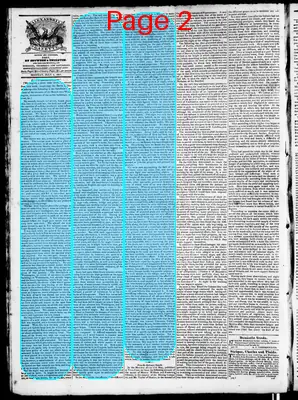
Phenix Gazette
Alexandria, Virginia
What is this article about?
A British subaltern recounts entering Washington after the Battle of Bladensburg in 1814, witnessing the burning of public buildings, bivouacking amid awe, enduring a thunderstorm and hurricane, and executing a secret nighttime retreat, leaving wounded behind, with reflections on comrades and the city's modest appearance.
Clipping
OCR Quality
Full Text
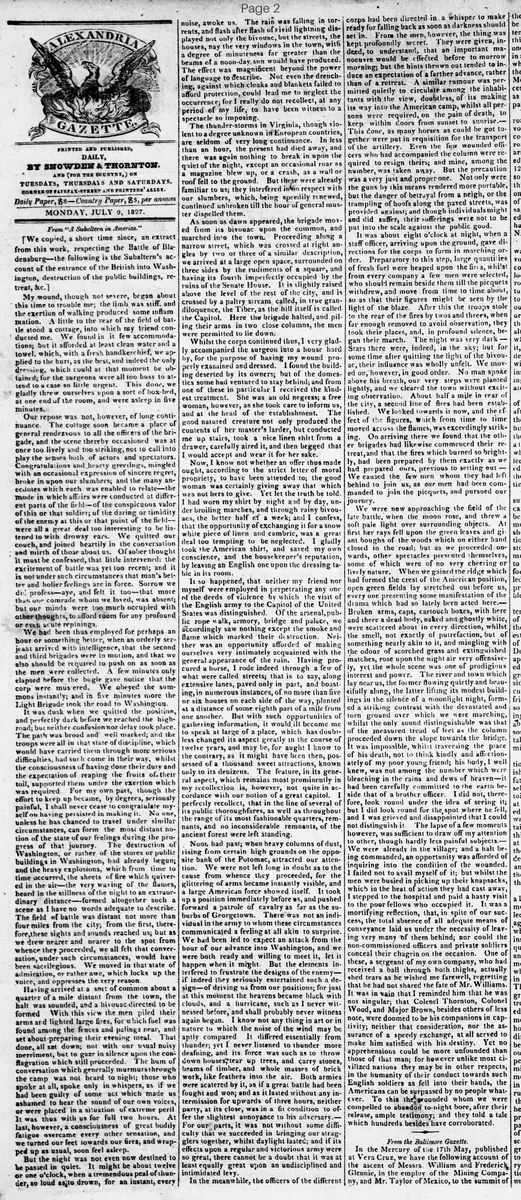
We copied, a short time since, an extract from this work, respecting the Battle of Bladensburg—the following is the Subaltern's account of the entrance of the British into Washington, destruction of the public buildings, retreat, &c.]
My wound, though not severe, began about this time to trouble me; the limb was stiff, and the exertion of walking produced some inflammation. A little to the rear of the field of battle stood a cottage, into which my friend conducted me. We found in it few accommodations; but it afforded at least clean water and a towel, which, with a fresh handkerchief, we applied to the hurt, as the best, and indeed the only dressing, which could at that moment be obtained; for the surgeons were all too busy to attend to a case so little urgent.
This done, we gladly threw ourselves upon a sort of box-bed, at one end of the room, and were asleep in five minutes.
Our repose was not, however, of long continuance. The cottage soon became a place of general rendezvous to all the officers of the brigade, and the scene thereby occasioned was at once too lively and too striking, not to call into play the senses both of actors and spectators.
Congratulations and hearty greetings, mingled with an occasional expression of sincere regret, broke in upon our slumbers; and the many anecdotes which each was enabled to relate—the mode in which affairs were conducted at different parts of the field—of the conspicuous valor of this or that soldier; of the daring or timidity of the enemy at this or that point of the field—were all a great deal too interesting to be listened to with drowsy ears. We quitted our couch, and joined heartily in the conversation and mirth of those about us. Of sober thought it must be confessed, that little intervened: the excitement of battle was yet too recent; and it is not under such circumstances that man's better and holier feelings are in force. Sorrow we did profess—aye, and felt it too—that more than one comrade whom we loved, was absent; but our minds were too much occupied with other thoughts, to afford room for any profound or even acute repinings.
We had been thus employed for perhaps an hour or something better, when an orderly sergeant arrived with intelligence, that the second and third brigades were in motion, and that we also should be required to push on as soon as the men were collected. A few minutes only elapsed before the bugle gave notice that the corps were mustered. We obeyed the summons instantly; and in five minutes more the Light Brigade took the road to Washington.
It was dusk when we quitted the position, and perfectly dark before we reached the high-road; but neither confusion nor delay took place. The path was broad and well marked; and the troops were all in that state of discipline, which would have carried them through more serious difficulties, had such come in their way, whilst the consciousness of having done their duty and the expectation of reaping the fruits of their toil, supported them under the exertion which was required. For my own part, though the effort to keep up became, by degrees, seriously painful, I shall never cease to congratulate myself on having persisted in making it. No one, unless he has chanced to travel under similar circumstances, can form the most distant notion of the state of our feelings during the progress of that journey. The destruction of Washington, or rather of the stores or public buildings in Washington, had already begun; and the heavy explosions, which from time to time occurred, the sheets of fire which quivered in the air, the very waving of the flames, heard in the stillness of the night to an extraordinary distance—formed altogether such a scene as I have no words adequate to describe.
The field of battle was distant not more than four miles from the city; from the first, therefore, these sights and sounds reached us; but as we drew nearer and nearer to the spot from whence they proceeded, we all felt that conversation, under such circumstances, would have been sacrilegious. We moved in that state of admiration, or rather awe, which locks up the voice, and oppresses the very reason.
Having arrived at a sort of common about a quarter of a mile distant from the town, the halt was sounded, and a bivouac directed to be formed. With this view the men piled their arms and lighted large fires, for which fuel was found among the fences and palings near, and set about preparing their evening meal. That done, all sat down; not with our usual noisy merriment, but to gaze in silence upon the conflagration which still proceeded. The hum of conversation which generally murmurs through the camp was not heard to night; those who spoke at all, spoke only in whispers, as if we had been guilty of some act which made us ashamed to hear the sound of our own voices, or were placed in a situation of extreme peril.
It was thus with us for full two hours. At last, however, a consciousness of great bodily fatigue overcame every other sensation, and we turned our feet towards our fires, and wrapped up as usual, soon fell asleep.
But the night was not even now destined to be passed in quiet. It might be about twelve or one o'clock, when a tremendous peal of thunder, so loud as to drown, for an instant, every noise, awoke us. The rain was falling in torrents, and flash after flash of vivid lightning displayed not only the bivouac, but the streets, the houses, nay the very windows in the town, with a degree of minuteness far greater than the beams of a noon-day sun would have produced.
The effect was magnificent beyond the power of language to describe. Not even the drenching, against which cloaks and blankets failed to afford protection, could lead me to neglect the occurrence; for I really do not recollect, at any period of my life, to have been witness to a spectacle so imposing.
The thunder-storms in Virginia, though violent to a degree unknown in European countries, are seldom of very long continuance. In less than an hour, the present had died away, and there was again nothing to break in upon the quiet of the night, except an occasional roar as a magazine blew up, or a crash, as a wall or roof fell to the ground. But these were already familiar to us; they interfered in no respect with our slumbers, which, being speedily renewed, continued unbroken till the hour of general muster dispelled them.
As soon as dawn appeared, the brigade moved from its bivouac upon the common, and marched into the town. Proceeding along a narrow street, which was crossed at right angles by two or three of a similar description, we arrived at a large open space, surrounded on three sides by the rudiments of a square, and having its fourth imperfectly occupied by the ruins of the Senate House. It is slightly raised above the level of the rest of the city, and is crossed by a paltry stream, called, in true graniloquence, the Tiber, as the hill itself is called the Capitol. Here the brigade halted, and piling their arms in two close columns, the men were permitted to lie down.
Whilst the corps continued thus, I very gladly accompanied the surgeon into a house hard by, for the purpose of having my wound properly examined and dressed. I found the building deserted by its owners; but of the domestics some had ventured to stay behind; and from one of these in particular I received the kindest treatment. She was an old negress; a free woman, however, as she took care to inform us, and at the head of the establishment. The good natured creature not only produced the contents of her master's larder, but conducted me up stairs, took a nice linen shirt from a drawer, carefully aired it, and then begged that I would accept and wear it for her sake.
Now, I know not whether an offer thus made ought, according to the strict letter of moral propriety, to have been attended to; the good woman was certainly giving away that which was not hers to give. Yet let the truth be told. I had worn my shirt by night and by day, under broiling marches, and through rainy bivouacs, the better half of a week; and I confess, that the opportunity of exchanging it for a snow white piece of linen and cambric, was a great deal too tempting to be neglected. I gladly took the American shirt, and saved my own conscience, and the housekeeper's reputation, by leaving an English one upon the dressing table in its room.
It so happened, that neither my friend nor myself were employed in perpetrating any one of the deeds of violence by which the visit of the English army to the Capitol of the United States was distinguished. Of the arsenal, public rope walk, armory, bridge and palace, we accordingly saw nothing except the smoke and flame which marked their destruction. Neither was an opportunity afforded of making ourselves very intimately acquainted with the general appearance of the ruin. Having procured a horse, I rode indeed through a few of what were called streets; that is to say, along extensive lanes, paved only in part, and boasting, in numerous instances, of no more than five or six houses on each side of the way, planted at a distance of some eighth part of a mile from one another. But with such opportunities of gathering information, it would ill become me to speak at large of a place, which has doubtless changed its aspect greatly in the course of twelve years, and may be, for aught I know to the contrary, as it might have been then, possessed of a thousand sweet attractions, known only to its denizens. The feature, in its general aspect, which remains most prominently in my recollection is, however, not quite in accordance with our notion of a great capitol. I perfectly recollect, that in the line of several of its public thoroughfares, as well as throughout the range of its most fashionable quarters, remnants, and no inconsiderable remnants, of the ancient forest were left standing.
Noon had past; when heavy columns of dust, rising from certain high grounds on the opposite bank of the Potomac, attracted our attention. We were not left long in doubt as to the cause from whence they proceeded, for the glittering of arms became instantly visible, and a large American force showed itself. It took up a position immediately before us, and pushed forward a patrol of cavalry as far as the suburbs of Georgetown. There was not an individual in the army to whom these circumstances communicated a feeling at all akin to surprise. We had been led to expect an attack from the hour of our advance into Washington, and we were both ready and willing to meet it, let it happen when it might. But the elements interfered to frustrate the designs of the enemy—if indeed they seriously entertained such a design—of driving us from our positions; for just at this moment the heavens became black with clouds, and a hurricane, such as I never witnessed before, and shall probably never witness again began. I know not any thing in art or in nature to which the noise of the wind may be aptly compared. It differed essentially from thunder; yet I never listened to thunder more deafening, and its force was such as to throw down houses, tear up trees, and carry stones, beams of timber, and whole masses of brick work, like feathers into the air. Both armies were scattered by it, as if a great battle had been fought and won; and as it lasted without any intermission for upwards of three hours, neither party, at its close, was in a fit condition to offer the slightest annoyance to his adversary. For our parts, it was not without some difficulty that we succeeded in bringing our stragglers together, whilst daylight lasted; and if its effects upon a regular and victorious army were so great, there cannot be a doubt that it was at least equally great upon an undisciplined and intimidated levy.
In the meanwhile, the officers of the different corps had been directed in a whisper to make ready for falling back as soon as darkness should set in. From the men, however, the thing was kept profoundly secret. They were given, indeed, to understand, that an important manoeuvre would be effected before to-morrow morning; but the hints thrown out tended to induce an expectation of a further advance, rather than of a retreat. A similar rumour was permitted quietly to circulate among the inhabitants with the view, doubtless, of its making its way into the American camp, whilst all persons were required, on the pain of death, to keep within doors from sunset to sunrise.
This done, as many horses as could be got together were put in requisition for the transport of the artillery. Even the few wounded officers who had accompanied the column were required to resign theirs; and mine, among the number, was taken away. But the precaution was a very just and proper one. Not only were the guns by this means rendered more portable, but the danger of betrayal from a neigh, or the trampling of hoofs along the paved streets, was provided against; and though individuals might and did suffer, their sufferings were not to be put into the scale against the public good.
It was about eight o'clock at night, when a staff officer, arriving upon the ground, gave directions for the corps to form in marching order. Preparatory to this step, large quantities of fresh fuel were heaped upon the fires, whilst from every company a few men were selected, who should remain beside them till the picquets withdrew, and move from time to time about, so as that their figures might be seen by the light of the blaze. After this the troops stole to the rear of the fires by twos and threes, when far enough removed to avoid observation, they took their places, and, in profound silence, began their march. The night was very dark—Stars there were, indeed, in the sky; but for some time after quitting the light of the bivouac, their influence was wholly unfelt. It moved on, however, in good order. No man spoke above his breath, our very steps were planted lightly, and we cleared the town without exciting observation. About half a mile in rear of the city, a second line of fires had been established. We looked towards it now, and the effect of the figures, which from time to time moved across the flames, was exceedingly striking. On arriving there we found that the other brigades had likewise commenced their retreat, and that the fires which burned so brightly, had been prepared by them exactly as we had prepared ours, previous to setting out. We caused the few men whom they had left behind to join us, as our men had been commanded to join the picquets, and pursued our journey.
We were now approaching the field of the late battle, when the moon rose, and threw a soft pale light over surrounding objects. At first her rays fell upon the green leaves and giant boughs of the woods which on either hand closed in the road; but as we proceeded onwards, other spectacles presented themselves, some of which were of no very cheering or lively nature. When we gained the ridge which had formed the crest of the American position, open green fields lay stretched out before us, every one presenting some manifestation of the drama which had so lately been acted here. Broken arms, caps, cartouch boxes, with here and there a dead body, naked and ghostly white, were scattered about in every direction, whilst the smell, not exactly of putrefaction, but of something nearly akin to it, and mingling with the odour of scorched grass and extinguished matches, rose upon the night air very offensively, yet the whole scene was one of prodigious interest and power. The river and town which lay near us, the former flowing quietly and beautifully along, the latter lifting its modest buildings in the silence of a moonlight night, formed a striking contrast with the devastated and torn ground over which we were marching, whilst the only sound distinguishable was that of the measured tread of feet as the column proceeded down the slope towards the bridge.
It was impossible, whilst traversing the place of his death, not to think kindly and affectionately of my poor young friend; his body, I well knew, was not among the number which were bleaching in the rains and dews of heaven—it had been carefully committed to the earth beside that of a brother officer, I did not, therefore, look round under the idea of seeing it; but I did look round for the spot where he fell, and I was grieved and disappointed that I could not distinguish it. The lapse of a few moments however, was sufficient to draw off my attention to other, though hardly less painful subjects.
We were already in the village: and a halt being commanded, an opportunity was afforded of inquiring into the condition of the wounded. I failed not to avail myself of it; but whilst the men were busied in picking up their knapsacks, which in the heat of action they had cast away, I stepped to the hospital and paid a hasty visit to the poor fellows who occupied it. It was a mortifying reflection, that, in spite of our success, the total absence of all adequate means of conveyance laid us under the necessity of leaving very many of them behind; nor could the non-commissioned officers and private soldiers conceal their chagrin on the occasion. One of these, a sergeant of my own company, who had received a ball through both thighs, actually shed tears as he wished me farewell, regretting that he had not shared the fate of Mr. Williams. It was in vain that I reminded him that he was not singular: that Colonel Thornton, Colonel Wood, and Major Brown, besides others of less note, were doomed to be his companions in captivity; neither that consideration, nor the assurance of a speedy exchange, at all served to make him satisfied with his destiny. Yet no apprehensions could be more unfounded than those of that man: for however unlike most civilized nations they may be in other respects, in the humanity of their conduct towards such English soldiers as fell into their hands, the Americans can be surpassed by no people whatever. To this the wounded whom we were compelled to abandon to-night bore, after their release, ample testimony; and they told a tale which hundreds besides have corroborated.
What sub-type of article is it?
What themes does it cover?
What keywords are associated?
What entities or persons were involved?
Where did it happen?
Story Details
Key Persons
Location
Washington, Bladensburg, Virginia
Event Date
1814
Story Details
The wounded subaltern rests after battle, joins officers in recounting events, marches to Washington witnessing its burning, bivouacs in awe, endures thunderstorm and hurricane that scatters both armies, receives aid from a negress, observes the modest city, and leads a secret retreat, leaving wounded behind who are treated humanely by Americans.