Thank you for visiting SNEWPapers!
Sign up free
Editorial
July 7, 1810
Alexandria Daily Gazette, Commercial & Political
Alexandria, Virginia
What is this article about?
Editorial criticizes US administration's continued submission to Napoleonic France's aggressions, despite insults and seizures of American property. It laments the lack of resistance, diversion of blame to England, and failure to rally patriotic spirit for independence.
Clipping
OCR Quality
95%
Excellent
Full Text
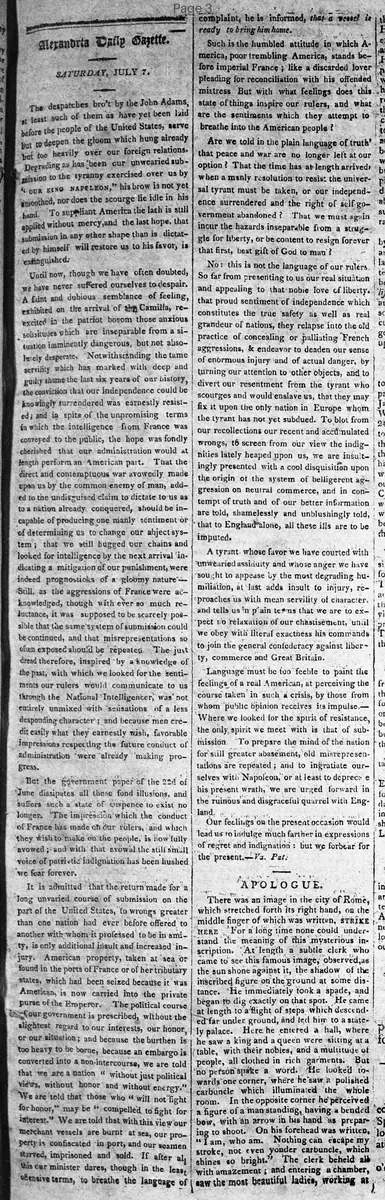
The despatches bro't by the John Adams, at least such of them as have yet been laid before the people of the United States, serve but to deepen the gloom which hung already over our foreign relations.
Degrading as has been our unwearied submission to the tyranny exercised over us by "our King Napoleon," his brow is not yet smoothed, nor does the scourge lie idle in his hand. To supplicant America the lash is still applied without mercy, and the last hope, that submission in any other shape than is dictated by himself will restore us to his favor, is extinguished:
Until now, though we have often doubted, we have never suffered ourselves to despair. A faint and dubious semblance of feeling, exhibited on the arrival of an Camilla, re-excited in the patriot bosom those anxious solicitudes which are inseparable from a situation imminently dangerous, but not absolutely desperate. Notwithstanding the tame servility which has marked with deep and guilty shame the last six years of our history, the conviction that our independence could be knowingly surrendered was earnestly resisted; and in spite of the unpromising terms in which the intelligence from France was conveyed to the public, the hope was fondly cherished that our administration would at length perform an American part. That the direct and contemptuous war avowedly made upon us by the common enemy of man, added to the undisguised claim to dictate to us as to a nation already conquered, should be incapable of producing one manly sentiment or of determining us to change our abject system; that we still hugged our chains and looked for intelligence by the next arrival indicating a mitigation of our punishment, were indeed prognosticks of a gloomy nature --
Still, as the aggressions of France were acknowledged, though with ever so much reluctance, it was supposed to be scarcely possible that the same system of submission could be continued, and that misrepresentations so often exposed should be repeated. The just dread therefore, inspired by a knowledge of the past, with which we looked for the sentiments our rulers would communicate to us through the National Intelligencer, was not entirely unmixed with sensations of a less desponding character; and because men credit easily what they earnestly wish, favorable impressions respecting the future conduct of administration were already making progress.
But the government paper of the 22d of June dissipates all those fond illusions, and suffers such a state of suspense to exist no longer. The impression which the conduct of France has made on our rulers, and which they wish to make on the people, is now fully avowed; and with that avowal the still small voice of patriotic indignation has been hushed we fear forever.
It is admitted that the return made for a long unvaried course of submission on the part of the United States, to wrongs greater than one nation had ever before offered to another with whom it professed to be in amity, is only additional insult and increased injury. American property, taken at sea or found in the ports of France or of her tributary states, which had been seized because it was American, is now carried into the private purse of the Emperor. The political course of our government is prescribed, without the slightest regard to our interests, our honor, or our situation; and because the burthen is too heavy to be borne, because an embargo is converted into a non-intercourse, we are told that we are a nation "without just political views, without honor and without energy."
We are told that those who "will not fight for honor," may be "compelled to fight for interest." We are told that with this view our merchant vessels are burnt at sea, our property is confiscated in port, and our seamen starved, imprisoned and sold. If after all, our minister dares, though in the least offensive terms, to breathe the language of complaint, he is informed, that a vessel is ready to bring him home.
Such is the humbled attitude in which America, poor trembling America, stands before imperial France; like a discarded lover pleading for reconciliation with his offended mistress. But with what feelings does this state of things inspire our rulers, and what are the sentiments which they attempt to breathe into the American people?
Are we told in the plain language of truth that peace and war are no longer left at our option? That the time has at length arrived when a manly resolution to resist the universal tyrant must be taken, or our independence surrendered and the right of self government abandoned? That we must again incur the hazards inseparable from a struggle for liberty, or be content to resign forever that first, best gift of God to man?
No: this is not the language of our rulers. So far from presenting to us our real situation and appealing to that noble love of liberty, that proud sentiment of independence which constitutes the true safety as well as real grandeur of nations, they relapse into the old practice of concealing or palliating French aggressions, & endeavor to deaden our sense of enormous injury and of actual danger, by turning our attention to other objects, and to divert our resentment from the tyrant who scourges and would enslave us, that they may fix it upon the only nation in Europe whom the tyrant has not yet subdued. To blot from our recollections our recent and accumulated wrongs, to screen from our view the indignities lately heaped upon us, we are insultingly presented with a cool disquisition upon the origin of the system of belligerent aggression on neutral commerce, and in contempt of truth and of our better information are told, shamelessly and unblushingly told, that to England alone, all these ills are to be imputed.
A tyrant, whose favor we have courted with unwearied assiduity and whose anger we have sought to appease by the most degrading humiliation, at last adds insult to injury, reproaches us with mean servility of character, and tells us in plain terms that we are to expect no relaxation of our chastisement, until we obey with literal exactness his commands to join the general confederacy against liberty, commerce and Great Britain.
Language must be too feeble to paint the feelings of a real American, at perceiving the course taken in such a crisis, by those from whom public opinion receives its impulse.— Where we looked for the spirit of resistance, the only spirit we meet with is that of submission. To prepare the mind of the nation for still greater abasement, old misrepresentations are repeated; and to ingratiate ourselves with Napoleon, or at least to deprecate his present wrath, "we are urged forward in the ruinous and disgraceful quarrel with England.
Our feelings on the present occasion would lead us to indulge much farther in expressions of regret and indignation: but we forbear for the present.—N. Y. Pat.
Degrading as has been our unwearied submission to the tyranny exercised over us by "our King Napoleon," his brow is not yet smoothed, nor does the scourge lie idle in his hand. To supplicant America the lash is still applied without mercy, and the last hope, that submission in any other shape than is dictated by himself will restore us to his favor, is extinguished:
Until now, though we have often doubted, we have never suffered ourselves to despair. A faint and dubious semblance of feeling, exhibited on the arrival of an Camilla, re-excited in the patriot bosom those anxious solicitudes which are inseparable from a situation imminently dangerous, but not absolutely desperate. Notwithstanding the tame servility which has marked with deep and guilty shame the last six years of our history, the conviction that our independence could be knowingly surrendered was earnestly resisted; and in spite of the unpromising terms in which the intelligence from France was conveyed to the public, the hope was fondly cherished that our administration would at length perform an American part. That the direct and contemptuous war avowedly made upon us by the common enemy of man, added to the undisguised claim to dictate to us as to a nation already conquered, should be incapable of producing one manly sentiment or of determining us to change our abject system; that we still hugged our chains and looked for intelligence by the next arrival indicating a mitigation of our punishment, were indeed prognosticks of a gloomy nature --
Still, as the aggressions of France were acknowledged, though with ever so much reluctance, it was supposed to be scarcely possible that the same system of submission could be continued, and that misrepresentations so often exposed should be repeated. The just dread therefore, inspired by a knowledge of the past, with which we looked for the sentiments our rulers would communicate to us through the National Intelligencer, was not entirely unmixed with sensations of a less desponding character; and because men credit easily what they earnestly wish, favorable impressions respecting the future conduct of administration were already making progress.
But the government paper of the 22d of June dissipates all those fond illusions, and suffers such a state of suspense to exist no longer. The impression which the conduct of France has made on our rulers, and which they wish to make on the people, is now fully avowed; and with that avowal the still small voice of patriotic indignation has been hushed we fear forever.
It is admitted that the return made for a long unvaried course of submission on the part of the United States, to wrongs greater than one nation had ever before offered to another with whom it professed to be in amity, is only additional insult and increased injury. American property, taken at sea or found in the ports of France or of her tributary states, which had been seized because it was American, is now carried into the private purse of the Emperor. The political course of our government is prescribed, without the slightest regard to our interests, our honor, or our situation; and because the burthen is too heavy to be borne, because an embargo is converted into a non-intercourse, we are told that we are a nation "without just political views, without honor and without energy."
We are told that those who "will not fight for honor," may be "compelled to fight for interest." We are told that with this view our merchant vessels are burnt at sea, our property is confiscated in port, and our seamen starved, imprisoned and sold. If after all, our minister dares, though in the least offensive terms, to breathe the language of complaint, he is informed, that a vessel is ready to bring him home.
Such is the humbled attitude in which America, poor trembling America, stands before imperial France; like a discarded lover pleading for reconciliation with his offended mistress. But with what feelings does this state of things inspire our rulers, and what are the sentiments which they attempt to breathe into the American people?
Are we told in the plain language of truth that peace and war are no longer left at our option? That the time has at length arrived when a manly resolution to resist the universal tyrant must be taken, or our independence surrendered and the right of self government abandoned? That we must again incur the hazards inseparable from a struggle for liberty, or be content to resign forever that first, best gift of God to man?
No: this is not the language of our rulers. So far from presenting to us our real situation and appealing to that noble love of liberty, that proud sentiment of independence which constitutes the true safety as well as real grandeur of nations, they relapse into the old practice of concealing or palliating French aggressions, & endeavor to deaden our sense of enormous injury and of actual danger, by turning our attention to other objects, and to divert our resentment from the tyrant who scourges and would enslave us, that they may fix it upon the only nation in Europe whom the tyrant has not yet subdued. To blot from our recollections our recent and accumulated wrongs, to screen from our view the indignities lately heaped upon us, we are insultingly presented with a cool disquisition upon the origin of the system of belligerent aggression on neutral commerce, and in contempt of truth and of our better information are told, shamelessly and unblushingly told, that to England alone, all these ills are to be imputed.
A tyrant, whose favor we have courted with unwearied assiduity and whose anger we have sought to appease by the most degrading humiliation, at last adds insult to injury, reproaches us with mean servility of character, and tells us in plain terms that we are to expect no relaxation of our chastisement, until we obey with literal exactness his commands to join the general confederacy against liberty, commerce and Great Britain.
Language must be too feeble to paint the feelings of a real American, at perceiving the course taken in such a crisis, by those from whom public opinion receives its impulse.— Where we looked for the spirit of resistance, the only spirit we meet with is that of submission. To prepare the mind of the nation for still greater abasement, old misrepresentations are repeated; and to ingratiate ourselves with Napoleon, or at least to deprecate his present wrath, "we are urged forward in the ruinous and disgraceful quarrel with England.
Our feelings on the present occasion would lead us to indulge much farther in expressions of regret and indignation: but we forbear for the present.—N. Y. Pat.
What sub-type of article is it?
Foreign Affairs
War Or Peace
Partisan Politics
What keywords are associated?
Napoleonic France
Us Submission
Foreign Policy
Administration Criticism
Neutral Commerce
Resistance Call
English Blame
What entities or persons were involved?
Napoleon
Us Administration
France
England
National Intelligencer
Editorial Details
Primary Topic
Criticism Of Us Submission To Napoleonic France
Stance / Tone
Strongly Critical Of Administration's Submissive Policy
Key Figures
Napoleon
Us Administration
France
England
National Intelligencer
Key Arguments
Us Submission To France Has Deepened Foreign Relations Gloom
France Continues To Insult And Injure The Us Despite Submission
Administration Conceals French Aggressions And Blames England
Us Independence Is At Risk Without Resistance
Rulers Fail To Inspire Manly Resistance Or Love Of Liberty
Napoleon Dictates Us Policy Without Regard To Honor Or Interests
Embargo And Non Intercourse Measures Highlight Us Weakness
Patriotic Indignation Is Hushed By Administration's Avowal
Misrepresentations Of Belligerent Aggression Origins Repeated
Us Urged Into Quarrel With England To Appease Napoleon