Thank you for visiting SNEWPapers!
Sign up free
Letter to Editor
August 23, 1813
Virginia Argus
Richmond, Virginia
What is this article about?
This letter criticizes Great Britain's imperial ambitions and hypocrisy, urging Americans to reject shared heritage as justification for overlooking outrages. It warns against internal British sympathizers and opposition to the administration, defends the embargo and Gallatin's appointment, and calls for patriotic unity during the war.
Clipping
OCR Quality
95%
Excellent
Full Text
For the ARGUS,
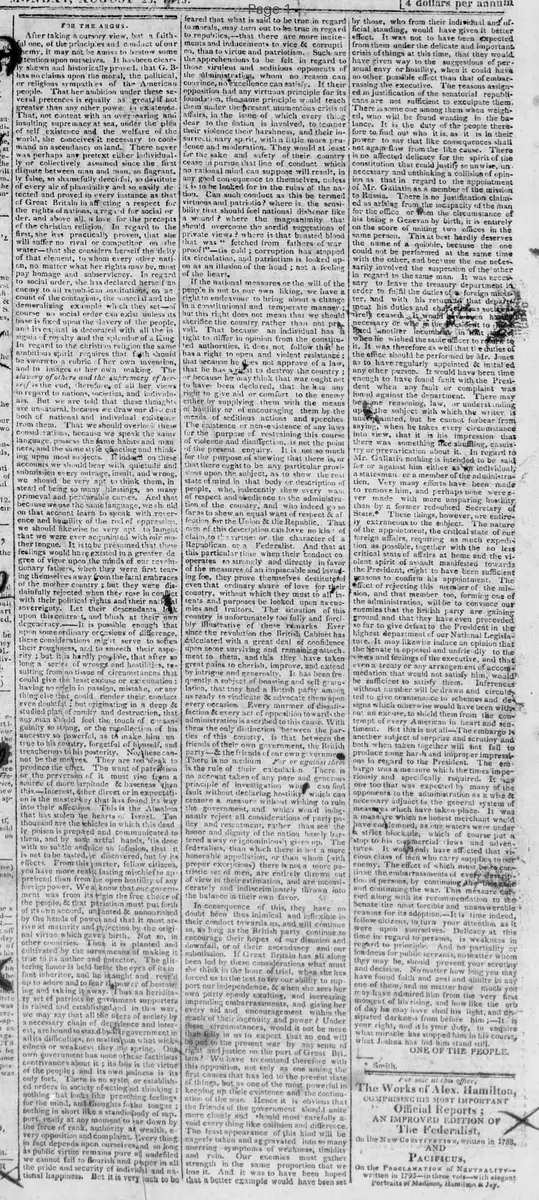
After taking a cursory view, but a faithful one, of the principles and conduct of our enemy, it may not be amiss to bestow some attention upon ourselves. It has been clearly shewn and historically proved, that G. B. has no claims upon the moral, the political, or religious sympathies of the American people. That her ambition under these several pretences is equally as great, if not greater than any other power in existence. That, not content with an overbearing and insulting supremacy at sea, under the plea of self existence and the welfare of the world, she conceives it necessary to command an ascendancy on land. There never was perhaps any pretext either individually or collectively assumed since the first dispute between man and man, so flagrantly false, so shamefully deceitful, so destitute of every air of plausibility and so easily detected and proved in every instance as that of Great Britain in affecting a respect for the rights of nations, a regard for social order, and above all, a love for the precepts of the christian religion. In regard to the first, she has practically proven, that she will suffer no rival or competitor on the water-that she considers herself the deity of that element, to whom every other nation, no matter what her rights may be, must pay homage and subserviency. In regard to social order, she has declared herself an enemy to all republican institutions, on account of the contagious, the unsocial and the demoralizing example which they set-of course no social order can exist unless its base is fixed upon the slavery of the people, and its capital is decorated with all the insignia of royalty and the splendor of a King. In regard to the christian religion the same ambitious spirit requires that faith should be sworn to a rubric of her own invention, and to images of her own making. The slavery of others and the supremacy of herself is the end, therefore, of all her views in regard to nations, societies, and individuals. But we are told that these thoughts are unnatural, because we draw our descent both of national and individual existence from them. That we should overlook these considerations, because we speak the same language, possess the same habits and manners, and the same style of acting and thinking upon most subjects. If indeed on these accounts we should bear with quietude and submission every outrage, insult, and wrong, we should be very apt to think them, instead of being so many blessings, so many primeval and perdurable curses. And that because we use the same language, we should on that account learn to speak with reverence and humility of the rod of oppression, we should likewise be very apt to lament that we were ever acquainted with our mother tongue. It is to be presumed that these feelings would have existed in a greater degree of vigor upon the minds of our revolutionary fathers, when they were first tearing themselves away from the fatal embraces of the mother country ; but they were disdainfully rejected when they rose in conflict with their political rights and their national sovereignty. Let their descendants look upon this contrast, and blush at their own degeneracy.--It is possible enough that upon some ordinary occasions of difference, these considerations might serve to soften their roughness, and to smooth their asperity ; but it is hardly possible, that after so long a series of wrongs and hostilities, resulting from no tissue of circumstances that could give the least excuse or extenuation: having no origin in passion, mistake, or anything else that could render their conduct even doubtful but originating in a deep & studied plan of enmity and destruction, that any man should feel the touch of consanguinity so strong, or the recollection of his ancestry so powerful, as to make him untrue to his country, forgetful of himself, and treacherous to his posterity. No, these cannot be the motives. They are too weak to produce the effect. The want of patriotism or the perversion of it must rise from a source of more turpitude & baseness than this.--Interest, either direct or in expectation is the master key that has found its way into their affections This is the Absalom that has stolen the hearts of Israel. Ten thousand are the vehicles in which this deadly poison is prepared and communicated to them, and by some artful hands. 'tis done with so subtle and nice an infusion, that it is not to be tasted, or discovered, but by its effects. From this quarter, fellow citizens, you have more real & lasting mischief to apprehend than from the open hostility of any foreign power. We all know that our government was from its origin the free choice of the people, & that patriotism must put forth of its own accord, unplanted & unnourished by the hands of power and that it must arrive at maturity and perfection by the original virtue which gave it birth. Not so, in other countries. There it is planted and cultivated by the surest means of making it true to its author and protector. The glittering honor is held before the eyes of its infant inheritor, and he is taught and reared up to adore and to fear that power of bestowing and taking it away. Thus an hereditary set of patriots or government supporters is raised and established, and in this way, we may say that all the orders of society by a necessary chain of dependence and interest, are bound to stand by their government in all its difficulties, no matter from what wickedness or weakness they may spring. Our own government has none of these factitious contrivances about it ; its basis is the virtue of the people; and its own goodness is its only fort. There is no system or established orders in society of acting and thinking; nothing that looks like prescribing feelings for the mind, and thoughts for the tongue ; nothing in short like a standing body of support, ready at any moment to bear down by the force of rank, authority and wealth, every opposition and complaint. Every thing in fact depends upon ourselves, and so long as public virtue remains pure and undefiled we cannot fail to flourish and prosper in all the pride and security of individual and national happiness. But it is very feared that what is said to be true in regard to morals, may turn out to be true in regard to republics,--that there are more incitements and inducements to vice & corruption, than to virtue and patriotism. Such are the apprehensions to be felt in regard to those virulent and seditious opponents of the administration, whom no reason can convince, no excellence can satisfy. If their opposition had any virtuous principle for its foundation, the same principle would teach them under the present momentous crisis of affairs, in the issue of , which every thing dear to the nation is involved, to temper their violence their harshness, and their insurrectionary spirit, with a little more prudence and moderation. They would at least for the sake and safety of their country cease to pursue that line of conduct which no rational mind can suppose will result, in any good consequence to themselves, unless it is to be looked for in the ruins of the nation. Can such conduct as this be termed virtuous and patriotic? where is the sensibility that should feel national dishonor like a wound? where the magnanimity that should overcome the sordid suggestions of private views ? where is that boasted blood that was " fetched from fathers of war proof!" -tis cold; corruption has stopped its circulation, and patriotism is looked upon as an illusion of the head; not a feeling of the heart.
If the national measures or the will of the people is not to our own liking, we have a right to endeavour to bring about a change in a constitutional and temperate manner; but this right does not mean that we should sacrifice the country rather than not prevail. That because an individual has a right to differ in opinion from the constituted authorities. it does not follow that he has a right to open and violent resistance; that because he does not approve of a law. that he has a right to destroy the country ; or because he may think that war ought not to have been declared, that he has any right to give aid or comfort to the enemy either by supplying them with the means of hostility or of encouraging them by the means of seditious actions and speeches The existence or non-existence of any laws for the purpose of restraining this course of violence and disaffection, is not the point of the present enquiry. It is not so much for the purpose of shewing that there is, or that there ought to be any particular provisions upon the subject, as to shew the real state of mind in that body or description of people, who, indecently shew every want of respect and obedience to the administration of the country. and who indeed go so far as to shew an equal want of respect & affection for the Union & the Republic. That men of this description can have no kind of claim to the virtues or the character of a Republican or a Federalist. And that at this particular time when their conduct co operates so strongly and directly in favor of the measures of an implacable and invading foe, they prove themselves destitute of even that ordinary share of love for their country, without which they must to all intents and purposes be looked upon as enemies and traitors. The situation of this country is unfortunately too fully and forcibly illustrative of these remarks Ever since the revolution the British Cabinet has calculated with a great deal of confidence upon some surviving and remaining attachment to them, and this they have taken great pains to cherish, improve, and extend by intrigue and generosity. It has been frequently a subject of boasting and self-gratulation, that they had a British party among us ready to vindicate & advocate them upon every occasion. Every murmur of dissatisfaction & every act of opposition towards the administration is ascribed to this cause. With them the only distinction between the parties of this country, is that between the friends of their own government, the British party-& the friends of our own government There is no medium For or against them is the rule of their calculation There is no account taken of any pure and generous principle of investigation which can find fault without declaring hostility? which can censure a measure without wishing to ruin the government, and which would indignantly reject all considerations of party policy and resentment. rather than see the honor and dignity of the nation basely bartered away or ignominiously given up. The federalists. than which there is not a more honorable appellation, or than whom (with proper exceptions) there is not a more patriotic set of men, are entirely thrown out of view in their estimation, and are inconsiderately and indiscriminately thrown into the balance in their own favor.
In consequence of this, they have no doubt been thus inimical and inflexible in their conduct towards us, and will continue so, as long as the British party Continue to encourage their hopes of our disunion and downfall, or of their ascendancy and our submission. If Great Britain has all along been led by these Considerations what must she think in the hour of trial, when she has forced us to the test to try our ability to support our independence, & when she sees her own party openly exulting, and increasing impendinig embarrassments, and giving her every aid and encouragement within the reach of their ingenuity and power ? Under these circumstances, would it not be more than folly in us to expect that an end will be put to the present war by any sense of right and justice on the part of Great Britain? We have to contend therefore with this opposition, not only as one among the first causes that has led to the present state of things, but as one of the most powerful in keeping up their existence and the continuation of the war. Hence it is obvious that the friends of the government should unite more closely and should most carefully avoid every thing like collision and difference. The least appearance of this kind will be eagerly taken and aggravated into so many unerring symptoms of weakness, timidity and ruin. Our enemies must gather strength in the same proportion that we lose it. And it was to have been hoped that a better example would have been set by those, who from their individual and official standing, would have given it better effect. It was not to have been expected from them under the delicate and important crisis of things at this time, that they would have given way to the suggestions of personal envy or hostility, when it could have no other possible effect than that of embarrassing the executive. The reasons assigned in justification of the senatorial republicans are not sufficient to excupate them. There is some one among them when weighed, who will be found wanting in the balance. It is the duty of the people therefore to find out who it is, as it is in their power to say that like consequences shall not again flow from the like cause. There is no affected delicacy for the spirit of the constitution that could justify so unwise. unnecessary and unthinking a collision of opinion as that in regard to the appointment of Mr. Gallatin as a member of the mission to Russia. There is no justification claimed as arising. from the incapacity of the man for the office or from the circumstance of his being a Genevan by birth, it is entirely on the score of uniting two offices in the same person. This at best hardly deserves the name of a quibble, because the one could not be performed at the same time with the other, and because the one necessarily involved the suspension of the other in regard to the same man. It was necessary to leave the treasury department in order to fulfill the duties of a foreign minister, and with his return to that department his duties and character as such entirely ceased. it would have been even more necessary or wise in the President to have fixed another incumbent-in that when he wished the same officer to return to it. It was therefore as well that the duties of the office should be performed by Mr. Jones as to have regularly appointed & instaled any other person. It would have been time enough to have found fault with the President when any fault or complaint was found against the department. There may be some reasoning, law, or understanding upon the subject with which the writer is unacquainted, but he cannot forbear from saying,' when he takes every circumstance into view. that it is his impression that there was something like shuffling, casuistry or prevarication about it. In regard to Mr. Gallatin nothing is intended to be said for or against him either as an individual, a statesman. or a member of the administration. Very many efforts have been made to remove him, and perhaps none were ever made with more unsparing hostility than by a former redoubted Secretary of State.* These things, however, are entirely extraneous to the subject. The nature of the appointment, the critical state of our foreign affairs, requiring as much expedition as possible, together with the no less critical state of affairs at home and the violent spirit of assault manifested towards the President, ought to have been sufficient reasons to confirm his appointment. The effect of rejecting this member of the mission, and that member too, forming one of the administration, will be to convince our enemies that the British party are gaining ground and that they have even proceeded so far to give defeat to the President in the highest department of our National Legislature. It may likewise induce an opinion that the Senate is opposed and unfriendly to the views and feelings of the executive, and that even a treaty or any arrangement of accommodation that would not satisfy him, would be sufficient to satisfy them. Inferences without number will be drawn and circulated to give countenance to schemes and designs which otherwise would have been without an excuse, to shield them from the contempt of every American in heart and sentiment. But this is not all--The embargo is another subject of surprise and scrutiny and both when taken together will not fail to produce some harsh and improper impressions in regard to the President. The embargo was a measure which the times imperiously and specifically required. It was one too that was expected by many of the opponents to the administration as a wise & necessary adjunct to the general system of measures which have taken place. It was a measure which no honest merchant would have condemned, as our waters were under a strict blockade, which of course put a stop to his commercial views and adventures. it would only have affected that vicious class of men who carry supplies to our enemy. The effect of which must be to continue the embarrassments of every description of persons, by continuing the blockade and continuing the war. This measure carried along with its recommendation to the Senate the most forcible and unanswerable reasons for its adoption.-It is time indeed, fellow citizens, to turn your attention as it were upon yourselves. Delicacy at this time in regard to persons, is weakness in regard to principle. And no partiality or fondness for public servants, no matter whom they may be, should prevent your scrutiny and decision. No matter how long you may have found faith and zeal and ability in any one of them, and no matter how much you may have admired him from the very first moment of his rising, and how like the orb of day he may have shed his light, and dissipated darkness from before him;-It is your right, and it is your duty, to enquire what miracle has stopped him in his course, what Joshua has bid him stand still.
ONE OF THE PEOPLE.
After taking a cursory view, but a faithful one, of the principles and conduct of our enemy, it may not be amiss to bestow some attention upon ourselves. It has been clearly shewn and historically proved, that G. B. has no claims upon the moral, the political, or religious sympathies of the American people. That her ambition under these several pretences is equally as great, if not greater than any other power in existence. That, not content with an overbearing and insulting supremacy at sea, under the plea of self existence and the welfare of the world, she conceives it necessary to command an ascendancy on land. There never was perhaps any pretext either individually or collectively assumed since the first dispute between man and man, so flagrantly false, so shamefully deceitful, so destitute of every air of plausibility and so easily detected and proved in every instance as that of Great Britain in affecting a respect for the rights of nations, a regard for social order, and above all, a love for the precepts of the christian religion. In regard to the first, she has practically proven, that she will suffer no rival or competitor on the water-that she considers herself the deity of that element, to whom every other nation, no matter what her rights may be, must pay homage and subserviency. In regard to social order, she has declared herself an enemy to all republican institutions, on account of the contagious, the unsocial and the demoralizing example which they set-of course no social order can exist unless its base is fixed upon the slavery of the people, and its capital is decorated with all the insignia of royalty and the splendor of a King. In regard to the christian religion the same ambitious spirit requires that faith should be sworn to a rubric of her own invention, and to images of her own making. The slavery of others and the supremacy of herself is the end, therefore, of all her views in regard to nations, societies, and individuals. But we are told that these thoughts are unnatural, because we draw our descent both of national and individual existence from them. That we should overlook these considerations, because we speak the same language, possess the same habits and manners, and the same style of acting and thinking upon most subjects. If indeed on these accounts we should bear with quietude and submission every outrage, insult, and wrong, we should be very apt to think them, instead of being so many blessings, so many primeval and perdurable curses. And that because we use the same language, we should on that account learn to speak with reverence and humility of the rod of oppression, we should likewise be very apt to lament that we were ever acquainted with our mother tongue. It is to be presumed that these feelings would have existed in a greater degree of vigor upon the minds of our revolutionary fathers, when they were first tearing themselves away from the fatal embraces of the mother country ; but they were disdainfully rejected when they rose in conflict with their political rights and their national sovereignty. Let their descendants look upon this contrast, and blush at their own degeneracy.--It is possible enough that upon some ordinary occasions of difference, these considerations might serve to soften their roughness, and to smooth their asperity ; but it is hardly possible, that after so long a series of wrongs and hostilities, resulting from no tissue of circumstances that could give the least excuse or extenuation: having no origin in passion, mistake, or anything else that could render their conduct even doubtful but originating in a deep & studied plan of enmity and destruction, that any man should feel the touch of consanguinity so strong, or the recollection of his ancestry so powerful, as to make him untrue to his country, forgetful of himself, and treacherous to his posterity. No, these cannot be the motives. They are too weak to produce the effect. The want of patriotism or the perversion of it must rise from a source of more turpitude & baseness than this.--Interest, either direct or in expectation is the master key that has found its way into their affections This is the Absalom that has stolen the hearts of Israel. Ten thousand are the vehicles in which this deadly poison is prepared and communicated to them, and by some artful hands. 'tis done with so subtle and nice an infusion, that it is not to be tasted, or discovered, but by its effects. From this quarter, fellow citizens, you have more real & lasting mischief to apprehend than from the open hostility of any foreign power. We all know that our government was from its origin the free choice of the people, & that patriotism must put forth of its own accord, unplanted & unnourished by the hands of power and that it must arrive at maturity and perfection by the original virtue which gave it birth. Not so, in other countries. There it is planted and cultivated by the surest means of making it true to its author and protector. The glittering honor is held before the eyes of its infant inheritor, and he is taught and reared up to adore and to fear that power of bestowing and taking it away. Thus an hereditary set of patriots or government supporters is raised and established, and in this way, we may say that all the orders of society by a necessary chain of dependence and interest, are bound to stand by their government in all its difficulties, no matter from what wickedness or weakness they may spring. Our own government has none of these factitious contrivances about it ; its basis is the virtue of the people; and its own goodness is its only fort. There is no system or established orders in society of acting and thinking; nothing that looks like prescribing feelings for the mind, and thoughts for the tongue ; nothing in short like a standing body of support, ready at any moment to bear down by the force of rank, authority and wealth, every opposition and complaint. Every thing in fact depends upon ourselves, and so long as public virtue remains pure and undefiled we cannot fail to flourish and prosper in all the pride and security of individual and national happiness. But it is very feared that what is said to be true in regard to morals, may turn out to be true in regard to republics,--that there are more incitements and inducements to vice & corruption, than to virtue and patriotism. Such are the apprehensions to be felt in regard to those virulent and seditious opponents of the administration, whom no reason can convince, no excellence can satisfy. If their opposition had any virtuous principle for its foundation, the same principle would teach them under the present momentous crisis of affairs, in the issue of , which every thing dear to the nation is involved, to temper their violence their harshness, and their insurrectionary spirit, with a little more prudence and moderation. They would at least for the sake and safety of their country cease to pursue that line of conduct which no rational mind can suppose will result, in any good consequence to themselves, unless it is to be looked for in the ruins of the nation. Can such conduct as this be termed virtuous and patriotic? where is the sensibility that should feel national dishonor like a wound? where the magnanimity that should overcome the sordid suggestions of private views ? where is that boasted blood that was " fetched from fathers of war proof!" -tis cold; corruption has stopped its circulation, and patriotism is looked upon as an illusion of the head; not a feeling of the heart.
If the national measures or the will of the people is not to our own liking, we have a right to endeavour to bring about a change in a constitutional and temperate manner; but this right does not mean that we should sacrifice the country rather than not prevail. That because an individual has a right to differ in opinion from the constituted authorities. it does not follow that he has a right to open and violent resistance; that because he does not approve of a law. that he has a right to destroy the country ; or because he may think that war ought not to have been declared, that he has any right to give aid or comfort to the enemy either by supplying them with the means of hostility or of encouraging them by the means of seditious actions and speeches The existence or non-existence of any laws for the purpose of restraining this course of violence and disaffection, is not the point of the present enquiry. It is not so much for the purpose of shewing that there is, or that there ought to be any particular provisions upon the subject, as to shew the real state of mind in that body or description of people, who, indecently shew every want of respect and obedience to the administration of the country. and who indeed go so far as to shew an equal want of respect & affection for the Union & the Republic. That men of this description can have no kind of claim to the virtues or the character of a Republican or a Federalist. And that at this particular time when their conduct co operates so strongly and directly in favor of the measures of an implacable and invading foe, they prove themselves destitute of even that ordinary share of love for their country, without which they must to all intents and purposes be looked upon as enemies and traitors. The situation of this country is unfortunately too fully and forcibly illustrative of these remarks Ever since the revolution the British Cabinet has calculated with a great deal of confidence upon some surviving and remaining attachment to them, and this they have taken great pains to cherish, improve, and extend by intrigue and generosity. It has been frequently a subject of boasting and self-gratulation, that they had a British party among us ready to vindicate & advocate them upon every occasion. Every murmur of dissatisfaction & every act of opposition towards the administration is ascribed to this cause. With them the only distinction between the parties of this country, is that between the friends of their own government, the British party-& the friends of our own government There is no medium For or against them is the rule of their calculation There is no account taken of any pure and generous principle of investigation which can find fault without declaring hostility? which can censure a measure without wishing to ruin the government, and which would indignantly reject all considerations of party policy and resentment. rather than see the honor and dignity of the nation basely bartered away or ignominiously given up. The federalists. than which there is not a more honorable appellation, or than whom (with proper exceptions) there is not a more patriotic set of men, are entirely thrown out of view in their estimation, and are inconsiderately and indiscriminately thrown into the balance in their own favor.
In consequence of this, they have no doubt been thus inimical and inflexible in their conduct towards us, and will continue so, as long as the British party Continue to encourage their hopes of our disunion and downfall, or of their ascendancy and our submission. If Great Britain has all along been led by these Considerations what must she think in the hour of trial, when she has forced us to the test to try our ability to support our independence, & when she sees her own party openly exulting, and increasing impendinig embarrassments, and giving her every aid and encouragement within the reach of their ingenuity and power ? Under these circumstances, would it not be more than folly in us to expect that an end will be put to the present war by any sense of right and justice on the part of Great Britain? We have to contend therefore with this opposition, not only as one among the first causes that has led to the present state of things, but as one of the most powerful in keeping up their existence and the continuation of the war. Hence it is obvious that the friends of the government should unite more closely and should most carefully avoid every thing like collision and difference. The least appearance of this kind will be eagerly taken and aggravated into so many unerring symptoms of weakness, timidity and ruin. Our enemies must gather strength in the same proportion that we lose it. And it was to have been hoped that a better example would have been set by those, who from their individual and official standing, would have given it better effect. It was not to have been expected from them under the delicate and important crisis of things at this time, that they would have given way to the suggestions of personal envy or hostility, when it could have no other possible effect than that of embarrassing the executive. The reasons assigned in justification of the senatorial republicans are not sufficient to excupate them. There is some one among them when weighed, who will be found wanting in the balance. It is the duty of the people therefore to find out who it is, as it is in their power to say that like consequences shall not again flow from the like cause. There is no affected delicacy for the spirit of the constitution that could justify so unwise. unnecessary and unthinking a collision of opinion as that in regard to the appointment of Mr. Gallatin as a member of the mission to Russia. There is no justification claimed as arising. from the incapacity of the man for the office or from the circumstance of his being a Genevan by birth, it is entirely on the score of uniting two offices in the same person. This at best hardly deserves the name of a quibble, because the one could not be performed at the same time with the other, and because the one necessarily involved the suspension of the other in regard to the same man. It was necessary to leave the treasury department in order to fulfill the duties of a foreign minister, and with his return to that department his duties and character as such entirely ceased. it would have been even more necessary or wise in the President to have fixed another incumbent-in that when he wished the same officer to return to it. It was therefore as well that the duties of the office should be performed by Mr. Jones as to have regularly appointed & instaled any other person. It would have been time enough to have found fault with the President when any fault or complaint was found against the department. There may be some reasoning, law, or understanding upon the subject with which the writer is unacquainted, but he cannot forbear from saying,' when he takes every circumstance into view. that it is his impression that there was something like shuffling, casuistry or prevarication about it. In regard to Mr. Gallatin nothing is intended to be said for or against him either as an individual, a statesman. or a member of the administration. Very many efforts have been made to remove him, and perhaps none were ever made with more unsparing hostility than by a former redoubted Secretary of State.* These things, however, are entirely extraneous to the subject. The nature of the appointment, the critical state of our foreign affairs, requiring as much expedition as possible, together with the no less critical state of affairs at home and the violent spirit of assault manifested towards the President, ought to have been sufficient reasons to confirm his appointment. The effect of rejecting this member of the mission, and that member too, forming one of the administration, will be to convince our enemies that the British party are gaining ground and that they have even proceeded so far to give defeat to the President in the highest department of our National Legislature. It may likewise induce an opinion that the Senate is opposed and unfriendly to the views and feelings of the executive, and that even a treaty or any arrangement of accommodation that would not satisfy him, would be sufficient to satisfy them. Inferences without number will be drawn and circulated to give countenance to schemes and designs which otherwise would have been without an excuse, to shield them from the contempt of every American in heart and sentiment. But this is not all--The embargo is another subject of surprise and scrutiny and both when taken together will not fail to produce some harsh and improper impressions in regard to the President. The embargo was a measure which the times imperiously and specifically required. It was one too that was expected by many of the opponents to the administration as a wise & necessary adjunct to the general system of measures which have taken place. It was a measure which no honest merchant would have condemned, as our waters were under a strict blockade, which of course put a stop to his commercial views and adventures. it would only have affected that vicious class of men who carry supplies to our enemy. The effect of which must be to continue the embarrassments of every description of persons, by continuing the blockade and continuing the war. This measure carried along with its recommendation to the Senate the most forcible and unanswerable reasons for its adoption.-It is time indeed, fellow citizens, to turn your attention as it were upon yourselves. Delicacy at this time in regard to persons, is weakness in regard to principle. And no partiality or fondness for public servants, no matter whom they may be, should prevent your scrutiny and decision. No matter how long you may have found faith and zeal and ability in any one of them, and no matter how much you may have admired him from the very first moment of his rising, and how like the orb of day he may have shed his light, and dissipated darkness from before him;-It is your right, and it is your duty, to enquire what miracle has stopped him in his course, what Joshua has bid him stand still.
ONE OF THE PEOPLE.
What sub-type of article is it?
Persuasive
Political
Provocative
What themes does it cover?
Politics
Military War
Economic Policy
What keywords are associated?
British Aggression
American Patriotism
War Opposition
Embargo Defense
Gallatin Appointment
Political Unity
Federalist Critique
What entities or persons were involved?
One Of The People
For The Argus
Letter to Editor Details
Author
One Of The People
Recipient
For The Argus
Main Argument
americans must reject british sympathies and internal divisions, unite behind the administration during the war, as opposition aids the enemy; defends the embargo and gallatin's appointment against senatorial objections.
Notable Details
Criticizes Great Britain's Hypocrisy In Claiming Respect For Nations' Rights, Social Order, And Christianity
References Revolutionary Fathers Rejecting British Ties
Alludes To Absalom Stealing Hearts Of Israel For Internal Betrayal
Defends Gallatin's Dual Role In Treasury And Mission To Russia
Supports Embargo As Necessary Against Blockade And Enemy Supplies