Thank you for visiting SNEWPapers!
Sign up free
Spirit Of Jefferson
Charles Town, Jefferson County, West Virginia
What is this article about?
During the 1888 presidential campaign, Democratic Vice-Presidential candidate Judge Allen G. Thurman speaks in Port Huron, Michigan, praising President Grover Cleveland's administration and arguing for tariff reduction to eliminate surplus revenue, relieve consumer burdens, and benefit laborers by lowering taxes on imported and domestic goods.
Clipping
OCR Quality
Full Text
CAMPAIGN
VICE-PRESIDENT
THURMAN'S
SPEECH AT PORT HURON.
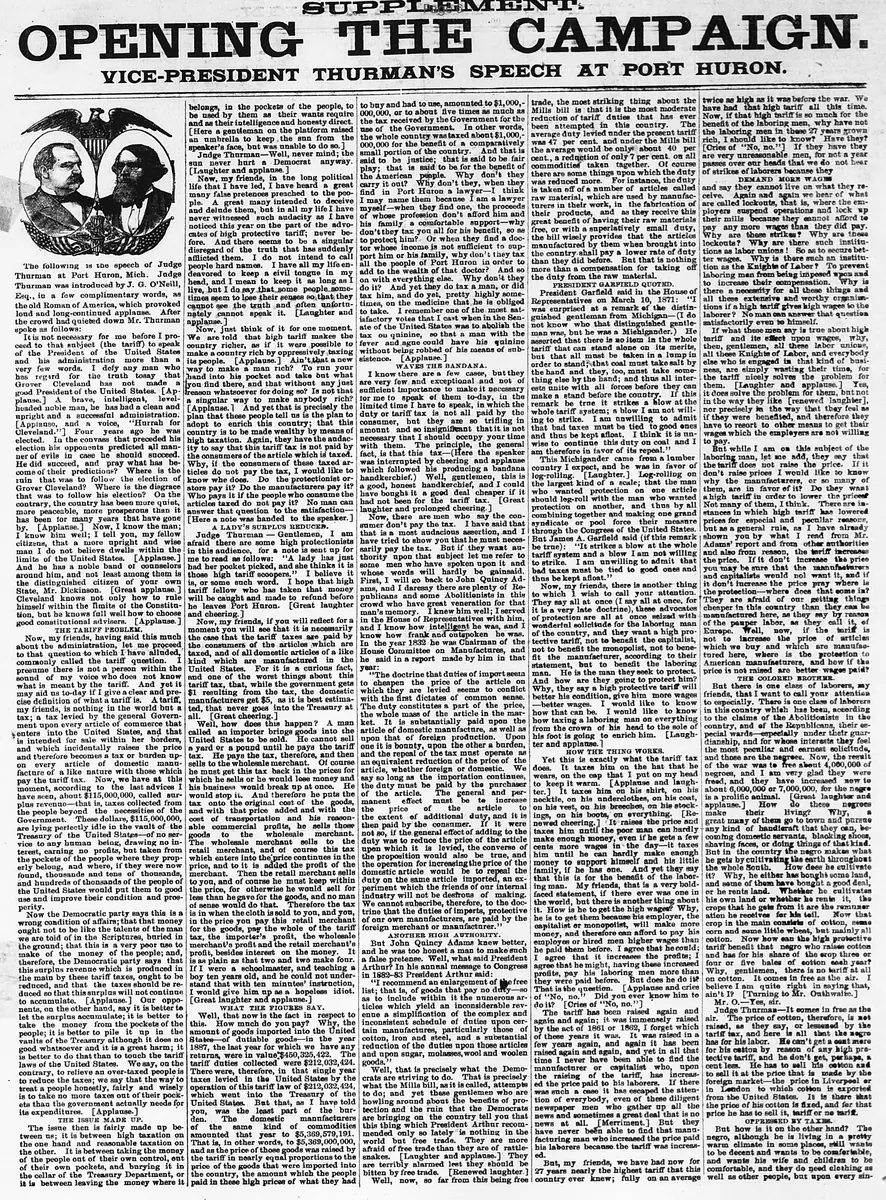
The following is the speech of Judge Thurman at Port Huron, Mich. Judge Thurman was introduced by J. G. O'Neill, Esq., in a few complimentary words, as the old Roman of America, which provoked loud and long-continued applause. After the crowd had quieted down Mr. Thurman spoke as follows:
It is not necessary for me before I proceed to that subject (the tariff) to speak of the President of the United States and his administration more than a very few words. I defy any man who has regard for the truth to say that Grover Cleveland has not made a good President of the United States. [Applause.] A brave, intelligent, level-headed noble man, he has had a clean and upright and a successful administration. [Applause, and a voice, "Hurrah for Cleveland."] Four years ago he was elected. In the canvass that preceded his election his opponents predicted all manner of evils in case he should succeed. He did succeed, and pray what has become of their predictions? Where is the ruin that was to follow the election of Grover Cleveland? Where is the disgrace that was to follow his election? On the contrary, the country has been more quiet, more peaceable, more prosperous than it has been for many years that have gone by. [Applause.] Now, I know the man; I know him well; I tell you, my fellow citizens, that a more upright and wise man I do not believe dwells within the limits of the United States. [Applause.] And he has a noble band of counselors around him, and not least among them is the distinguished citizen of your own State, Mr. Dickinson. [Great applause.] Cleveland knows not only how to rule himself within the limits of the Constitution, but he knows full well how to choose good constitutional advisers. [Applause.]
THE TARIFF PROBLEM
Now, my friends, having said this much about the administration, let me proceed to that question to which I have alluded, commonly called the tariff question. I presume there is not a person within the sound of my voice who does not know what is meant by the tariff. And yet it may aid us to-day if I give a clear and precise definition of what a tariff is. A tariff, my friends, is nothing in the world but a tax; a tax levied by the general Government upon every article of commerce that enters into the United States, and that is intended for sale within her borders, and which incidentally raises the price and therefore becomes a tax or burden upon every article of domestic manufacture of a like nature with those which pay the tariff tax. Now, we have at this moment, according to the last advices I have seen, about $115,000,000, called surplus revenue-that is, taxes collected from the people beyond the necessities of the Government. These dollars, $115,000,000, are lying perfectly idle in the vault of the Treasury of the United States-of no service to any human being, drawing no interest, earning no profits, but taken from the pockets of the people where they properly belong, and where, if they were now found, thousands and tens of thousands, and hundreds of thousands of the people of the United States would put them to good use and improve their condition and prosperity.
Now the Democratic party says this is a wrong condition of affairs; that that money ought not to be like the talents of the man we are told of in the Scriptures, buried in the ground; that this is a very poor use to make of the money of the people; and, therefore, the Democratic party says that this surplus revenue which is produced in the main by these tariff taxes, ought to be reduced, and that the taxes should be reduced so that this surplus will not continue to accumulate. [Applause.] Our opponents, on the other hand, say it is better to let the surplus accumulate; it is better to take the money from the pockets of the people; it is better to pile it up in the vaults of the Treasury although it does no good whatsoever and it is a great harm; it is better to do that than to touch the tariff laws of the United States. We say, on the contrary, to relieve an over-taxed people is to reduce the taxes; we say that the way to treat a people honestly, fairly and wisely is to take no more taxes out of their pockets than the government actually needs for its expenditures. [Applause.]
THE ISSUE MADE UP.
The issue then is fairly made up between us; it is between high taxation on the one hand and reasonable taxation on the other. It is between taking the money of the people out of their own control, out of their own pockets, and burying it in the cellar of the Treasury Department, or it is between leaving the money where it belongs, in the pockets of the people, to be used by them as their wants require and as their intelligence and honesty direct. [Here a gentleman on the platform raised an umbrella to keep the sun from the speaker's face, but was unable to do so.]
Judge Thurman-Well, never mind; the sun never hurts a Democrat anyway. [Laughter and applause.]
Now, my friends, in the long political life that I have led, I have heard a great many false pretenses preached to the people. A great many intended to deceive and delude them, but in all my life I have never witnessed such audacity as I have noticed this year on the part of the advocates of high protective tariff; never before. And there seems to be a singular disregard of the truth that has suddenly afflicted them. I do not intend to call people hard names. I have all my life endeavored to keep a civil tongue in my head, and I mean to keep it as long as I live, but I do say that some people sometimes seem to lose their senses so that they cannot see the truth and often unfortunately cannot speak it. [Laughter and applause.]
Now, just think of it for one moment. We are told that high tariff makes the country richer, as if it were possible to make a country rich by oppressively taxing its people. [Applause.] Ain't that a new way to make a man rich? To run your hand into his pocket and take out what you find there, and that without any just reason whatsoever for doing so? Is not that a singular way to make anybody rich? [Applause.] And yet that is precisely the plan that these people tell us is the plan to adopt to enrich this country; that this country is to be made wealthy by means of high taxation. Again, they have the audacity to say that this tariff tax is not paid by the consumers of the article which is taxed. Why, if the consumers of these taxed articles do not pay the tax, I would like to know who does. Do the protectionist orators pay it? Do the manufacturers pay it? Who pays it if the people who consume the articles taxed do not pay it? No man can answer that question to the satisfaction-[Here a note was handed to the speaker.]
A LADY'S SURPLUS REDUCED.
Judge Thurman-Gentlemen, I am afraid there are some high protectionists in this audience, for a note is sent up for me to read as follows: "A lady has just had her pocket picked, and she thinks it is those high tariff scoopers." I believe it is, or some such word. I hope that high tariff fellow who has taken that money will be caught and made to refund before he leaves Port Huron. [Great laughter and cheering.]
Now, my friends, if you will reflect for a moment you will see that it is necessarily the case that the tariff taxes are paid by the consumers of the articles which are taxed, and of all domestic articles of a like kind which are manufactured in the United States. For it is a curious fact, and one of the worst things about this tariff tax, that, while the government gets $1 resulting from the tax, the domestic manufacturers get $5, as it is best estimated, that never goes into the Treasury at all. [Great cheering.]
Well, how does this happen? A man called an importer brings goods into the United States to be sold. He cannot sell a yard or a pound until he pays the tariff tax. He pays the tax, therefore, and then sells to the wholesale merchant. Of course he must get this tax back in the price for which he sells or he would lose money and his business would break up at once. He would stop it. And therefore he puts the tax onto the original cost of the goods, and with that price added and with the cost of transportation and his reasonable commercial profits, he sells those goods to the wholesale merchant. The wholesale merchant sells to the retail merchant, and of course this tax which enters into the price continues in the price, and to it is added the profit of the merchant. Then the retail merchant sells to you, and of course he must keep within the price, for otherwise he would sell for less than he gave for the goods, and no man of sense would do that. Therefore the tax is in when the cloth is sold to you, and you, in the price you pay this retail merchant for the goods, pay the whole of the tariff tax, the importer's profit, the wholesale merchant's profit and the retail merchant's profit, besides interest on the money. It is as plain as that two and two make four. If I were a schoolmaster, and teaching a boy ten years old, and he could not understand that with ten minutes' instruction, I would give him up as a hopeless idiot. [Great laughter and applause.]
WHAT THE FIGURES SAY.
Well, that now is the fact in respect to this. How much do you pay? Why, the amount of goods imported into the United States-of dutiable goods-in the year 1887, the last year for which we have any returns, were in value $450,325,422. The tariff duties collected were $212,032,424. There were, therefore, in that single year taxes levied in the United States by the operation of this tariff law of $212,032,424, which went into the Treasury of the United States. But that, as I have told you, was the least part of the burden. The domestic manufacturers of the same kind of commodities amounted that year to $5,369,579,191. That is, in other words, to $5,369,000,000, and as the price of those goods was raised by the tariff in nearly equal proportions to the price of the goods that were imported into the country, the amount which the people paid in these high prices of what they had to buy and had to use, amounted to $1,000,000,000, or to about five times as much as the tax received by the Government for the use of the Government. In other words, the whole country was taxed about $1,000,000,000 for the benefit of a comparatively small portion of the country. And that is said to be justice; that is said to be fair play; that is said to be for the benefit of the American people. Why don't they carry it out? Why don't they, when they find in Port Huron a lawyer-I think I may name them because I am a lawyer myself-when they find one, the proceeds of whose profession don't afford him and his family a comfortable support--why don't they tax you all for his benefit, so as to protect him? Or when they find a doctor whose income is not sufficient to support him or his family, why don't they tax all the people of Port Huron in order to add to the wealth of that doctor? And so on with everything else. Why don't they do it? And yet they do tax a man, or did tax him, and do yet, pretty highly sometimes, on the medicine that he is obliged to take. I remember one of the most satisfactory votes that I cast when in the Senate of the United States was to abolish the tax on quinine, so that a man with the fever and ague could have his quinine without being robbed of his means of subsistence. [Applause.]
WAVES THE BANDANA.
I know there are a few cases, but they are very few and exceptional and not of sufficient importance to make it necessary for me to speak of them to-day, in the limited time I have to speak, in which the duty or tariff tax is not all paid by the consumer, but they are so trifling in amount and so insignificant that it is not necessary that I should occupy your time with them. The principle, the general fact, is that this tax--(Here the speaker was interrupted by cheering and applause which followed his producing a bandana handkerchief.) Well, gentlemen, this is a good, honest handkerchief, and I could have bought it a good deal cheaper if it had not been for the tariff tax. [Great laughter and prolonged cheering.]
Now, there are men who say the consumer don't pay the tax. I have said that that is a most audacious assertion, and I have tried to show you that he must necessarily pay the tax. But if they want authority upon that subject let me refer to some men who have spoken upon it and whose words will hardly be gainsaid. First, I will go back to John Quincy Adams, and I daresay there are plenty of Republicans and some Abolitionists in this crowd who have great veneration for that man's memory. I knew him well; I served in the House of Representatives with him, and I know how intelligent he was, and I know how frank and outspoken he was. In the year 1832 he was Chairman of the House Committee on Manufactures, and he said in a report made by him in that year:
"The doctrine that duties of import seem to cheapen the price of the article on which they are levied seems to conflict with the first dictates of common sense. The duty constitutes a part of the price, the whole mass of the article in the market. It is substantially paid upon the article of domestic manufacture, as well as upon that of foreign production. Upon one it is bounty, upon the other a burden, and the repeal of the tax must operate as an equivalent reduction of the price of the article, whether foreign or domestic. We say so long as the importation continues, the duty must be paid by the purchaser of the article. The general and permanent effect must be to increase the price of the article to the extent of additional duty, and it is then paid by the consumer. If it were not so, if the general effect of adding to the duty was to reduce the price of the article upon which it is levied, the converse of the proposition would also be true, and the operation for increasing the price of the domestic article would be to repeal the duty on the same article imported, an experiment which the friends of our internal industry will not be desirous of making. We cannot subscribe, therefore, to the doctrine that the duties of imports, protective of our own manufacturers, are paid by the foreign merchant or manufacturer."
ANOTHER HIGH AUTHORITY.
But John Quincy Adams knew better, and he was too honest a man to make such a false pretense. Well, what said President Arthur? In his annual message to Congress in 1882-83 President Arthur said:
"I recommend an enlargement of the free list; that is, of goods that pay no duty-so as to include within it the numerous articles which yield an inconsiderable revenue a simplification of the complex and inconsistent schedule of duties upon certain manufactures, particularly those of cotton, iron and steel, and a substantial reduction of the duties upon those articles and upon sugar, molasses, wool and woolen goods."
Well, that is precisely what the Democrats are striving to do. That is precisely what the Mills bill, as it is called, attempts to do; and yet these gentlemen who are howling around about the benefits of protection and the ruin that the Democrats are bringing on the country tell you that this thing which President Arthur recommended only so lately is nothing in the world but free trade. They are more afraid of free trade than they are of rattlesnakes. [Laughter and applause.] They are terribly alarmed lest they should be bitten by free trade. [Renewed laughter.] Well, now, so far from this being free trade, the most striking thing about the Mills bill is that it is the most moderate reduction of tariff duties that has ever been attempted in this country. The average duty levied under the present tariff was 47 per cent. and under the Mills bill the average would be only about 40 per cent., a reduction of only 7 per cent. on all commodities taken together. Of course there are some things upon which the duty was reduced more. For instance, the duty is taken off of a number of articles called raw material, which are used by manufacturers in their work, in the fabrication of their products, and as they receive this great benefit of having their raw materials free, or with a superlatively small duty, the bill wisely provides that the articles manufactured by them when brought into the country shall pay a lower rate of duty than they did before. But that is nothing more than a compensation for taking off the duty from the raw material.
PRESIDENT GARFIELD QUOTED.
President Garfield said in the House of Representatives on March 10, 1871: "I was surprised at a remark of the distinguished gentleman from Michigan-(I do not know who that distinguished gentleman was, but he was a Michigander.) He asserted that there is no item in the whole tariff that can stand alone on its merits, but that all must be taken in a lump in order to stand; that coal must take salt by the hand and they, too, must take something else by the hand; and thus all interests unite with all forces before they can make a stand before the country. If this remark be true it strikes a blow at the whole tariff system; a blow I am not willing to strike. I am unwilling to admit that bad taxes must be tied to good ones and thus be kept afloat. I think it is unwise to continue this duty on coal and I am therefore in favor of its repeal."
This Michigander came from a lumber country I expect, and he was in favor of log-rolling. [Laughter.] Log-rolling on the largest kind of a scale; that the man who wanted protection on one article should log-roll with the man who wanted protection on another, and thus by all combining together and making one grand syndicate or pool force their measure through the Congress of the United States. But James A. Garfield said (if this remark be true): "It strikes a blow at the whole tariff system and a blow I am not willing to strike. I am unwilling to admit that bad taxes must be tied to good ones and thus be kept afloat."
Now, my friends, there is another thing to which I wish to call your attention. They say all at once (I say all at once, for it is a very late doctrine), these advocates of protection are all at once seized with wonderful solicitude for the laboring man of the country, and they want a high protective tariff, not to benefit the capitalist, not to benefit the monopolist, not to benefit the manufacturer, according to their statement, but to benefit the laboring man. He is the man they seek to protect. And how are they going to protect him? Why, they say a high protective tariff will better his condition, give him more wages-better wages. I would like to know how that can be. I would like to know how taxing a laboring man on everything from the crown of his head to the sole of his foot is going to enrich him. [Laughter and applause.]
HOW THE THING WORKS.
Yet this is exactly what the tariff tax does. It taxes him on the hat that he wears, on the cap that I put on my head to keep it warm. [Applause and laughter.] It taxes him on his shirt, on his necktie, on his underclothes, on his coat, on his vest, on his breeches, on his stockings, on his boots, on everything. [Renewed cheering.] It raises the price and taxes him until the poor man can hardly make enough money, even if he gets a few cents more wages in the day it taxes him until he can hardly make enough money to support himself and his little family, if he has one. And yet they say that this is for the benefit of the laboring man. My friends, that is a very bold-faced statement, if there ever was one in the world. but there is another thing about it. How is he to get the high wages? Why, he is to get them because his employer, the capitalist or monopolist, will make more money, and therefore can afford to pay his employes or hired men higher wages than he paid them before. I agree that he could; I agree that it increases the profits; I agree that he might, having these increased profits, pay his laboring men more than they were paid before. But does he do it? That is the question. [Applause and cries of "No, no." Did you ever know him to do it? [Cries of "No, no."] The tariff has been raised again and again and again; it was immensely raised by the act of 1861 or 1862, I forget which of these years it was. It was raised in a few years again, and again it has been raised again and again, and yet in all that time I never have been able to find the manufacturer or capitalist who, upon the raising of the tariff, has increased the price paid to his laborers. If there was such a case it has escaped the attention of everybody, even of these diligent newspaper men who gather up all the news and sometimes a great deal that is no news at all. [Merriment.] But they have never been able to find that manufacturing man who increased the price paid his laborers because the tariff was increased.
But, my friends, we have had now for 27 years nearly the highest tariff that this country ever knew; fully on an average twice as high as it was before the war. We have had that high tariff all this time. Now, if that high tariff is so much for the benefit of the laboring men, why have not the laboring men in these 27 years grown rich, I should like to know? Have they? [Cries of "No, no."] If they have they are very unreasonable men, for not a year passes over our heads that we do not hear of strikes of laborers because they DEMAND MORE WAGES and say they cannot live on what they receive. Again and again we hear of what are called lockouts, that is, where the employers suspend operations and lock up their mills because they cannot afford to pay any more wages than they did pay. Why are these strikes? Why are these lockouts? Why are there such institutions as labor unions! So as to secure better wages. Why is there such an institution as the Knights of Labor? To prevent laboring men from being imposed upon and to increase their compensation. why is there a necessity for all these things and all these extensive and worthy organizations if a high tariff gives high wages to the laborer? No man can answer that question satisfactorily even to himself.
If what these men say is true about high tariff and its effect upon wages, why, then, gentlemen, all these labor unions, all these Knights of Labor, and everybody else who is engaged in that kind of business, are simply wasting their time, for the tariff nicely solves the problem for them. [Laughter and applause.] Yes, it does solve the problem for them, but not in the way they like [renewed laughter], nor precisely in the way that they feel as if they were benefited, and therefore they have to resort to other means to get their wages which the employers are not willing to pay.
But while I am on this subject of the laboring man, let me add, they say that the tariff does not raise the price. If it don't raise prices I would like to know why the manufacturers, or so many of them, are in favor of it? Do they want a high tariff in order to lower the prices? Not many of them, I think. There are instances in which high tariff has lowered prices for especial and peculiar reasons, but as a general rule, as I have already shown you by what I read from Mr. Adams' report and from other authorities and also from reason, the tariff increases the price. If it don't increase the price you may be sure that the manufacturers and capitalists would not want it, and if it don't increase the price pray where is the protection-where does that come in? They are afraid of our getting things cheaper in this country than they can be manufactured here, as they say by reason of the pauper labor, as they call it, of Europe. Well, now, if the tariff is not to increase the price of articles which we buy and which are manufactured here, where is the protection to American manufacturers, and how if the price is not raised are better wages paid?
THE COLORED BROTHER.
But there is one class of laborers, my friends, that I want to call your attention to especially. There is one class of laborers in this country which has been, according to the claims of the Abolitionists in the country, and of the Republicans, their especial wards--especially under their guardianship, and for whose interests they feel the most peculiar and earnest solicitude, and those are the negroes. Now, the result of the war was to free about 4,000,000 of negroes, and I am very glad they were freed, and they have increased now to about 6,000,000 or 7,000,000, for the negro is a prolific animal. [Great laughter and applause.] How do these negroes make their living? Why, a great many of them go to town and pursue any kind of handicraft that they can, becoming domestic servants, blacking shoes, shaving faces, or doing things of that kind. But in the country the negro makes what he gets by cultivating the earth throughout the whole South. How does he cultivate it? Why, he either has bought some land, and some of them have bought a good deal, or he rents land. Whether he cultivates his own land or whether he rents it, the crops that he gets from it are the remuneration he receives for his toil. Now that crop in the main consists of cotton, some corn and some little wheat, but mainly all cotton. Now how can the high protective tariff benefit that negro who raises cotton and has for his share of the crop three or four or five bales of cotton each year? Why, gentlemen, there is no tariff at all on cotton. It comes in free as the air. I believe I am quite right in saying that, ain't I? [Turning to Mr. Outhwaite.]
Mr. O.-Yes, sir.
Judge Thurman-It comes in free as the air. The price of cotton, therefore, is not raised, as they say, or lessened by the tariff tax, and here is all that the negro has for his labor. He can't get a cent more for his cotton by reason of any high protective tariff, and he don't get, perhaps, a cent less. He has to sell his cotton and to sell it at the price that is made by the foreign market-the price in Liverpool or in London to which cotton is exported from the United States. It is there that the price of his cotton is fixed, and for that price he has to sell it, tariff or no tariff.
OPPRESSED BY TAXES.
But how is it on the other hand? The negro, although he is living in a pretty warm climate in some places, still wants to be decent and wants to be comfortable, and wants his wife and children to be comfortable, and they do need clothing as well as other people, but upon every single article of clothing that he buys there is a tariff tax.
What sub-type of article is it?
What themes does it cover?
What keywords are associated?
What entities or persons were involved?
Where did it happen?
Story Details
Key Persons
Location
Port Huron, Mich.
Story Details
Judge Thurman praises President Cleveland's administration and delivers a speech advocating for Democratic tariff reform, defining tariffs as taxes on consumers, criticizing surplus revenue accumulation, explaining how tariffs benefit manufacturers at the expense of the public, quoting past presidents on the issue, and arguing that high tariffs do not benefit laborers or Southern cotton farmers like African Americans.