Thank you for visiting SNEWPapers!
Sign up free
The New Hampshire Gazette
Portsmouth, Rockingham County, New Hampshire
What is this article about?
The Liverpool Chronicle reports on the recent hostile encounter between British frigate Leopard and American frigate Chesapeake, where British attempted to search the American ship, leading to gunfire and deaths. This sparks outrage in the US, with public meetings passing resolutions against British ships and volunteer militias mobilizing, amid fears of war impacting British trade.
Clipping
OCR Quality
Full Text
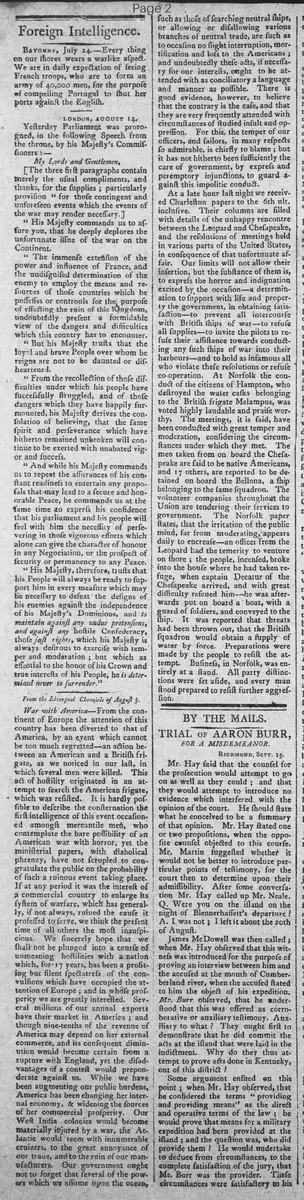
War with America.—From the continent of Europe the attention of this country has been diverted to that of America, by an event which cannot be too much regretted—an action between an American and a British frigate, as we noticed in our last, in which several men were killed. This act of hostility originated in an attempt to search the American frigate, which was resisted. It is hardly possible to describe the consternation the first intelligence of this event occasioned amongst mercantile men, who contemplate the bare possibility of an American war with horror, yet the ministerial papers, with diabolical phrensy, have not scrupled to congratulate the public on the probability of such a ruinous event taking place.
If at any period it was the interest of a commercial country to enlarge its system of warfare, which has generally, if not always, ruined the cause it professed to serve, we think the present time of all others the most inauspicious. We sincerely hope that we shall not be plunged into a course of unmeaning hostilities with a nation which, for 17 years, has been a profiting but silent spectator of the convulsions which have occupied the attention of Europe; and in whose prosperity we are greatly interested. Several millions of our annual exports have their market in America; and though nine-tenths of the revenue of America may depend on her external commerce, and its consequent diminution would become certain from a rupture with England, yet the disadvantages of a contest would preponderate against us. While we have been augmenting our public burdens, America has been changing her internal economy, & widening the sources of her commercial prosperity. Our West India colonies would become materially injured by a war, the Atlantic would teem with innumerable cruizers, to the great annoyance of our trade, and to the ruin of our manufacturers. Our government ought not to forget that several of the powers which we assume upon the ocean,
such as those of searching neutral ships, or allowing or disallowing various branches of neutral trade, are such as to occasion no slight interruption, mortification and loss to the Americans; and undoubtedly these acts, if necessary for our interests, ought to be attended with as conciliatory a language and manner as possible. There is good evidence, however, to believe that the contrary is the case, and that they are very frequently attended with circumstances of studied insult and oppression. For this, the temper of our officers, and sailors, in many respects so admirable, is chiefly to blame; but it has not hitherto been sufficiently the care of government, by express and peremptory injunctions, to guard against this impolitic conduct.
At a late hour last night we received Charlestown papers to the 6th ult. inclusive. Their columns are filled with details of the unhappy rencontre between the Leopard and Chesapeake, and the resolutions of meetings held in various parts of the United States, in consequence of that unfortunate affair. Our limits will not allow their insertion, but the substance of them is, to express the horror and indignation excited by the occasion—a determination to support with life and property the government, in obtaining satisfaction—to prevent all intercourse with British ships of war—to refuse all supplies—to invite the pilots to refuse their assistance towards conducting any such ships of war into their harbours—and to hold as infamous all who violate these resolutions or refuse co-operation. At Norfolk the conduct of the citizens of Hampton, who destroyed the water casks belonging to the British frigate Melampus, was voted highly laudable and praiseworthy. The meetings, it is said, have been conducted with great temper and moderation, considering the circumstances under which they met. The men taken from on board the Chesapeake are said to be native Americans, and 17 others, are reported to be detained on board the Bellona, a ship belonging to the same squadron. The volunteer companies throughout the Union are tendering their services to government. The Norfolk paper states, that the irritation of the public mind, far from moderating, appears daily to increase—an officer from the Leopard had the temerity to venture on shore; the people, incensed, broke into the house where he had taken refuge, when captain Decatur of the Chesapeake arrived, and with great difficulty rescued him—he was afterwards put on board a boat, with a guard of soldiers, and conveyed to the ship. It was reported that threats had been thrown out, that the British squadron would obtain a supply of water by force. Preparations were made by the people to resist the attempt. Business, in Norfolk, was entirely at a stand. All party distinctions were set aside, and every man stood prepared to resist further aggression.
What sub-type of article is it?
What keywords are associated?
What entities or persons were involved?
Where did it happen?
Foreign News Details
Primary Location
United States
Event Date
As Of 6th Ult. (July 1807)
Key Persons
Outcome
several men were killed; american public resolutions to resist british ships, volunteer companies mobilizing, increased irritation and preparations to resist aggression
Event Details
British frigate Leopard attempted to search American frigate Chesapeake, leading to resistance and hostile action with deaths. US papers detail public meetings expressing horror and indignation, resolutions to support government, prevent intercourse with British warships, refuse supplies and pilot assistance. Citizens destroyed water casks of British frigate Melampus. Men taken from Chesapeake reported as native Americans, others detained on Bellona. Incident at Norfolk where British officer was rescued from mob by Captain Decatur. Threats of forced water supply met with resistance preparations; business halted, unity against aggression.