Thank you for visiting SNEWPapers!
Sign up free
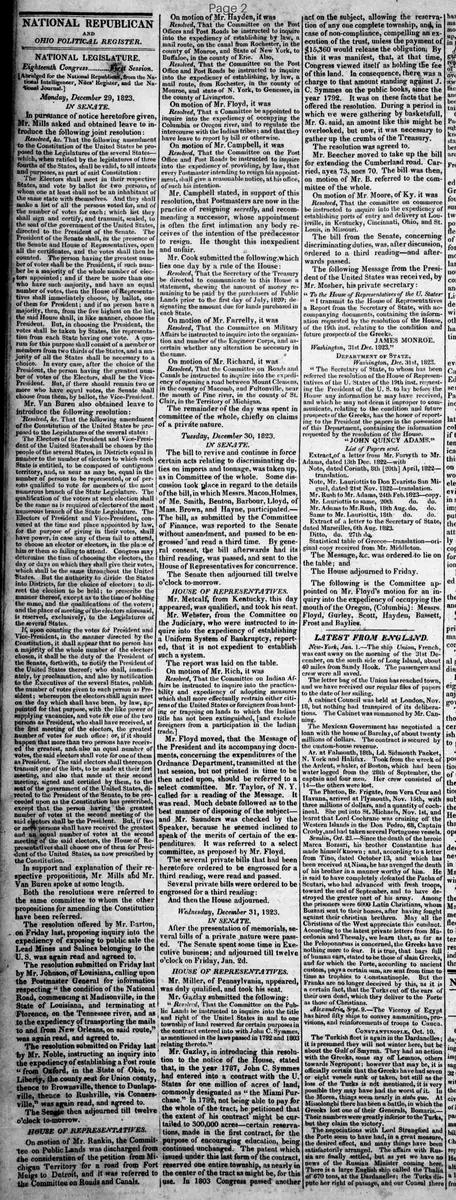
The National Republican And Ohio Political Register
Cincinnati, Hamilton County, Ohio
What is this article about?
Proceedings of the 18th U.S. Congress, First Session, in Senate and House of Representatives from December 29-31, 1823, covering proposed constitutional amendments for presidential elections, resolutions on post routes, roads, public lands, military affairs, and receipt of presidential message on Greek affairs.
Merged-components note: Continuous report on National Legislature proceedings spanning multiple days.
Clipping
OCR Quality
Full Text
AND
OHIO POLITICAL REGISTER.
NATIONAL LEGISLATURE.
Eighteenth Congress.....First Session.
Abridged for the National Republican, from the National Intelligencer, Niles' Register, and the National Journal.
Monday, December 29, 1823.
IN SENATE.
In pursuance of notice heretofore given, Mr. Mills asked and obtained leave to introduce the following joint resolution:
Resolved, &c. That the following amendment to the Constitution of the United States be proposed to the Legislatures of the several States—which, when ratified by the legislatures of three fourths of the States, shall be valid, to all intents and purposes, as part of said Constitution:
The Electors shall meet in their respective States, and vote by ballot for two persons, of whom one at least shall not be an inhabitant of the same state with themselves. And they shall make a list of all the persons voted for, and of the number of votes for each; which list they shall sign and certify, and transmit, sealed, to the seat of the government of the United States, directed to the President of the Senate. The President of the Senate shall, in the presence of the Senate and House of Representatives, open all the certificates, and the votes shall then be counted. The person having the greatest number of votes shall be the President, if such number be a majority of the whole number of electors appointed; and if there be more than one who have such majority, and have an equal number of votes, then the House of Representatives shall immediately choose, by ballot, one of them for President: and if no person have a majority, then, from the five highest on the list, the said House shall, in like manner, choose the President. But, in choosing the President, the votes shall be taken by States, the representation from each State having one vote. A quorum for this purpose shall consist of a member or members from two thirds of the States, and a majority of all the States shall be necessary to a choice. In every case, after the choice of the President, the person having the greatest number of votes of the Electors, shall be the Vice-President. But, if there should remain two or more who have equal votes, the Senate shall choose from them, by ballot, the Vice-President.
Mr. Van Buren also obtained leave to introduce the following resolution:
Resolved, &c. That the following amendment of the Constitution of the United States be proposed to the Legislatures of the several states:
The Electors of the President and Vice-President of the United States shall be chosen by the people of the several States, in Districts equal in number to the number of electors to which each State is entitled, to be composed of contiguous territory, and, as near as may be, equal in the number of persons to be represented, or of persons qualified to vote for members of the most numerous branch of the State Legislature. The qualification of the voters at such election shall be the same as is required of electors of the most numerous branch of the State Legislature. The Electors of President and Vice-President, convened at the time and place appointed by law, for the purpose of giving in their votes, shall have power, in case any of them fail to attend, to choose an elector or electors, in the place of him or them so failing to attend. Congress may determine the time of choosing the electors, the day or days on which they shall give their votes, which shall be the same throughout the United States. But the authority to divide the States into Districts, for the choice of electors; to direct the election to be held; to prescribe the manner thereof, except as to the time of holding the same, and the qualifications of the voters; and the place of meeting of the electors aforesaid, is reserved, exclusively, to the Legislatures of the several States.
If, upon counting the votes for President and Vice-President, in the manner directed by the Constitution, it shall appear that no person has a majority of the whole number of the electors chosen, it shall be the duty of the President of the Senate, forthwith, to notify the President of the United States thereof; who shall, immediately, by proclamation, and also by notification to the Executives of the several States, publish the number of votes given to each person as President: whereupon the electors shall again meet on the day which shall have been, by law, appointed for that purpose, with the like power of supplying vacancies, and vote for one of the two persons as President, who shall have received, at the first meeting of the electors, the greatest number of votes for such office: or, if it should happen that more than two persons have received the greatest, and also an equal number of votes, the said electors shall vote for one of them as President. The said electors shall thereupon transmit one of the lists, to be made at their first meeting, and also that made at their second meeting, signed and certified by them, to the seat of the government of the United States, directed to the President of the Senate, to be proceeded upon as the Constitution has prescribed, except that the person having the greatest number of votes at the second meeting of the said electors shall be the President. But, if two or more persons shall have received the greatest and an equal number of votes at the second meeting of the said electors, the House of Representatives shall choose one of them for President of the United States, as now prescribed by the Constitution.
In support and explanation of their respective propositions, Mr. Mills and Mr. Van Buren spoke at some length.
Both the resolutions were referred to the same committee to whom the other propositions for amending the Constitution have been referred.
The resolution offered by Mr. Barton, on Friday last, proposing inquiry into the expediency of exposing to public sale the Lead Mines and Salines belonging to the U. S. was again read and agreed to.
The resolution submitted on Friday last by Mr. Johnson, of Louisiana, calling upon the Postmaster General for information respecting "the condition of the National Road, commencing at Madisonville, in the State of Louisiana, and terminating at Florence, on the Tennessee river, and as to the expediency of transporting the mails to and from New Orleans, on said route," was again read, and agreed to.
The resolution submitted on Friday last by Mr. Noble, instructing an inquiry into the expediency of establishing a Post route "from Oxford, in the State of Ohio, to Liberty, the county seat for Union county, thence to Brownsville, thence to Dunlapsville, thence to Rushville, via Connerville," was again read, and agreed to.
The Senate then adjourned till twelve o'clock to-morrow.
HOUSE OF REPRESENTATIVES
On motion of Mr. Rankin, the Committee on Public Lands was discharged from the consideration of the petition from Michigan Territory for a road from Fort Meigs to Detroit, and it was referred to the Committee on Roads and Canals.
On motion of Mr. Hayden, it was
Resolved, That the Committee on the Post Offices and Post Roads be instructed to inquire into the expediency of establishing by law, a mail route, on the canal from Rochester, in the county of Monroe, and State of New York, to Buffaloe, in the county of Erie. Also,
Resolved, That the Committee on the Post Office and Post Roads be instructed to inquire into the expediency of establishing, by law, a mail route, from Rochester, in the county of Monroe, and state of N. York, to Genessee, in the county of Livingston.
On motion of Mr. Floyd, it was
Resolved, That a Committee be appointed to inquire into the expediency of occupying the Columbia or Oregon river, and to regulate the intercourse with the Indian tribes; and that they have leave to report by bill or otherwise.
On motion of Mr. Campbell, it was
Resolved, That the Committee on the Post Office and Post Roads be instructed to inquire into the expediency of providing, by law, that every Postmaster intending to resign his appointment, shall give a reasonable notice, at his office, of such his intention.
Mr. Campbell stated, in support of this resolution, that Postmasters are now in the practice of resigning secretly, and recommending a successor, whose appointment is often the first intimation any body receives of the intention of the predecessor to resign. He thought this inexpedient and unfair.
Mr. Cook submitted the following, which lies one day by a rule of the House:
Resolved, That the Secretary of the Treasury be directed to communicate to this House a statement, shewing the amount of money remaining to be paid by the purchasers of Public Lands prior to the first day of July, 1820; designating the amount due for lands purchased in each State.
On motion of Mr. Farrelly, it was
Resolved, That the Committee on Military Affairs be instructed to inquire into the organization and number of the Engineer Corps, and ascertain whether any alteration be necessary in the same.
On motion of Mr. Richard, it was
Resolved, That the Committee on Roads and Canals be instructed to inquire into the expediency of opening a road between Mount Clemens, in the county of Macomb, and Fultonville, near the mouth of Pine river, in the county of St. Clair, in the Territory of Michigan.
The remainder of the day was spent in committee of the whole, chiefly on claims of a private nature.
Tuesday, December 30, 1823
IN SENATE.
The bill to revive and continue in force certain acts relating to discriminating duties on imports and tonnage, was taken up, as in Committee of the whole. Some discussion took place in regard to the details of the bill, in which Messrs. Macon, Holmes of Me. Smith, Benton, Barbour, Lloyd, of Mass. Brown, and Hayne, participated.
The bill, as submitted by the Committee of Finance, was reported to the Senate without amendment, and passed to be engrossed and read a third time. By general consent, the bill afterwards had its third reading, was passed, and sent to the House of Representatives for concurrence.
The Senate then adjourned till twelve o'clock to-morrow.
HOUSE OF REPRESENTATIVES
Mr. Metcalf, from Kentucky, this day appeared, was qualified, and took his seat.
Mr. Webster, from the Committee on the Judiciary, who were instructed to inquire into the expediency of establishing a Uniform System of Bankruptcy, reported, that it is not expedient to establish such a system.
The report was laid on the table.
On motion of Mr. Rich, it was
Resolved, That the Committee on Indian Affairs be instructed to inquire into the practicability and expediency of adopting measures which shall more effectually restrain either citizens of the United States or foreigners from hunting or trapping on lands to which the Indian title has not been extinguished, and exclude foreigners from a participation in the Indian trade.
Mr. Floyd moved, that the Message of the President and its accompanying documents, concerning the expenditures of the Ordnance Department, transmitted at the last session, but not printed in time to be then acted upon, should be referred to a select committee. Mr. Taylor, of N. Y. called for a reading of the Message. It was read. Much debate followed as to the best manner of disposing of the subject—and Mr. Saunders was checked by the Speaker, because he seemed inclined to speak of the merits of certain of the expenditures. It was referred to a select committee, as proposed by Mr. Floyd.
The several private bills that had been heretofore ordered to be engrossed for a third reading, were read and passed.
Several private bills were ordered to be engrossed for a third reading:
And then the House adjourned.
Wednesday, December 31, 1823.
IN SENATE.
After the presentation of memorials, several bills of a private nature were passed. The Senate spent some time in Executive business; and adjourned till twelve o'clock on Friday, Jan. 2d.
HOUSE OF REPRESENTATIVES.
Mr. Miller, of Pennsylvania, appeared, was duly qualified, and took his seat.
Mr. Gazlay submitted the following:
"Resolved, That the Committee on the Public Lands be instructed to inquire into the title and right of the United States in and to one township of land reserved for certain purposes in the contract entered into with John C. Symmes, as mentioned in the laws passed in 1792 and 1803 relating thereto."
Mr. Gazlay, in introducing this resolution to the notice of the House, stated that, in the year 1787, John C. Symmes had entered into a contract with the U. States for one million of acres of land, commonly designated as "the Miami Purchase." In 1792, not being able to pay for the whole of the tract, he petitioned that the extent of his contract might be curtailed to 300,000 acres—certain reservations, made in the first contract, for the purpose of encouraging education, being continued unchanged. The patent which issued under this last form of the contract, reserved one entire township, as nearly in the center of the tract as might be, for this use. In 1803 Congress passed another
act on the subject, allowing the reservation of any one complete township, and, in case of non-compliance, compelling an execution of the trust, unless the payment of $15,360 would release the obligation; By this it was manifest, that, at that time, Congress viewed itself as holding the fee of this land. In consequence, there was a charge to that amount standing against J. C. Symmes on the public books, since the year 1792. It was on these facts that he offered the resolution. During a period in which we were gathering by basketsfull, Mr. G. said, an amount like this might be overlooked, but now, it was necessary to gather up the crumbs of the Treasury.
The resolution was agreed to.
Mr. Beecher moved to take up the bill for extending the Cumberland road. Carried, ayes 73, noes 70. The bill was then, on motion of Mr. B. referred to the committee of the whole.
On motion of Mr. Moore, of Ky. it was
Resolved, That the committee on commerce be instructed to inquire into the expediency of establishing ports of entry and delivery at Louisville, in Kentucky, Cincinnati, Ohio, and St. Louis, in Missouri.
The bill from the Senate, concerning discriminating duties, was, after discussion, ordered to a third reading—and afterwards passed.
The following Message from the President of the United States was received, by Mr. Mosher, his private secretary:
"To the House of Representatives of the U. States
I transmit to the House of Representatives a Report from the Secretary of State, with accompanying documents, containing the information requested by the resolution of the House, of the 1st inst. relating to the condition and future prospects of the Greeks.
JAMES MONROE.
Washington, 31st Dec. 1823."
Department of State,
Washington, Dec. 31st, 1823.
"The Secretary of State, to whom has been referred the resolution of the House of Representatives of the U. States of the 19th inst. requesting the President of the U. S. to lay before the House any information he may have received, and which he may not deem it improper to communicate, relating to the condition and future prospects of the Greeks, has the honor of reporting to the President the papers in the possession of this Department, containing the information requested by the resolution of the House.
JOHN QUINCY ADAMS."
List of Papers sent.
Extract of a letter from Mr. Forsyth to Mr. Adams, dated 13th Dec. 1822—with Note, dated Corinth, 8th [20th] April, 1822 translation.
Note, Mr. Lauriottis to Don Evaristo San Miguel, dated 21st Nov. 1822—translation.
Mr. Rush to Mr. Adams, 24th Feb. 1823—copy.
Mr. Lauriottis to same, 20th do.
do.
do.
Mr. Adams to Mr. Rush, 18th Aug. do., do.
Same to Mr. Lauriottis. 18th: do.
do.
Extract of a letter to the Secretary of State, dated Marseilles, 6th Aug. 1823.
Ditto, do. 27th do
Statistical table of Greece—translation—original copy received from Mr. Middleton.
The Message, &c. was ordered to lie on the table: and
The House adjourned to Friday.
The following is the Committee appointed on Mr. Floyd's motion for an inquiry into the expediency of occupying the mouth of the Oregon, (Columbia): Messrs. Floyd, Gurley, Scott, Hayden, Bassett, Frost and Baylies.
What sub-type of article is it?
What keywords are associated?
What entities or persons were involved?
Where did it happen?
Domestic News Details
Primary Location
Washington, D.C.
Event Date
December 29 31, 1823
Key Persons
Outcome
various resolutions introduced, referred to committees, or passed; bills on discriminating duties passed; presidential message on greeks received and tabled.
Event Details
Senate: Mr. Mills and Mr. Van Buren introduced resolutions proposing constitutional amendments on presidential electors and election districts; resolutions on lead mines, national road, and post routes agreed to. House: Motions on public lands, post office notices, public lands payments, engineer corps, roads in Michigan, Indian affairs, bankruptcy system (deemed inexpedient), ordnance expenditures; private bills passed. Additional proceedings on December 30-31 included bill on discriminating duties, member qualifications, resolutions on lands and ports, and message from President Monroe on Greek condition.