Thank you for visiting SNEWPapers!
Sign up free
Plentywood Herald
Plentywood, Sheridan County, Montana
What is this article about?
President Roosevelt returns to address the escalating labor crisis involving C.I.O. sit-down strikes, legal challenges to the Wagner Act, and rivalries between leaders John Lewis and William Green. Political and legal considerations shape potential national labor policy emphasizing collective bargaining with strike restraints.
Merged-components note: Split article on labor policy; second part continues the narrative on sit-down strikes and government intervention.
Clipping
OCR Quality
Full Text
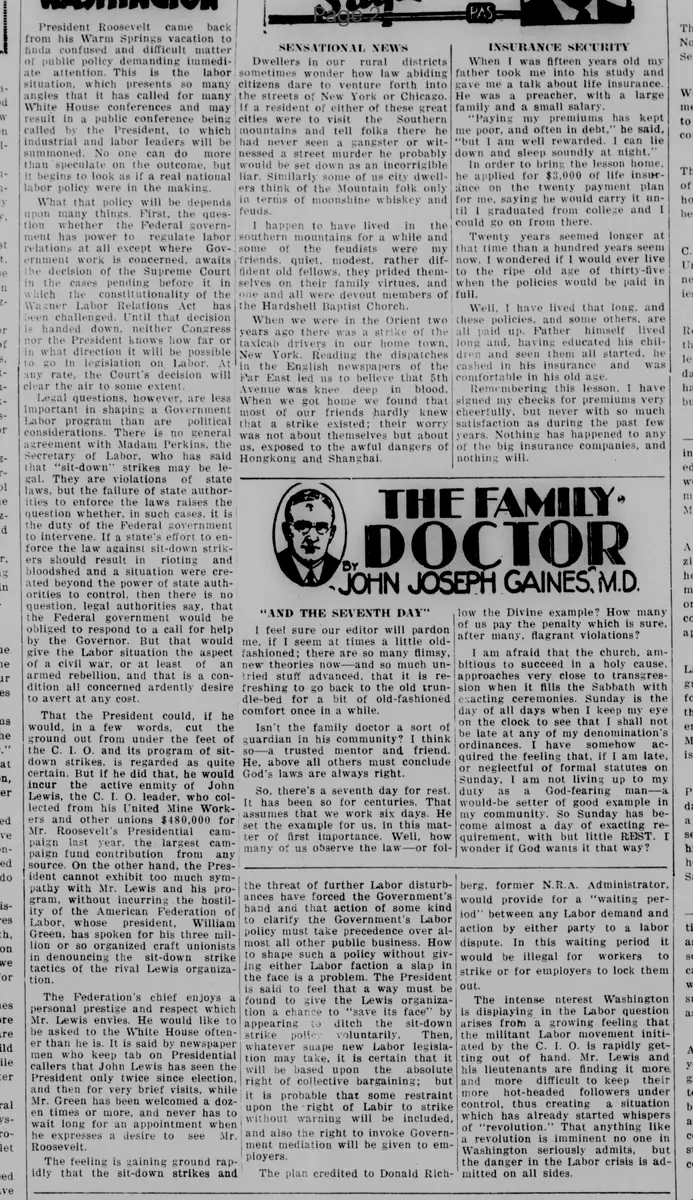
What that policy will be depends upon many things. First, the question whether the Federal government has power to regulate labor relations at all except where Government work is concerned, awaits the decision of the Supreme Court in the cases pending before it in which the constitutionality of the Wagner Labor Relations Act has been challenged. Until that decision is handed down, neither Congress nor the President knows how far or in what direction it will be possible to go in legislation on labor. At any rate, the Court's decision will clear the air to some extent.
Legal questions, however, are less important in shaping a Government Labor program than are political considerations. There is no general agreement with Madam Perkins, the Secretary of Labor, who has said that "sit-down" strikes may be legal. They are violations of state laws, but the failure of state authorities to enforce the laws raises the question whether, in such cases, it is the duty of the Federal government to intervene. If a state's effort to enforce the law against sit-down strikers should result in rioting and bloodshed and a situation were created beyond the power of state authorities to control, then there is no question, legal authorities say, that the Federal government would be obliged to respond to a call for help by the Governor. But that would give the Labor situation the aspect of a civil war, or at least of an armed rebellion, and that is a condition all concerned ardently desire to avert at any cost.
That the President could, if he would, in a few words, cut the ground out from under the feet of the C. I. O. and its program of sit-down strikes, is regarded as quite certain. But if he did that, he would incur the active enmity of John Lewis, the C. I. O. leader, who collected from his United Mine Workers and other unions $480,000 for Mr. Roosevelt's Presidential campaign last year, the largest campaign fund contribution from any source. On the other hand, the President cannot exhibit too much sympathy with Mr. Lewis and his program, without incurring the hostility of the American Federation of Labor, whose president, William Green, has spoken for his three million or so organized craft unionists in denouncing the sit-down strike tactics of the rival Lewis organization.
The Federation's chief enjoys a personal prestige and respect which Mr. Lewis envies. He would like to be asked to the White House oftener than he is. It is said by newspaper men who keep tab on Presidential callers that John Lewis has seen the President only twice since election, and then for very brief visits, while Mr. Green has been welcomed a dozen times or more, and never has to wait long for an appointment when he expresses a desire to see Mr. Roosevelt.
The feeling is gaining ground rapidly that the sit-down strikes and
the threat of further Labor disturbances have forced the Government's hand and that action of some kind to clarify the Government's Labor policy must take precedence over almost all other public business. How to shape such a policy without giving either Labor faction a slap in the face is a problem. The President is said to feel that a way must be found to give the Lewis organization a chance to "save its face" by appearing to ditch the sit-down strike policy voluntarily. Then, whatever shape new Labor legislation may take, it is certain that it will be based upon the absolute right of collective bargaining; but it is probable that some restraint upon the right of Labor to strike without warning will be included, and also the right to invoke Government mediation will be given to employers.
The plan credited to Donald Richberg, former N.R.A. Administrator, would provide for a "waiting period" between any Labor demand and action by either party to a labor dispute. In this waiting period it would be illegal for workers to strike or for employers to lock them out.
The intense interest Washington is displaying in the Labor question arises from a growing feeling that the militant Labor movement initiated by the C. I. O. is rapidly getting out of hand. Mr. Lewis and his lieutenants are finding it more and more difficult to keep their more hot-headed followers under control, thus creating a situation which has already started whispers of "revolution." That anything like a revolution is imminent no one in Washington seriously admits, but the danger in the Labor crisis is admitted on all sides.
What sub-type of article is it?
What themes does it cover?
What keywords are associated?
What entities or persons were involved?
Where did it happen?
Story Details
Key Persons
Location
Washington
Story Details
President Roosevelt navigates political tensions between C.I.O. leader John Lewis and A.F.L. president William Green amid sit-down strikes, awaiting Supreme Court ruling on Wagner Act, to formulate a national labor policy promoting collective bargaining with mediation and strike waiting periods.