Thank you for visiting SNEWPapers!
Sign up free
Literary
December 5, 1832
The Massachusetts Spy
Worcester, Worcester County, Massachusetts
What is this article about?
Extract from Mary Russell Mitford's 'Our Village' depicts two sisters, Agnes and Jessy Molesworth, whose father's marriage plans—pairing Jessy with cousin Charles Woodford and Agnes with a baronet—fail when Charles loves Agnes instead, leading to a joyful family resolution emphasizing love over ambition.
Clipping
OCR Quality
98%
Excellent
Full Text
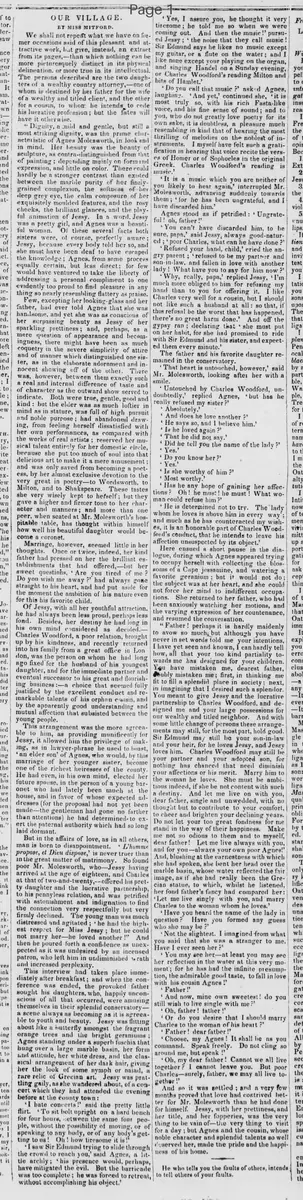
OUR VILLAGE.
BY MISS MITFORD.
We shall not repeat what we have on former occasions said of this pleasant and attractive work, but give, instead, an extract from its pages,—than which nothing can be more picturesquely distinct in its physical delineation, or more true in its intellectual.
The persons described are the two daughters of a wealthy country attorney,—one of whom is destined by her father for the wife of a wealthy and titled client, and the other for a cousin, to whom he intends to cede his lucrative profession; but the fates will have it otherwise.
"Dignity, a mild and gentle, but still a most striking dignity, was the prime characteristic of Agnes Molesworth, in look and in mind. Her beauty was the beauty of sculpture, as contra-distinguished from that of painting; depending mainly on form and expression, and little on color. There could hardly be a stronger contrast than existed between the marble purity of her finely-grained complexion, the softness of her deep grey eye, the calm composure of her exquisitely moulded features, and the rosy cheeks, the brilliant glances, and the playful animation of Jessy. In a word, Jessy was a pretty girl, and Agnes was a beautiful woman. Of these several facts both sisters were, of course, perfectly aware; Jessy, because every body told her so, and she must have been deaf to have escaped the knowledge; Agnes, from some process equally certain, but less direct: for few would have ventured to take the liberty of addressing a personal compliment to one evidently too proud to find pleasure in any thing so nearly resembling flattery as praise. Few, excepting her looking-glass and her father, had ever told Agnes that she was handsome, and yet she was as conscious of her surpassing beauty as Jessy of her sparkling prettiness; and, perhaps, as a mere question of appearance and becomingness, there might have been as much coquetry in the severe simplicity of attire and of manner which distinguished one sister, as in the elaborate adornment and innocent showing off of the other. There was, however, between them exactly such a real and internal difference of taste and of character as the outward show served to indicate. Both were true, gentle, good and kind: but the elder was as much loftier in mind as in stature, was full of high pursuit and noble purpose: had abandoned drawing, from feeling herself dissatisfied with her own performances, as compared with the works of real artists; reserved her musical talent entirely for her domestic circle, because she put too much of soul into that delicious art to make it a mere amusement: and was only saved from becoming a poetess, by her almost exclusive devotion to the very great in poetry—to Wordsworth, to Milton, and to Shakspeare. These tastes she very wisely kept to herself; but they gave a higher and firmer tone to her character and manners; and more than one peer, when seated at Mr. Molesworth's hospitable table, has thought within himself how well his beautiful daughter would become a coronet.
Marriage, however, seemed little in her thoughts. Once or twice, indeed, her kind father had pressed on her the brilliant establishments that had offered,—but her sweet questions, 'Are you tired of me? Do you wish me away?' had always gone straight to his heart, and had put aside for the moment the ambition of his nature even for this his favorite child.
Of Jessy, with all her youthful attraction, he had always been less proud, perhaps less fond. Besides, her destiny he had long in his own mind considered as decided.—Charles Woodford, a poor relation, brought up by his kindness, and recently returned into his family from a great office in London, was the person on whom he had long ago fixed for the husband of his youngest daughter, and for the immediate partner and eventual successor to his great and flourishing business: a choice that seemed fully justified by the excellent conduct and remarkable talents of his orphan cousin, and by the apparently good understanding and mutual affection that subsisted between the young people.
This arrangement was the more agreeable to him, as providing munificently for Jessy, it allowed him the privilege of making, as in lawyer-phrase he used to boast, 'an elder son' of Agnes, who would, by this marriage of her younger sister, become one of the richest heiresses of the county. He had even, in his own mind, elected her future spouse, in the person of a young baronet who had lately been much at the house, and in favor of whose expected addresses (for the proposal had not yet been made—the gentleman had gone no farther than attentions) he had determined—to exert the paternal authority which had so long laid dormant.
But in the affairs of love, as in all others, man is born to disappointment. 'L'homme propose, et Dieu dispose,' is never truer than in the great matter of matrimony. So found poor Mr. Molesworth, who—Jessy having arrived at the age of eighteen, and Charles at that of two-and-twenty,—offered his pretty daughter and the lucrative partnership to his pennyless relation, and was petrified with astonishment and indignation to find the connection very respectfully but very firmly declined. The young man was much distressed and agitated; he had the highest respect for Miss Jessy; but he could not marry her—he loved another!" And then he poured forth a confidence as unexpected as it was undesired by an incensed patron, who left him in undiminished wrath and increased perplexity.
This interview had taken place immediately after breakfast: and when the conference was ended, the provoked father sought his daughters, who, happily unconscious of all that occurred, were amusing themselves in their splendid conservatory—a scene always as becoming as it is agreeable to youth and beauty. Jessy was flitting about like a butterfly amongst the fragrant orange trees and the bright geraniums: Agnes standing under a superb fuchsia that hung over a large marble basin, her form and attitude, her white dress, and the classical arrangement of her dark hair, giving her the look of some nymph or naiad, a rare relic of Grecian art. Jessy was prattling gaily, as she wandered about, of a concert which they had attended the evening before at the county town:
'I hate concerts!' said the pretty little flirt. 'To sit bolt upright on a hard bench for four hours, between the same four people, without the possibility of moving, or of speaking to any body, or of any body's getting to us! Oh! how tiresome it is!'
'I saw Sir Edmund trying to slide through the crowd to reach you,' said Agnes, a little archly; 'his presence would, perhaps, have mitigated the evil. But the barricade was too complete; he was forced to retreat, without accomplishing his object.'
'Yes, I assure you, he thought it very tiresome; he told me so when we were coming out. And then the music!' pursued Jessy; 'the noise that they call music! Sir Edmund says he likes no music except my guitar, or a flute on the water; and I like none except your playing on the organ, and singing Handel on a Sunday evening, or Charles Woodford's reading Milton and bits of Hamlet.'
'Do you call that music?' asked Agnes, laughing. 'And yet,' continued she, 'it is most truly so, with his rich Faust-like voice, and his fine sense of sound; and to you, who do not greatly love poetry for its own sake, it is doubtless, a pleasure much resembling in kind that of hearing the most thrilling of melodies on the noblest of instruments. I myself have felt such a gratification in hearing that voice recite the verses of Homer or of Sophocles in the original Greek. Charles Woodford's reading is music.'
'It is a music which you are neither of you likely to hear again,' interrupted Mr. Molesworth, advancing suddenly towards them; 'for he has been ungrateful, and I have discarded him.'
Agnes stood as if petrified: 'Ungrateful! oh, father!'
'You can't have discarded him, to be sure, papa,' said Jessy, always good-natured; 'poor Charles, what can he have done?'
'Refused your hand, child,' cried the angry parent; 'refused to be my partner and son-in-law, and fallen in love with another lady! What have you to say for him now?'
'Why, really, papa,' replied Jessy, 'I'm much more obliged to him for refusing my hand than to you for offering it. I like Charles very well for a cousin, but I should not like such a husband at all: so that, if this refusal be the worst that has happened, there's no great harm done.' And off the gypsy ran; declaring that she must put on her habit, for she had promised to ride with Sir Edmund and his sister, and expected them every minute.
The father and his favorite daughter remained in the conservatory.
'That heart is untouched, however,' said Mr. Molesworth, looking after her with a smile.
'Untouched by Charles Woodford, undoubtedly,' replied Agnes, 'but has he really refused my sister?'
'Absolutely.'
'And does he love another?'
'He says so, and I believe him.'
'Is he loved again?'
'That he did not say.'
'Did he tell you the name of the lady?'
'Yes.'
'Do you know her?'
'Yes.'
'Is she worthy of him?'
'Most worthy.'
'Has he any hope of gaining her affections? Oh! he must! he must! What woman could refuse him?'
'He is determined not to try. The lady whom he loves is above him in every way'; and much as he has counteracted my wishes, it is an honorable part of Charles Woodford's conduct, that he intends to leave his affection unsuspected by its object.'
Here ensued a short pause in the dialogue, during which Agnes appeared trying to occupy herself with collecting the blossoms of a Cape jessamine, and watering a favorite geranium; but it would not do—the subject was at her heart, and she could not force her mind to indifferent occupations. She returned to her father, who had been anxiously watching her motions, and the varying expression of her countenance, and resumed the conversation.
"Father! perhaps it is hardly maidenly to avow so much, but although you have never in set words told me your intentions, I have yet seen and known, I can hardly tell how, all that your too kind partiality towards me has designed for your children. You have mistaken me, dearest father, doubly mistaken me; first, in thinking me fit to fill a splendid place in society: next, in imagining that I desired such a splendor. You meant to give Jessy and the lucrative partnership to Charles Woodford, and designed me and your large possessions for our wealthy and titled neighbor. And with some little change of persons these arrangements may still, for the most part, hold good. Sir Edmund may still be your son-in-law and your heir, for he loves Jessy, and Jessy loves him. Charles Woodford may still be your partner and your adopted son, for nothing has chanced that need diminish your affections or his merit. Marry him to the woman he loves. She must be ambitious indeed, if she be not content with such a destiny. And let me live on with you, dear father, single and unwedded, with no thought but to contribute to your comfort, to cheer and brighten your declining years. Do not let your too great fondness for me stand in the way of their happiness. Make me not so odious to them and to myself dear father! Let me live always with you, and for you—always your own poor Agnes!'
And, blushing at the earnestness with which she had spoken, she bent her head over the marble basin, whose water reflected the fair image, as if she had really been the Grecian statue, to which, whilst he listened, her fond father's fancy had compared her:
'Let me live singly with you, and marry Charles to the woman whom he loves.'
'Have you heard the name of the lady in question? Have you formed any guess who she may be?'
'Not the slightest. I imagined from what you said that she was a stranger to me.'
'Have I ever seen her?'
'You may see her—at least you may see her reflection in the water at this very moment'; for he has had the infinite presumption, the admirable good taste, to fall in love with his cousin Agnes!
'Father!'
'And now, mine own sweetest! do you still wish to live single with me?'
'Oh, father! father!'
'Or do you desire that I should marry Charles to the woman of his heart?'
'Father! dear father!'
'Choose, my Agnes! It shall be as you command. Speak freely. Do not cling so around me, but speak!'
'Oh, my dear father! Cannot we all live together? I cannot leave you. But poor Charles—surely, father, we may all live together!'
And so it was settled; and a very few months proved that love had contrived better for Mr. Molesworth than he had done for himself. Jessy, with her prettiness, and her title, and her fopperies, was the very thing to be vain of—the very thing to visit for a day; but Agnes and the cousin, whose noble character and splendid talents so well deserved her, made the pride and the happiness of his home.
He who tells you the faults of others, intends to tell others of your faults.
BY MISS MITFORD.
We shall not repeat what we have on former occasions said of this pleasant and attractive work, but give, instead, an extract from its pages,—than which nothing can be more picturesquely distinct in its physical delineation, or more true in its intellectual.
The persons described are the two daughters of a wealthy country attorney,—one of whom is destined by her father for the wife of a wealthy and titled client, and the other for a cousin, to whom he intends to cede his lucrative profession; but the fates will have it otherwise.
"Dignity, a mild and gentle, but still a most striking dignity, was the prime characteristic of Agnes Molesworth, in look and in mind. Her beauty was the beauty of sculpture, as contra-distinguished from that of painting; depending mainly on form and expression, and little on color. There could hardly be a stronger contrast than existed between the marble purity of her finely-grained complexion, the softness of her deep grey eye, the calm composure of her exquisitely moulded features, and the rosy cheeks, the brilliant glances, and the playful animation of Jessy. In a word, Jessy was a pretty girl, and Agnes was a beautiful woman. Of these several facts both sisters were, of course, perfectly aware; Jessy, because every body told her so, and she must have been deaf to have escaped the knowledge; Agnes, from some process equally certain, but less direct: for few would have ventured to take the liberty of addressing a personal compliment to one evidently too proud to find pleasure in any thing so nearly resembling flattery as praise. Few, excepting her looking-glass and her father, had ever told Agnes that she was handsome, and yet she was as conscious of her surpassing beauty as Jessy of her sparkling prettiness; and, perhaps, as a mere question of appearance and becomingness, there might have been as much coquetry in the severe simplicity of attire and of manner which distinguished one sister, as in the elaborate adornment and innocent showing off of the other. There was, however, between them exactly such a real and internal difference of taste and of character as the outward show served to indicate. Both were true, gentle, good and kind: but the elder was as much loftier in mind as in stature, was full of high pursuit and noble purpose: had abandoned drawing, from feeling herself dissatisfied with her own performances, as compared with the works of real artists; reserved her musical talent entirely for her domestic circle, because she put too much of soul into that delicious art to make it a mere amusement: and was only saved from becoming a poetess, by her almost exclusive devotion to the very great in poetry—to Wordsworth, to Milton, and to Shakspeare. These tastes she very wisely kept to herself; but they gave a higher and firmer tone to her character and manners; and more than one peer, when seated at Mr. Molesworth's hospitable table, has thought within himself how well his beautiful daughter would become a coronet.
Marriage, however, seemed little in her thoughts. Once or twice, indeed, her kind father had pressed on her the brilliant establishments that had offered,—but her sweet questions, 'Are you tired of me? Do you wish me away?' had always gone straight to his heart, and had put aside for the moment the ambition of his nature even for this his favorite child.
Of Jessy, with all her youthful attraction, he had always been less proud, perhaps less fond. Besides, her destiny he had long in his own mind considered as decided.—Charles Woodford, a poor relation, brought up by his kindness, and recently returned into his family from a great office in London, was the person on whom he had long ago fixed for the husband of his youngest daughter, and for the immediate partner and eventual successor to his great and flourishing business: a choice that seemed fully justified by the excellent conduct and remarkable talents of his orphan cousin, and by the apparently good understanding and mutual affection that subsisted between the young people.
This arrangement was the more agreeable to him, as providing munificently for Jessy, it allowed him the privilege of making, as in lawyer-phrase he used to boast, 'an elder son' of Agnes, who would, by this marriage of her younger sister, become one of the richest heiresses of the county. He had even, in his own mind, elected her future spouse, in the person of a young baronet who had lately been much at the house, and in favor of whose expected addresses (for the proposal had not yet been made—the gentleman had gone no farther than attentions) he had determined—to exert the paternal authority which had so long laid dormant.
But in the affairs of love, as in all others, man is born to disappointment. 'L'homme propose, et Dieu dispose,' is never truer than in the great matter of matrimony. So found poor Mr. Molesworth, who—Jessy having arrived at the age of eighteen, and Charles at that of two-and-twenty,—offered his pretty daughter and the lucrative partnership to his pennyless relation, and was petrified with astonishment and indignation to find the connection very respectfully but very firmly declined. The young man was much distressed and agitated; he had the highest respect for Miss Jessy; but he could not marry her—he loved another!" And then he poured forth a confidence as unexpected as it was undesired by an incensed patron, who left him in undiminished wrath and increased perplexity.
This interview had taken place immediately after breakfast: and when the conference was ended, the provoked father sought his daughters, who, happily unconscious of all that occurred, were amusing themselves in their splendid conservatory—a scene always as becoming as it is agreeable to youth and beauty. Jessy was flitting about like a butterfly amongst the fragrant orange trees and the bright geraniums: Agnes standing under a superb fuchsia that hung over a large marble basin, her form and attitude, her white dress, and the classical arrangement of her dark hair, giving her the look of some nymph or naiad, a rare relic of Grecian art. Jessy was prattling gaily, as she wandered about, of a concert which they had attended the evening before at the county town:
'I hate concerts!' said the pretty little flirt. 'To sit bolt upright on a hard bench for four hours, between the same four people, without the possibility of moving, or of speaking to any body, or of any body's getting to us! Oh! how tiresome it is!'
'I saw Sir Edmund trying to slide through the crowd to reach you,' said Agnes, a little archly; 'his presence would, perhaps, have mitigated the evil. But the barricade was too complete; he was forced to retreat, without accomplishing his object.'
'Yes, I assure you, he thought it very tiresome; he told me so when we were coming out. And then the music!' pursued Jessy; 'the noise that they call music! Sir Edmund says he likes no music except my guitar, or a flute on the water; and I like none except your playing on the organ, and singing Handel on a Sunday evening, or Charles Woodford's reading Milton and bits of Hamlet.'
'Do you call that music?' asked Agnes, laughing. 'And yet,' continued she, 'it is most truly so, with his rich Faust-like voice, and his fine sense of sound; and to you, who do not greatly love poetry for its own sake, it is doubtless, a pleasure much resembling in kind that of hearing the most thrilling of melodies on the noblest of instruments. I myself have felt such a gratification in hearing that voice recite the verses of Homer or of Sophocles in the original Greek. Charles Woodford's reading is music.'
'It is a music which you are neither of you likely to hear again,' interrupted Mr. Molesworth, advancing suddenly towards them; 'for he has been ungrateful, and I have discarded him.'
Agnes stood as if petrified: 'Ungrateful! oh, father!'
'You can't have discarded him, to be sure, papa,' said Jessy, always good-natured; 'poor Charles, what can he have done?'
'Refused your hand, child,' cried the angry parent; 'refused to be my partner and son-in-law, and fallen in love with another lady! What have you to say for him now?'
'Why, really, papa,' replied Jessy, 'I'm much more obliged to him for refusing my hand than to you for offering it. I like Charles very well for a cousin, but I should not like such a husband at all: so that, if this refusal be the worst that has happened, there's no great harm done.' And off the gypsy ran; declaring that she must put on her habit, for she had promised to ride with Sir Edmund and his sister, and expected them every minute.
The father and his favorite daughter remained in the conservatory.
'That heart is untouched, however,' said Mr. Molesworth, looking after her with a smile.
'Untouched by Charles Woodford, undoubtedly,' replied Agnes, 'but has he really refused my sister?'
'Absolutely.'
'And does he love another?'
'He says so, and I believe him.'
'Is he loved again?'
'That he did not say.'
'Did he tell you the name of the lady?'
'Yes.'
'Do you know her?'
'Yes.'
'Is she worthy of him?'
'Most worthy.'
'Has he any hope of gaining her affections? Oh! he must! he must! What woman could refuse him?'
'He is determined not to try. The lady whom he loves is above him in every way'; and much as he has counteracted my wishes, it is an honorable part of Charles Woodford's conduct, that he intends to leave his affection unsuspected by its object.'
Here ensued a short pause in the dialogue, during which Agnes appeared trying to occupy herself with collecting the blossoms of a Cape jessamine, and watering a favorite geranium; but it would not do—the subject was at her heart, and she could not force her mind to indifferent occupations. She returned to her father, who had been anxiously watching her motions, and the varying expression of her countenance, and resumed the conversation.
"Father! perhaps it is hardly maidenly to avow so much, but although you have never in set words told me your intentions, I have yet seen and known, I can hardly tell how, all that your too kind partiality towards me has designed for your children. You have mistaken me, dearest father, doubly mistaken me; first, in thinking me fit to fill a splendid place in society: next, in imagining that I desired such a splendor. You meant to give Jessy and the lucrative partnership to Charles Woodford, and designed me and your large possessions for our wealthy and titled neighbor. And with some little change of persons these arrangements may still, for the most part, hold good. Sir Edmund may still be your son-in-law and your heir, for he loves Jessy, and Jessy loves him. Charles Woodford may still be your partner and your adopted son, for nothing has chanced that need diminish your affections or his merit. Marry him to the woman he loves. She must be ambitious indeed, if she be not content with such a destiny. And let me live on with you, dear father, single and unwedded, with no thought but to contribute to your comfort, to cheer and brighten your declining years. Do not let your too great fondness for me stand in the way of their happiness. Make me not so odious to them and to myself dear father! Let me live always with you, and for you—always your own poor Agnes!'
And, blushing at the earnestness with which she had spoken, she bent her head over the marble basin, whose water reflected the fair image, as if she had really been the Grecian statue, to which, whilst he listened, her fond father's fancy had compared her:
'Let me live singly with you, and marry Charles to the woman whom he loves.'
'Have you heard the name of the lady in question? Have you formed any guess who she may be?'
'Not the slightest. I imagined from what you said that she was a stranger to me.'
'Have I ever seen her?'
'You may see her—at least you may see her reflection in the water at this very moment'; for he has had the infinite presumption, the admirable good taste, to fall in love with his cousin Agnes!
'Father!'
'And now, mine own sweetest! do you still wish to live single with me?'
'Oh, father! father!'
'Or do you desire that I should marry Charles to the woman of his heart?'
'Father! dear father!'
'Choose, my Agnes! It shall be as you command. Speak freely. Do not cling so around me, but speak!'
'Oh, my dear father! Cannot we all live together? I cannot leave you. But poor Charles—surely, father, we may all live together!'
And so it was settled; and a very few months proved that love had contrived better for Mr. Molesworth than he had done for himself. Jessy, with her prettiness, and her title, and her fopperies, was the very thing to be vain of—the very thing to visit for a day; but Agnes and the cousin, whose noble character and splendid talents so well deserved her, made the pride and the happiness of his home.
He who tells you the faults of others, intends to tell others of your faults.
What sub-type of article is it?
Prose Fiction
What themes does it cover?
Love Romance
Social Manners
What keywords are associated?
Sisters
Marriage
Family
Love
Country Life
Ambition
Resolution
What entities or persons were involved?
By Miss Mitford
Literary Details
Author
By Miss Mitford
Key Lines
Dignity, A Mild And Gentle, But Still A Most Striking Dignity, Was The Prime Characteristic Of Agnes Molesworth, In Look And In Mind.
In A Word, Jessy Was A Pretty Girl, And Agnes Was A Beautiful Woman.
'L'homme Propose, Et Dieu Dispose,' Is Never Truer Than In The Great Matter Of Matrimony.
Charles Woodford's Reading Is Music.
And So It Was Settled; And A Very Few Months Proved That Love Had Contrived Better For Mr. Molesworth Than He Had Done For Himself.