Thank you for visiting SNEWPapers!
Sign up free
Letter to Editor
April 28, 1808
Alexandria Daily Advertiser
Alexandria, Virginia
What is this article about?
A letter criticizing the U.S. Embargo as unjustified, arguing it responds to unauthorized British actions while ignoring France's treaty violations under Bonaparte. It calls for lifting the Embargo, confronting France as an act of war, restoring commerce, and defending constitutional liberties to prevent national ruin.
Clipping
OCR Quality
98%
Excellent
Full Text
For the Alexandria Daily Advertiser.
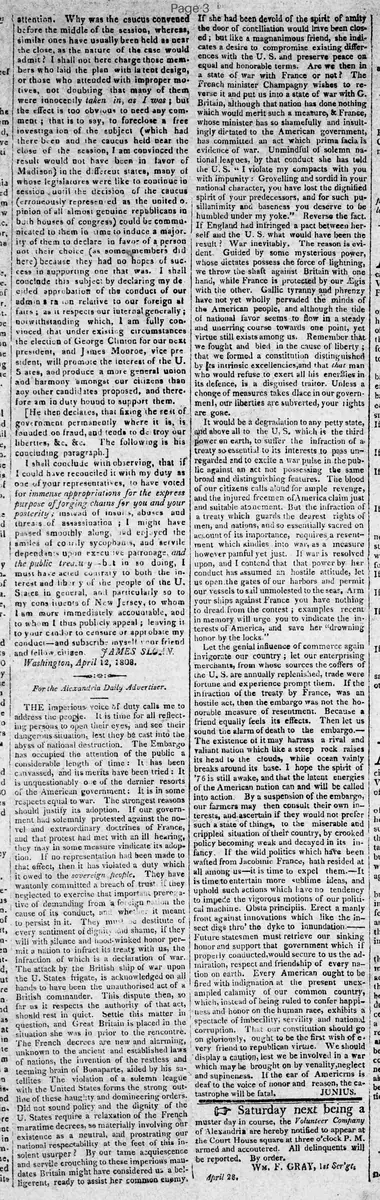
THE imperious voice of duty calls me to address the people. It is time for all reflecting persons to open their eyes, and see their dangerous situation, lest they be cast into the abyss of national destruction. The Embargo has occupied the attention of the public a considerable length of time: It has been canvassed, and its merits have been tried: It is unquestionably one of the dernier resorts of the American government: It is in some respects equal to war. The strongest reasons should justify its adoption. If our government had solemnly protested against the novel and extraordinary doctrines of France, and that protest had met with an ill hearing, they may in some measure vindicate its adoption. If no representation had been made to that effect, then it has violated a duty which it owed to the sovereign people. They have wantonly committed a breach of trust, if they neglected to exercise that important prerogative of demanding from a foreign nation the cause of its conduct, and whether it meant to persist in it. They must be destitute of every sentiment of dignity and shame, if they will with silence and hood-winked honor permit a nation to infract its treaty with us, the infraction of which is a declaration of war.
The attack by the British ship of war upon the U. States frigate, is acknowledged on all hands to have been the unauthorised act of a British commander. This dispute then, so far as it respects the authority of that act, should rest in quiet. Settle this matter in question, and Great Britain is placed in the situation she was in prior to the rencontre.
The French decrees are new and alarming, unknown to the ancient and established laws of nations, the invention of the restless and teeming brain of Bonaparte, aided by his satellites. The violation of a solemn league with the United States forms the strong outline of these haughty and domineering orders. Did not sound policy and the dignity of the U. States require a relaxation of the French maritime decrees, so materially involving our existence as a neutral, and prostrating our national respectability at the feet of this insolent usurper? By our tame acquiescence and servile crouching to these imperious mandates Britain might have considered us a belligerent, ready to assist her common enemy.
If she had been devoid of the spirit of amity the door of conciliation would have been closed; but like a magnanimous friend, she indicates a desire to compromise existing differences with the U. S. and preserve peace on equal and honorable terms. Are we then in a state of war with France or not? The French minister Champagny wishes to reverse it and put us into a state of war with G. Britain, although that nation has done nothing which would merit such a measure, & France, whose minister has so shamefully and insultingly dictated to the American government, has committed an act which prima facia is evidence of war. Unmindful of solemn national leagues, by that conduct she has told the U.S. "I violate my compacts with you with impunity: Grovelling and sordid in your national character, you have lost the dignified spirit of your predecessors, and for such pusillanimity and baseness you deserve to be humbled under my yoke." Reverse the fact. If England had infringed a pact between herself and the U. S. what would have been the result? War inevitably. The reason is evident. Guided by some mysterious power, whose dictates possess the force of lightning, we throw the shaft against Britain with one hand, while France is protected by our Egis with the other. Gallic tyranny and phrenzy have not yet wholly pervaded the minds of the American people, and although the tide of national favor seems to flow in a steady and unerring course towards one point, yet virtue still exists among us. Remember that we fought and bled in the cause of liberty; that we formed a constitution distinguished by its intrinsic excellencies, and that that man who would refuse to exert all his energies in its defence, is a disguised traitor. Unless a change of measures takes place in our government, our liberties are subverted, your rights are gone.
It would be a degradation to any petty state, and above all to the U. S. which is the third power on earth, to suffer the infraction of a treaty so essential to its interests to pass unregarded and to excite a war pulse in the public against an act not possessing the same broad and distinguishing features. The blood of our citizens calls aloud for ample revenge, and the injured freemen of America claim just and suitable atonement. But the infraction of a treaty which guards the dearest rights of men, and nations, and so essentially sacred on account of its importance, requires a resentment which kindles into war, as a measure however painful yet just. If war is resolved upon, and I contend that that power by her conduct has assumed an hostile attitude, let us open the gates of our harbors and permit our vessels to sail unmolested to the seas. Arm your ships against France you have nothing to dread from the contest; examples recent in memory will urge you to vindicate the interests of America, and save her "drowning honor by the locks."
Let the genial influence of commerce again invigorate our country; let our enterprising merchants, from whose sources the coffers of the U. S. are annually replenished, trade were fortune and experience prompt them. If the infraction of the treaty by France, was an hostile act, then the embargo was not the honorable measure of resentment. Because a friend equally feels its effects. Then let us sound the alarm of death to the embargo.-- The existence of it may harass a rival and valiant nation which like a steep rock raises its head to the clouds, while ocean vainly breaks around its base. I hope the spirit of '76 is still awake, and that the latent energies of the American nation can and will be called into action. By a suspension of the embargo, our farmers may then consult their own interests, and ascertain if they would not prefer such a state of things, to the miserable and crippled situation of their country, by crooked policy becoming weak and decayed in its infancy. If the wild politics which have been wafted from Jacobinic France, hath resided at all among us—it is time to expel them.--It is time to entertain more sublime ideas, and uphold such actions which have no tendency to impede the vigorous motions of our political machine. Obsta principiis. Erect a manly front against innovations which like the insect digs thro' the dyke to inundation... Future statesmen must retrieve our sinking honor and support that government which if properly conducted, would secure to us the admiration, respect and friendship of every nation on earth. Every American ought to be fired with indignation at the present unexampled calamity of our common country, which, instead of being ruled to confer happiness and honor on the human race, exhibits a spectacle of imbecility, servility and national corruption. That our constitution should go on gloriously, ought to be the first wish of every friend to republican virtue. We should display a caution, lest we be involved in a war which may be brought on by venality, neglect and supineness. If the ear of Americans is deaf to the voice of honor and reason, the catastrophe will be fatal.
JUNIUS.
THE imperious voice of duty calls me to address the people. It is time for all reflecting persons to open their eyes, and see their dangerous situation, lest they be cast into the abyss of national destruction. The Embargo has occupied the attention of the public a considerable length of time: It has been canvassed, and its merits have been tried: It is unquestionably one of the dernier resorts of the American government: It is in some respects equal to war. The strongest reasons should justify its adoption. If our government had solemnly protested against the novel and extraordinary doctrines of France, and that protest had met with an ill hearing, they may in some measure vindicate its adoption. If no representation had been made to that effect, then it has violated a duty which it owed to the sovereign people. They have wantonly committed a breach of trust, if they neglected to exercise that important prerogative of demanding from a foreign nation the cause of its conduct, and whether it meant to persist in it. They must be destitute of every sentiment of dignity and shame, if they will with silence and hood-winked honor permit a nation to infract its treaty with us, the infraction of which is a declaration of war.
The attack by the British ship of war upon the U. States frigate, is acknowledged on all hands to have been the unauthorised act of a British commander. This dispute then, so far as it respects the authority of that act, should rest in quiet. Settle this matter in question, and Great Britain is placed in the situation she was in prior to the rencontre.
The French decrees are new and alarming, unknown to the ancient and established laws of nations, the invention of the restless and teeming brain of Bonaparte, aided by his satellites. The violation of a solemn league with the United States forms the strong outline of these haughty and domineering orders. Did not sound policy and the dignity of the U. States require a relaxation of the French maritime decrees, so materially involving our existence as a neutral, and prostrating our national respectability at the feet of this insolent usurper? By our tame acquiescence and servile crouching to these imperious mandates Britain might have considered us a belligerent, ready to assist her common enemy.
If she had been devoid of the spirit of amity the door of conciliation would have been closed; but like a magnanimous friend, she indicates a desire to compromise existing differences with the U. S. and preserve peace on equal and honorable terms. Are we then in a state of war with France or not? The French minister Champagny wishes to reverse it and put us into a state of war with G. Britain, although that nation has done nothing which would merit such a measure, & France, whose minister has so shamefully and insultingly dictated to the American government, has committed an act which prima facia is evidence of war. Unmindful of solemn national leagues, by that conduct she has told the U.S. "I violate my compacts with you with impunity: Grovelling and sordid in your national character, you have lost the dignified spirit of your predecessors, and for such pusillanimity and baseness you deserve to be humbled under my yoke." Reverse the fact. If England had infringed a pact between herself and the U. S. what would have been the result? War inevitably. The reason is evident. Guided by some mysterious power, whose dictates possess the force of lightning, we throw the shaft against Britain with one hand, while France is protected by our Egis with the other. Gallic tyranny and phrenzy have not yet wholly pervaded the minds of the American people, and although the tide of national favor seems to flow in a steady and unerring course towards one point, yet virtue still exists among us. Remember that we fought and bled in the cause of liberty; that we formed a constitution distinguished by its intrinsic excellencies, and that that man who would refuse to exert all his energies in its defence, is a disguised traitor. Unless a change of measures takes place in our government, our liberties are subverted, your rights are gone.
It would be a degradation to any petty state, and above all to the U. S. which is the third power on earth, to suffer the infraction of a treaty so essential to its interests to pass unregarded and to excite a war pulse in the public against an act not possessing the same broad and distinguishing features. The blood of our citizens calls aloud for ample revenge, and the injured freemen of America claim just and suitable atonement. But the infraction of a treaty which guards the dearest rights of men, and nations, and so essentially sacred on account of its importance, requires a resentment which kindles into war, as a measure however painful yet just. If war is resolved upon, and I contend that that power by her conduct has assumed an hostile attitude, let us open the gates of our harbors and permit our vessels to sail unmolested to the seas. Arm your ships against France you have nothing to dread from the contest; examples recent in memory will urge you to vindicate the interests of America, and save her "drowning honor by the locks."
Let the genial influence of commerce again invigorate our country; let our enterprising merchants, from whose sources the coffers of the U. S. are annually replenished, trade were fortune and experience prompt them. If the infraction of the treaty by France, was an hostile act, then the embargo was not the honorable measure of resentment. Because a friend equally feels its effects. Then let us sound the alarm of death to the embargo.-- The existence of it may harass a rival and valiant nation which like a steep rock raises its head to the clouds, while ocean vainly breaks around its base. I hope the spirit of '76 is still awake, and that the latent energies of the American nation can and will be called into action. By a suspension of the embargo, our farmers may then consult their own interests, and ascertain if they would not prefer such a state of things, to the miserable and crippled situation of their country, by crooked policy becoming weak and decayed in its infancy. If the wild politics which have been wafted from Jacobinic France, hath resided at all among us—it is time to expel them.--It is time to entertain more sublime ideas, and uphold such actions which have no tendency to impede the vigorous motions of our political machine. Obsta principiis. Erect a manly front against innovations which like the insect digs thro' the dyke to inundation... Future statesmen must retrieve our sinking honor and support that government which if properly conducted, would secure to us the admiration, respect and friendship of every nation on earth. Every American ought to be fired with indignation at the present unexampled calamity of our common country, which, instead of being ruled to confer happiness and honor on the human race, exhibits a spectacle of imbecility, servility and national corruption. That our constitution should go on gloriously, ought to be the first wish of every friend to republican virtue. We should display a caution, lest we be involved in a war which may be brought on by venality, neglect and supineness. If the ear of Americans is deaf to the voice of honor and reason, the catastrophe will be fatal.
JUNIUS.
What sub-type of article is it?
Persuasive
Political
Provocative
What themes does it cover?
Economic Policy
Politics
Military War
What keywords are associated?
Embargo Opposition
French Treaty Violation
British Relations
National Honor
Commerce Restoration
War With France
Constitutional Liberty
What entities or persons were involved?
Junius.
For The Alexandria Daily Advertiser.
Letter to Editor Details
Author
Junius.
Recipient
For The Alexandria Daily Advertiser.
Main Argument
the u.s. embargo unjustly punishes britain for an unauthorized act while ignoring france's treaty violations, which amount to a declaration of war; lift the embargo, arm against france, and restore commerce to defend national honor and liberties.
Notable Details
References British Attack On U.S. Frigate As Unauthorized
Criticizes French Decrees As Bonaparte's Invention Violating Treaties
Invokes Spirit Of '76 And Constitutional Defense
Quotes 'Obsta Principiis' And Warns Against Jacobinic Influence