Thank you for visiting SNEWPapers!
Sign up free
Alexandria Gazette & Daily Advertiser
Alexandria, Virginia
What is this article about?
Informational article on the black currant shrub, native to England, highlighting its value for farmers in hedges for fruit, its historical use in treating sore throats in humans (revived by Mr. Baker of the Royal Society), and its benefits for cattle fevers and purgings, proposing it as a remedy for the ongoing European cattle throat inflammation disease.
Clipping
OCR Quality
Full Text
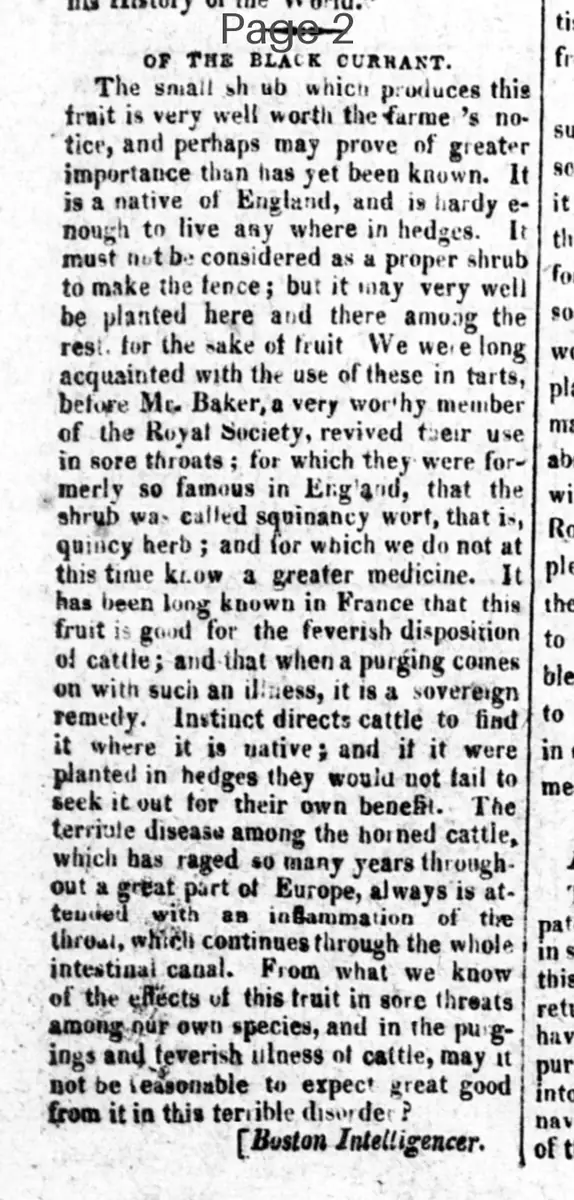
The small shrub which produces this fruit is very well worth the farmer's notice, and perhaps may prove of greater importance than has yet been known. It is a native of England, and is hardy enough to live anywhere in hedges. It must not be considered as a proper shrub to make the fence; but it may very well be planted here and there among the rest, for the sake of fruit. We were long acquainted with the use of these in tarts, before Mr. Baker, a very worthy member of the Royal Society, revived their use in sore throats; for which they were formerly so famous in England, that the shrub was called squinancy wort, that is, quincy herb; and for which we do not at this time know a greater medicine. It has been long known in France that this fruit is good for the feverish disposition of cattle; and that when a purging comes on with such an illness, it is a sovereign remedy. Instinct directs cattle to find it where it is native; and if it were planted in hedges they would not fail to seek it out for their own benefit. The terrible disease among the horned cattle, which has raged so many years throughout a great part of Europe, always is attended with an inflammation of the throat, which continues through the whole intestinal canal. From what we know of the effects of this fruit in sore throats among our own species, and in the purgings and feverish illness of cattle, may it not be reasonable to expect great good from it in this terrible disorder?
[Boston Intelligencer.]
What sub-type of article is it?
What keywords are associated?
What entities or persons were involved?
Domestic News Details
Key Persons
Event Details
The small shrub which produces this fruit is very well worth the farmer's notice, and perhaps may prove of greater importance than has yet been known. It is a native of England, and is hardy enough to live anywhere in hedges. It must not be considered as a proper shrub to make the fence; but it may very well be planted here and there among the rest, for the sake of fruit. We were long acquainted with the use of these in tarts, before Mr. Baker, a very worthy member of the Royal Society, revived their use in sore throats; for which they were formerly so famous in England, that the shrub was called squinancy wort, that is, quincy herb; and for which we do not at this time know a greater medicine. It has been long known in France that this fruit is good for the feverish disposition of cattle; and that when a purging comes on with such an illness, it is a sovereign remedy. Instinct directs cattle to find it where it is native; and if it were planted in hedges they would not fail to seek it out for their own benefit. The terrible disease among the horned cattle, which has raged so many years throughout a great part of Europe, always is attended with an inflammation of the throat, which continues through the whole intestinal canal. From what we know of the effects of this fruit in sore throats among our own species, and in the purgings and feverish illness of cattle, may it not be reasonable to expect great good from it in this terrible disorder?