Thank you for visiting SNEWPapers!
Sign up free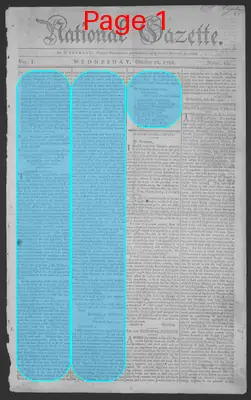
National Gazette
Philadelphia, Philadelphia County, Pennsylvania
What is this article about?
Former officers of the New York line of the American Army present a memorial to Congress in 1792, seeking payment of unpaid dues and compensation for their Revolutionary War service, highlighting sacrifices and quoting George Washington's 1783 letter on the debt of gratitude.
Clipping
OCR Quality
Full Text
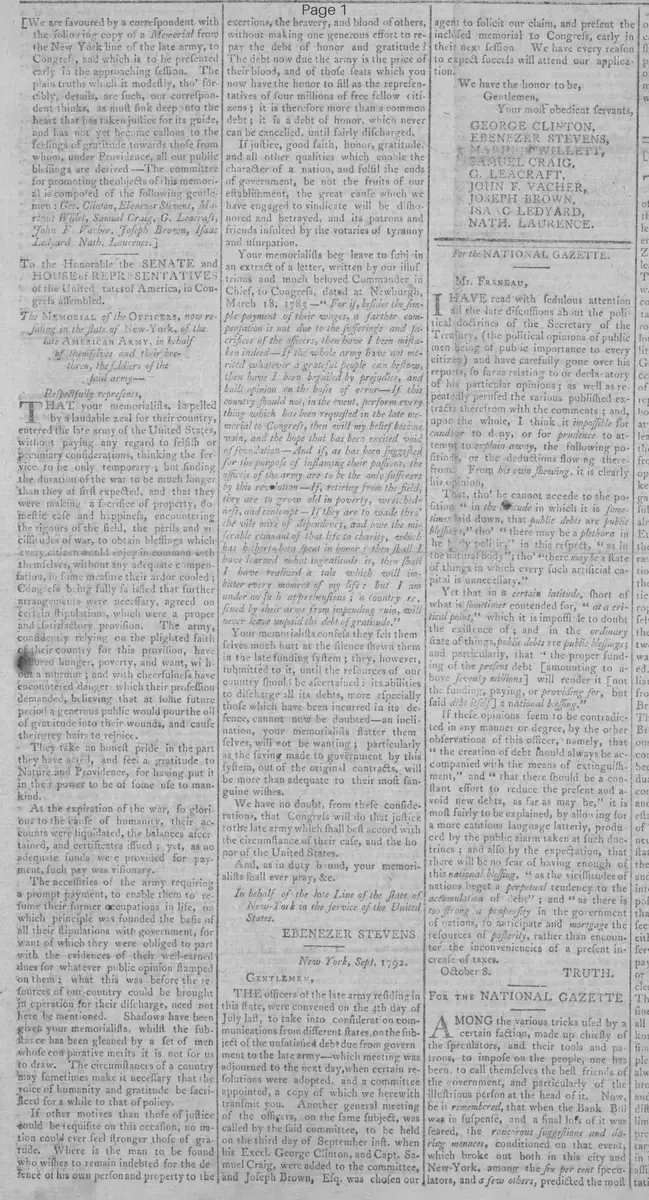
To the Honorable the SENATE and HOUSE OF REPRESENTATIVES of the United States of America, in Congress assembled.
The MEMORIAL of the Officers, now residing in the state of New-York, of the late AMERICAN ARMY, in behalf of themselves and their brethren, the Soldiers of the said army—
Respectfully represents,
THAT your memorialists, impelled by a laudable zeal for their country, entered the late army of the United States, without paying any regard to selfish or pecuniary considerations, thinking the service to be only temporary; but finding the duration of the war to be much longer than they at first expected, and that they were making a sacrifice of property, domestic ease and happiness, encountering the rigours of the field, the perils and vicissitudes of war, to obtain blessings which every citizen would enjoy in common with themselves, without any adequate compensation, in some measure their ardor cooled; Congress being fully satisfied that further arrangements were necessary, agreed on certain stipulations, which were a proper and satisfactory provision. The army, confidently relying on the plighted faith of their country for this provision, have endured hunger, poverty, and want, without a murmur; and with cheerfulness have encountered danger which their profession demanded, believing that at some future period a generous public would pour the oil of gratitude into their wounds, and cause their grey hairs to rejoice.
They take an honest pride in the part they have acted, and feel a gratitude to Nature and Providence, for having put it in their power to be of some use to mankind.
At the expiration of the war, so glorious to the cause of humanity, their accounts were liquidated, the balances ascertained, and certificates issued; yet, as no adequate funds were provided for payment, such pay was visionary.
The necessities of the army requiring a prompt payment, to enable them to resume their former occupations in life, on which principle was founded the basis of all their stipulations with government, for want of which they were obliged to part with the evidences of their well-earned dues for whatever public opinion stamped on them: what this was before the resources of our country could be brought in operation for their discharge, need not here be mentioned. Shadows have been given your memorialists, whilst the substance has been gleaned by a set of men whose comparative merits it is not for us to draw. The circumstances of a country may sometimes make it necessary that the voice of humanity and gratitude be sacrificed for a while to that of policy.
If other motives than those of justice could be requisite on this occasion, no nation could ever feel stronger those of gratitude. Where is the man to be found who wishes to remain indebted for the defence of his own person and property to the exertions, the bravery, and blood of others, without making one generous effort to repay the debt of honor and gratitude?
The debt now due the army is the price of their blood, and of those seats which you now have the honor to fill as the representatives of four millions of free fellow citizens; it is therefore more than a common debt; it is a debt of honor, which never can be cancelled, until fairly discharged.
If justice, good faith, honor, gratitude, and all other qualities which ennoble the character of a nation, and fulfil the ends of government, be not the fruits of our establishment, the great cause which we have engaged to vindicate will be dishonored and betrayed, and its patrons and friends insulted by the votaries of tyranny and usurpation.
Your memorialists beg leave to subjoin an extract of a letter, written by our illustrious and much beloved Commander in Chief, to Congress, dated at Newburgh, March 18, 1783— "For if, besides the simple payment of their wages, a farther compensation is not due to the sufferings and sacrifices of the officers, then have I been mistaken indeed—If the whole army have not merited whatever a grateful people can bestow, then have I been beguiled by prejudice, and built opinion on the basis of error—If this country should not, in the event, perform every thing which has been requested in the late memorial to Congress, then will my belief become vain, and the hope that has been excited void of foundation—And if, as has been suggested for the purpose of inflaming their passions, the officers of the army are to be the only sufferers by this revolution—If, retiring from the field, they are to grow old in poverty, wretchedness, and contempt—If they are to wade thro' the vile mire of dependency, and owe the miserable remnant of that life to charity, which has hitherto been spent in honor: then shall I have learned what ingratitude is, then shall I have realized a tale which will embitter every moment of my life: but I am under no such apprehensions; a country rescued by their arms from impending ruin, will never leave unpaid the debt of gratitude."
Your memorialists confess they felt themselves much hurt at the silence shown them in the late funding system; they, however, submitted to it, until the resources of our country should be ascertained: its abilities to discharge all its debts, more especially those which have been incurred in its defence, cannot now be doubted—an inclination, your memorialists flatter themselves, will not be wanting; particularly as the saving made to government by this system, out of the original contracts, will be more than adequate to their most sanguine wishes.
We have no doubt, from these considerations, that Congress will do that justice to the late army which shall best accord with the circumstances of their case, and the honor of the United States.
And, as in duty bound, your memorialists shall ever pray, &c.
In behalf of the late Line of the state of New-York in the service of the United States.
EBENEZER STEVENS
New York, Sept. 1792.
GENTLEMEN,
THE officers of the late army residing in this state, were convened on the 4th day of July last, to take into consideration communications from different states, on the subject of the unsatisfied debt due from government to the late army—which meeting was adjourned to the next day, when certain resolutions were adopted, and a committee appointed, a copy of which we herewith transmit you. Another general meeting of the officers, on the same subject, was called by the said committee, to be held on the third day of September inst. when his Excel. George Clinton, and Capt. Samuel Craig, were added to the committee, and Joseph Brown, Esq. was chosen our agent to solicit our claim, and present the enclosed memorial to Congress, early in their next session. We have every reason to expect success will attend our application.
We have the honor to be,
Gentlemen,
Your most obedient servants,
GEORGE CLINTON,
EBENEZER STEVENS,
MARINUS WILLETT,
SAMUEL CRAIG,
G. LEACRAFT,
JOHN F. VACHER,
JOSEPH BROWN,
ISAAC LEDYARD,
NATH. LAURENCE.
What sub-type of article is it?
What keywords are associated?
What entities or persons were involved?
Where did it happen?
Domestic News Details
Primary Location
New York
Event Date
Sept. 1792
Key Persons
Outcome
officers sold certificates at reduced value due to lack of funds; seeking full payment and compensation through congress.
Event Details
Officers of the late New York line army submit memorial to Congress detailing their sacrifices during the war, reliance on promised provisions, issuance of unpaid certificates, and plea for justice and gratitude; committee appointed at meetings on July 4 and September 3, 1792, to present it early in the next session.