Thank you for visiting SNEWPapers!
Sign up free
The New Hampshire Gazette And Historical Chronicle
Portsmouth, Greenland, Rockingham County, New Hampshire
What is this article about?
In Providence on Nov. 28, 1765, a town meeting of merchants and freemen unanimously voted to promote colonial industry and restrict European imports to prevent economic distress. On Dec. 2, they adopted a subscription agreement prohibiting import or purchase of listed luxury goods from Jan. 1, 1766, and encouraging local wool and flax production.
Merged-components note: Continuation of the Providence town meeting report and non-importation subscription agreement across pages; original label of second component changed from 'notice' to 'domestic_news' as it fits the overall content.
Clippings
1 of 2
OCR Quality
Full Text
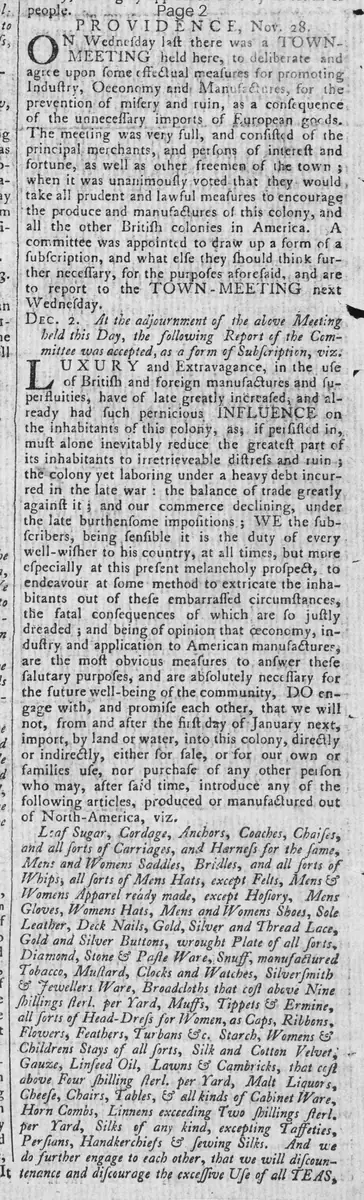
On Wednesday last there was a TOWN-MEETING held here, to deliberate and agree upon some effectual measures for promoting Industry, Oeconomy and Manufactures, for the prevention of misery and ruin, as a consequence of the unnecessary imports of European goods. The meeting was very full, and consisted of the principal merchants, and persons of interest and fortune, as well as other freemen of the town; when it was unanimously voted that they would take all prudent and lawful measures to encourage the produce and manufactures of this colony, and all the other British colonies in America. A committee was appointed to draw up a form of a subscription, and what else they should think further necessary, for the purposes aforesaid, and are to report to the TOWN-MEETING next Wednesday.
Dec. 2. At the adjournment of the above Meeting held this Day, the following Report of the Committee was accepted, as a form of Subscription, viz:
LUXURY and Extravagance, in the use of British and foreign manufactures and superfluities, have of late greatly increased; and already had such pernicious INFLUENCE on the inhabitants of this colony, as, if persisted in, must alone inevitably reduce the greatest part of its inhabitants to irretrievable distress and ruin; the colony yet laboring under a heavy debt incurred in the late war: the balance of trade greatly against it; and our commerce declining, under the late burdensome impositions; WE the subscribers, being sensible it is the duty of every well-wisher to his country, at all times, but more especially at this present melancholy prospect; to endeavour at some method to extricate the inhabitants out of these embarrassed circumstances, the fatal consequences of which are so justly dreaded; and being of opinion that oeconomy, industry and application to American manufacturers are the most obvious measures to answer these salutary purposes, and are absolutely necessary for the future well-being of the community, DO engage with, and promise each other, that we will not, from and after the first day of January next, import, by land or water, into this colony, directly or indirectly, either for sale, or for our own or families use, nor purchase of any other person who may, after said time, introduce any of the following articles, produced or manufactured out of North-America, viz.
Leaf Sugar, Cordage, Anchors, Coaches, Chaises, and all sorts of Carriages, and Harness for the same, Mens and Womens Saddles, Bridles, and all sorts of Whips; all Sorts of Mens Hats, except Felts, Mens & Womens Apparel ready made, except Hosiery, Mens Gloves, Womens Hats, Mens and Womens Shoes, Sole Leather, Deck Nails, Gold, Silver and Thread Lace, Gold and Silver Buttons, wrought Plate of all sorts, Diamond, Stone & Paste Ware, Snuff, manufactured Tobacco, Mustard, Clocks and Watches, Silversmith & Jewellers Ware, Broadcloths that cost above Nine Shillings sterling per Yard, Muffs, Tippets & Ermine, all Sorts of Head-Dress for Women, as Caps, Ribbons, Flowers, Feathers, Turbans &c. Starch, Womens & Childrens Stays of all sorts, Silk and Cotton Velvet; Gauze, Linseed Oil, Lawns & Cambricks, that cost above Four shillings sterling per Yard, Malt Liquors, Cheese, Chairs, Tables, & all kinds of Cabinet Ware, Horn Combs, Linnens exceeding Two shillings sterling per Yard, Silks of any kind, excepting Taffeties, Persians, Handkerchiefs & Sewing Silks. And we do further engage to each other, that we will discountenance and discourage the excessive Use of all TEAS, Superfluities, and all such other Articles of foreign China Ware, Spices & Black Pepper, all British Manufactures not herein enumerated, as, by due Encouragement, are or may be fabricated in North-America, and all the Use of black or Mourning Apparel, Gloves & Liquors, at Funerals. And whereas Wool and Flax are the natural Produce and Staple of this Colony, We will, as far as We can, encourage the raising and manufacturing those articles, particularly into Flannel and Tow Cloth (they being already made cheaper, and more durable, than English Swanskins or Ozenbrigs) that thereby a sufficient Quantity to answer the Consumption may be at Market.
And furthermore, to the end that this union be not violated, and the good Effects that must naturally result be thereby frustrated, if any inhabitant of this town does not sign and conform to the regulations herein made; but, disregarding the interest of the colony, still continues to import and introduce any of the aforementioned restricted articles, such person or persons shall be by us discountenanced, in the most effectual, but decent and lawful manner.
What sub-type of article is it?
What keywords are associated?
Where did it happen?
Domestic News Details
Primary Location
Providence
Event Date
Nov. 28 And Dec. 2
Outcome
unanimous adoption of a subscription agreement to restrict imports of listed european luxury goods starting jan. 1, 1766, encourage local manufactures, and socially discountenance non-conformers.
Event Details
A town meeting was held to address economic distress from excessive imports; participants voted to promote colonial produce and manufactures. A committee drafted and the meeting accepted a subscription pledging non-importation and non-purchase of specified foreign articles, discouragement of luxuries like tea, and promotion of local wool and flax products.