Thank you for visiting SNEWPapers!
Sign up free
Literary
January 10, 1878
The Worthington Advance
Worthington, Nobles County, Minnesota
What is this article about?
Two young women, Kitty and Lucretia Armstrong, discuss a wealthy cripple, Gale Bertram, whose elegance highlights his disability. Lucretia admires his intellect and face. Through conversations and a carriage ride where Lucretia aids an injured dog, Bertram recognizes her compassion for the 'maimed.' He proposes, and she accepts, valuing his noble character over his infirmity.
Clipping
OCR Quality
95%
Excellent
Full Text
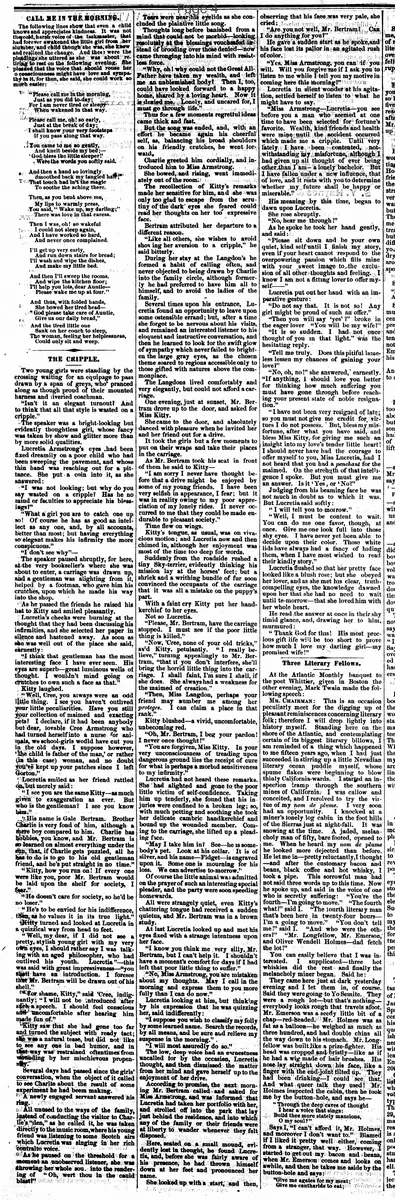
THE CRIPPLE.
Two young girls were standing by the crossing waiting for an equipage to pass drawn by a span of greys, who pranced along as though proud of their mounted harness and liveried coachman.
"Isn't it an elegant turnout? And to think that all that style is wasted on a cripple."
The speaker was a bright-looking but evidently thoughtless girl, whose fancy was taken by show and glitter more than by more solid qualities.
Lucretia Armstrong's eyes had been fixed dreamily on a poor child who had been sweeping the pavement, and whose thin hand was reaching out for a pittance. She put a coin into it, as she answered:
"I was not looking; but why do you say wasted on a cripple? Has he no mind or faculties to appreciate his blessings?"
"What a girl you are to catch one up so! Of course he has as good an intellect as any one, and, by all accounts, better than most; but having everything so elegant makes his infirmity the more conspicuous."
"I don't see why"
The speaker paused abruptly, for here, at the very bookseller's where she was about to enter, a carriage was drawn up, and a gentleman was alighting from it, helped by a footman, who gave him his crutches, upon which he made his way into the shop.
As he passed the friends he raised his hat to Kitty and smiled pleasantly.
Lucretia's cheeks were burning at the thought that they had been discussing his infirmities, and she selected her paper in silence and hastened away. As soon as she was well out of the place she said earnestly:
"I think that gentleman has the most interesting face I have ever seen. His eyes are superb—great luminous wells of thought. I wouldn't mind going on crutches to own such a face as that."
Kitty laughed.
"Well, Cree, you always were an odd little thing. I see you haven't outlived your little peculiarities. Have you still your collection of maimed and exacting pets? I declare, if it had been anybody but dear, lovable Cree Armstrong who had turned herself into a nurse for animals, we school-girls would have cut you in the old days. I suppose however, the child is father of the man,' or rather (in this case) woman, and no doubt you've kept up your practices since I left Gorton."
Lucretia smiled as her friend rattled on, but merely said:
"I see you are the same Kitty—as much given to exaggeration as ever. But who is the gentleman? I see you know him."
"His name is Gale Bertram. Brother Charlie is very fond of him, although a mere boy compared to him. Charlie has hobbies, you know, and Mr. Bertram is so learned on almost everything under the sun, that, if Charlie gets puzzled, all he has to do is to go to his old gentleman friend, and he's put straight in no time."
"Kitty, how you run on! If every one were like you, poor Mr. Bertram would be laid upon the shelf for 'society, I fear."
"He doesn't care for society, so he'd be no loser."
"He's to be envied for his indifference, then, he values it in its true light."
Kitty turned and looked at Lucretia in a quizzical way from head to feet.
"Well, my dear, if I did not see a pretty, stylish young girl with my very own eyes, I should rather say I was talking with an aged philosopher, who had outlived his youth. Lucretia"—this was said with great impressiveness—"you shall have an introduction. I foresee that Mr. Bertram will be drawn out of his shell."
"For shame, Kitty," said Cree, indignantly "I will not be introduced after such a speech. I should feel conscious and uncomfortable after hearing him made fun of."
Kitty saw that she had gone too far and turned the subject with ready tact; she was a natural tease, but did not like to see any one in bad humor, and in that way was restrained oftentimes from wounding by her mischievous propensities.
Several days had passed since the girls' conversation, when the object of it called to see Charlie about the result of some experiment he had been making.
A newly engaged servant—answered his call, unused to the ways of the family instead of conducting the visitor to Charlie's 'den,' as he called it, he was taken directly to the music room, where his young friend was listening to some Scotch airs which Lucretia was singing in her rich contralto voice.
As he paused on the threshold for a moment an unobserved listener, she was throwing her whole soul into the rendering of "Oh, wert thou in the cauld blast."
Tears were near his eyelids as she concluded the plaintive little song.
Thoughts long before banished from a mind that could not be morbid—looking resolutely at the blessings vouchsafed in stead of brooding over those denied—now came thronging into his mind with resistless force.
"Why, oh why could not the Great All-Father have taken my wealth, and left me an unblemished body! Then I, too, could have looked forward to a happy home, shared by a loving heart. Now it is denied me. Lonely, and uncared for, I must go through life."
Thus for a few moments regretful ideas came thick and fast.
But the song was ended, and, with an effort he became again his cheerful self, as, balancing his broad shoulders on his friendly crutches, he went forward.
Charlie greeted him cordially, and introduced him to Miss Armstrong.
She bowed; and rising, went immediately out of the room!
The recollection of Kitty's remarks made her sensitive for him, and she was only too glad to escape from the scrutiny of the dark eyes she feared could read her thoughts on her too expressive face.
Bertram attributed her departure to a different reason.
"Like all others, she wishes to avoid showing her aversion to a cripple," he said bitterly.
During her stay at the Langdon's he formed a habit of calling often, and never objected to being drawn by Charlie into the family circle, although formerly he had preferred to have him all to himself, and to avoid the ladies of the family.
Several times upon his entrance, Lucretia found an opportunity to leave upon some ostensible errand; but, after a time she forgot to be nervous about his visits and remained an interested listener to his eloquent and instructive conversation, and then he learned to look for the swift glow of sympathy which never failed to brighten the large gray eyes, as the chosen theme soared to regions accessible only to those gifted with natures above the commonplace.
The Langdons lived comfortably and very elegantly, but could not afford a carriage.
One evening, just at sunset, Mr. Bertram drove up to the door, and asked for Miss Kitty.
She came to the door, and absolutely danced with pleasure when he invited her and her friend out for a drive.
It took the girls but a few moments to put on their wraps and take their places in the carriage.
As Mr. Bertram took his seat in front of them he said to Kitty
"I am sorry I never have thought before that a drive might be enjoyed by some of my young friends. I have been very selfish in appearance, I fear; but it was in reality owing to my poor appreciation of my lonely rides. It never occurred to me that they could be made endurable to pleasant society."
Time flew on wings.
Kitty's tongue, as usual, was on vivacious motion; and Lucretia now and then chimed in, although her enjoyment was most of the time too deep for words.
Suddenly from the roadside rushed a tiny Skye-terrier, evidently thinking his mission lay at the horses' feet; but a shriek and a writhing bundle of fur soon convinced the occupants of the carriage that it was all a mistake on the puppy's part.
With a faint cry Kitty put her handkerchief to her eyes.
Not so Lucretia.
"Please, Mr. Bertram, have the carriage stopped. I must see if the poor little thing is killed."
"Now, Cree, none of your old tricks," said Kitty petulantly. "I really believe," turning appealingly to Mr. Bertram, "that if you don't interfere, she'll bring the horrid little thing into the carriage. I shall faint, I'm sure I shall, if she does. She always had a weakness for the maimed of creation."
"Then, Miss Langdon, perhaps your friend may number me among her proteges. I can claim a place in that rank."
Kitty blushed—a vivid, uncomfortable, unbecoming red.
"Oh, Mr. Bertram, I beg your pardon! I never once thought!"
"You are forgiven, Miss Kitty. In your very unconsciousness of treading upon dangerous ground lies the receipt of cure for what is perhaps a morbid sensitiveness to my infirmity."
Lucretia had not heard these remarks. She had alighted and gone to the poor little victim of self-confidence. Taking him up tenderly, she found that his injuries were confined to a broken leg; so, with much petting and soothing she took her delicate cambric handkerchief and bound up the wounded member. Coming to the carriage, she lifted up a pleading face.
"May I take him in? See—he is somebody's pet. Look at his collar. It is of silver, and his name—Fidget—is engraved upon it. Some one is mourning for his loss. We can advertise to-morrow."
Of course the little animal was admitted on the prayer of such an interesting special pleader, and the party were soon speeding homewards.
All were strangely quiet, even Kitty's chattering tongue had received a sudden quietus, and Mr. Bertram was in a brown study.
At last Lucretia looked up and met his eyes fixed with a strange intentness upon her face.
"I know you think me very silly, Mr. Bertram, but I can't help it. I shouldn't have a moment's comfort for days if I had left that poor little thing to suffer."
"No, Miss Armstrong, you are mistaken about my thoughts. May I call in the morning and express them to you more fully than I can do now?"
Lucretia looking at him, but thinking by his expression that he was quizzing her, said indifferently:
"I suppose you wish to classify my folly by some learned name. Search the records, by all means, and be sure and relieve my suspense in the morning."
"I will most assuredly do so."
The low, deep voice had an earnestness uncalled for by the occasion, Lucretia thought, and then dismissed the matter from her mind and gave herself up to the enjoyment of her drive.
According to promise, the next morning Mr. Bertram called—and asked for Miss Armstrong, and was informed that Lucretia had taken her portfolio with her and strolled off into the park that lay just behind the residence, and into which any of the family or their friends were at liberty to wander whenever they felt disposed.
Here, seated on a small mound evidently lost in thought, he found Lucretia and, before she was fairly aware of his presence, he had thrown himself down at her feet and pronounced her name.
She looked up with a start, and then, observing that his face was very pale, she said:
"Are you not well, Mr. Bertram? Can I do anything for you?"
He gave a sudden start as he spoke, and his face lost its pallor in an agitated rush of color.
"Yes, Miss Armstrong, you can if you will. Will you forgive me if I ask you to listen to me while I tell you my motive in coming here this morning?"
Lucretia in silent wonder at his agitation, settled herself to listen to what he might have to say.
"Miss Armstrong—Lucretia—you see before you a man who seemed at one time to have been selected for fortune's favorite. Wealth, kind friends and health were mine until the accident occurred which made me a cripple. Until very lately I have been contented, notwithstanding my misfortune, although I had given up all thought of ever being other than I am—a lonely bachelor. But I have fallen under a new influence, that of love, and it rests with you to determine whether my future shall be happy or miserable."
His meaning, by this time, began to dawn upon Lucretia.
She rose abruptly.
"No, hear me through!"
As he spoke he took her hand gently and said:
"Please sit down and be your own quiet, kind self until I finish my story, even if your heart cannot respond to the overpowering passion which fills mine with your sweet image to the exclusion of all other thoughts and feeling. I know I am not a fitting lover to offer myself"
Lucretia put out her hand with an imperative gesture:
"Do not say that. It is not so! Any girl might be proud of such an offer."
"Then you will say yes?" broke in the eager lover "You will be my wife?"
"It is so sudden. I had not once thought of you in that light." was the hesitating reply.
"Tell me truly. Does this pitiful lameness lessen my chances of gaining your love?"
"No, oh, no!" she answered earnestly. "If anything, I should love you better for thinking how much suffering you must have gone through before reaching your present state of noble resignation."
"I have not been very resigned of late; so you must not give me credit for virtues I do not possess." But, bless my misfortune, after what you have said,' and bless Miss Kitty, for giving me such an insight into my love's tender little heart! I should never have had the courage to offer myself to you, Miss Lucretia, had I not heard that you had a penchant for the maimed. On the strength of that intelligence I spoke. But you must give me an answer. Is it 'Yes,' or 'No'?"
Judging from his beaming face he was not much in doubt as to which it was.
But Lucretia said softly:
"I will tell you to-morrow."
"Well, I must be content to wait. You can do me one favor, though, at once. Give me one look full into those shy eyes. I have never yet been able to decide upon their color. Those white lids have always had a fancy of hiding them, when I have most wished to read their kindly story."
Lucretia flushed so that her pretty face looked like a blush rose; but she obeyed her lover, and as she met his clear, truth-compelling eyes, the knowledge dawned upon her that she had no need to wait until to-morrow—that she loved him with her whole heart.
He read the answer at once in their shy timid glance, and, drawing her to him, murmured:
"Thank God for this! His most precious gift life will be too short to prove how much I love my darling girl—my promised wife!"
Two young girls were standing by the crossing waiting for an equipage to pass drawn by a span of greys, who pranced along as though proud of their mounted harness and liveried coachman.
"Isn't it an elegant turnout? And to think that all that style is wasted on a cripple."
The speaker was a bright-looking but evidently thoughtless girl, whose fancy was taken by show and glitter more than by more solid qualities.
Lucretia Armstrong's eyes had been fixed dreamily on a poor child who had been sweeping the pavement, and whose thin hand was reaching out for a pittance. She put a coin into it, as she answered:
"I was not looking; but why do you say wasted on a cripple? Has he no mind or faculties to appreciate his blessings?"
"What a girl you are to catch one up so! Of course he has as good an intellect as any one, and, by all accounts, better than most; but having everything so elegant makes his infirmity the more conspicuous."
"I don't see why"
The speaker paused abruptly, for here, at the very bookseller's where she was about to enter, a carriage was drawn up, and a gentleman was alighting from it, helped by a footman, who gave him his crutches, upon which he made his way into the shop.
As he passed the friends he raised his hat to Kitty and smiled pleasantly.
Lucretia's cheeks were burning at the thought that they had been discussing his infirmities, and she selected her paper in silence and hastened away. As soon as she was well out of the place she said earnestly:
"I think that gentleman has the most interesting face I have ever seen. His eyes are superb—great luminous wells of thought. I wouldn't mind going on crutches to own such a face as that."
Kitty laughed.
"Well, Cree, you always were an odd little thing. I see you haven't outlived your little peculiarities. Have you still your collection of maimed and exacting pets? I declare, if it had been anybody but dear, lovable Cree Armstrong who had turned herself into a nurse for animals, we school-girls would have cut you in the old days. I suppose however, the child is father of the man,' or rather (in this case) woman, and no doubt you've kept up your practices since I left Gorton."
Lucretia smiled as her friend rattled on, but merely said:
"I see you are the same Kitty—as much given to exaggeration as ever. But who is the gentleman? I see you know him."
"His name is Gale Bertram. Brother Charlie is very fond of him, although a mere boy compared to him. Charlie has hobbies, you know, and Mr. Bertram is so learned on almost everything under the sun, that, if Charlie gets puzzled, all he has to do is to go to his old gentleman friend, and he's put straight in no time."
"Kitty, how you run on! If every one were like you, poor Mr. Bertram would be laid upon the shelf for 'society, I fear."
"He doesn't care for society, so he'd be no loser."
"He's to be envied for his indifference, then, he values it in its true light."
Kitty turned and looked at Lucretia in a quizzical way from head to feet.
"Well, my dear, if I did not see a pretty, stylish young girl with my very own eyes, I should rather say I was talking with an aged philosopher, who had outlived his youth. Lucretia"—this was said with great impressiveness—"you shall have an introduction. I foresee that Mr. Bertram will be drawn out of his shell."
"For shame, Kitty," said Cree, indignantly "I will not be introduced after such a speech. I should feel conscious and uncomfortable after hearing him made fun of."
Kitty saw that she had gone too far and turned the subject with ready tact; she was a natural tease, but did not like to see any one in bad humor, and in that way was restrained oftentimes from wounding by her mischievous propensities.
Several days had passed since the girls' conversation, when the object of it called to see Charlie about the result of some experiment he had been making.
A newly engaged servant—answered his call, unused to the ways of the family instead of conducting the visitor to Charlie's 'den,' as he called it, he was taken directly to the music room, where his young friend was listening to some Scotch airs which Lucretia was singing in her rich contralto voice.
As he paused on the threshold for a moment an unobserved listener, she was throwing her whole soul into the rendering of "Oh, wert thou in the cauld blast."
Tears were near his eyelids as she concluded the plaintive little song.
Thoughts long before banished from a mind that could not be morbid—looking resolutely at the blessings vouchsafed in stead of brooding over those denied—now came thronging into his mind with resistless force.
"Why, oh why could not the Great All-Father have taken my wealth, and left me an unblemished body! Then I, too, could have looked forward to a happy home, shared by a loving heart. Now it is denied me. Lonely, and uncared for, I must go through life."
Thus for a few moments regretful ideas came thick and fast.
But the song was ended, and, with an effort he became again his cheerful self, as, balancing his broad shoulders on his friendly crutches, he went forward.
Charlie greeted him cordially, and introduced him to Miss Armstrong.
She bowed; and rising, went immediately out of the room!
The recollection of Kitty's remarks made her sensitive for him, and she was only too glad to escape from the scrutiny of the dark eyes she feared could read her thoughts on her too expressive face.
Bertram attributed her departure to a different reason.
"Like all others, she wishes to avoid showing her aversion to a cripple," he said bitterly.
During her stay at the Langdon's he formed a habit of calling often, and never objected to being drawn by Charlie into the family circle, although formerly he had preferred to have him all to himself, and to avoid the ladies of the family.
Several times upon his entrance, Lucretia found an opportunity to leave upon some ostensible errand; but, after a time she forgot to be nervous about his visits and remained an interested listener to his eloquent and instructive conversation, and then he learned to look for the swift glow of sympathy which never failed to brighten the large gray eyes, as the chosen theme soared to regions accessible only to those gifted with natures above the commonplace.
The Langdons lived comfortably and very elegantly, but could not afford a carriage.
One evening, just at sunset, Mr. Bertram drove up to the door, and asked for Miss Kitty.
She came to the door, and absolutely danced with pleasure when he invited her and her friend out for a drive.
It took the girls but a few moments to put on their wraps and take their places in the carriage.
As Mr. Bertram took his seat in front of them he said to Kitty
"I am sorry I never have thought before that a drive might be enjoyed by some of my young friends. I have been very selfish in appearance, I fear; but it was in reality owing to my poor appreciation of my lonely rides. It never occurred to me that they could be made endurable to pleasant society."
Time flew on wings.
Kitty's tongue, as usual, was on vivacious motion; and Lucretia now and then chimed in, although her enjoyment was most of the time too deep for words.
Suddenly from the roadside rushed a tiny Skye-terrier, evidently thinking his mission lay at the horses' feet; but a shriek and a writhing bundle of fur soon convinced the occupants of the carriage that it was all a mistake on the puppy's part.
With a faint cry Kitty put her handkerchief to her eyes.
Not so Lucretia.
"Please, Mr. Bertram, have the carriage stopped. I must see if the poor little thing is killed."
"Now, Cree, none of your old tricks," said Kitty petulantly. "I really believe," turning appealingly to Mr. Bertram, "that if you don't interfere, she'll bring the horrid little thing into the carriage. I shall faint, I'm sure I shall, if she does. She always had a weakness for the maimed of creation."
"Then, Miss Langdon, perhaps your friend may number me among her proteges. I can claim a place in that rank."
Kitty blushed—a vivid, uncomfortable, unbecoming red.
"Oh, Mr. Bertram, I beg your pardon! I never once thought!"
"You are forgiven, Miss Kitty. In your very unconsciousness of treading upon dangerous ground lies the receipt of cure for what is perhaps a morbid sensitiveness to my infirmity."
Lucretia had not heard these remarks. She had alighted and gone to the poor little victim of self-confidence. Taking him up tenderly, she found that his injuries were confined to a broken leg; so, with much petting and soothing she took her delicate cambric handkerchief and bound up the wounded member. Coming to the carriage, she lifted up a pleading face.
"May I take him in? See—he is somebody's pet. Look at his collar. It is of silver, and his name—Fidget—is engraved upon it. Some one is mourning for his loss. We can advertise to-morrow."
Of course the little animal was admitted on the prayer of such an interesting special pleader, and the party were soon speeding homewards.
All were strangely quiet, even Kitty's chattering tongue had received a sudden quietus, and Mr. Bertram was in a brown study.
At last Lucretia looked up and met his eyes fixed with a strange intentness upon her face.
"I know you think me very silly, Mr. Bertram, but I can't help it. I shouldn't have a moment's comfort for days if I had left that poor little thing to suffer."
"No, Miss Armstrong, you are mistaken about my thoughts. May I call in the morning and express them to you more fully than I can do now?"
Lucretia looking at him, but thinking by his expression that he was quizzing her, said indifferently:
"I suppose you wish to classify my folly by some learned name. Search the records, by all means, and be sure and relieve my suspense in the morning."
"I will most assuredly do so."
The low, deep voice had an earnestness uncalled for by the occasion, Lucretia thought, and then dismissed the matter from her mind and gave herself up to the enjoyment of her drive.
According to promise, the next morning Mr. Bertram called—and asked for Miss Armstrong, and was informed that Lucretia had taken her portfolio with her and strolled off into the park that lay just behind the residence, and into which any of the family or their friends were at liberty to wander whenever they felt disposed.
Here, seated on a small mound evidently lost in thought, he found Lucretia and, before she was fairly aware of his presence, he had thrown himself down at her feet and pronounced her name.
She looked up with a start, and then, observing that his face was very pale, she said:
"Are you not well, Mr. Bertram? Can I do anything for you?"
He gave a sudden start as he spoke, and his face lost its pallor in an agitated rush of color.
"Yes, Miss Armstrong, you can if you will. Will you forgive me if I ask you to listen to me while I tell you my motive in coming here this morning?"
Lucretia in silent wonder at his agitation, settled herself to listen to what he might have to say.
"Miss Armstrong—Lucretia—you see before you a man who seemed at one time to have been selected for fortune's favorite. Wealth, kind friends and health were mine until the accident occurred which made me a cripple. Until very lately I have been contented, notwithstanding my misfortune, although I had given up all thought of ever being other than I am—a lonely bachelor. But I have fallen under a new influence, that of love, and it rests with you to determine whether my future shall be happy or miserable."
His meaning, by this time, began to dawn upon Lucretia.
She rose abruptly.
"No, hear me through!"
As he spoke he took her hand gently and said:
"Please sit down and be your own quiet, kind self until I finish my story, even if your heart cannot respond to the overpowering passion which fills mine with your sweet image to the exclusion of all other thoughts and feeling. I know I am not a fitting lover to offer myself"
Lucretia put out her hand with an imperative gesture:
"Do not say that. It is not so! Any girl might be proud of such an offer."
"Then you will say yes?" broke in the eager lover "You will be my wife?"
"It is so sudden. I had not once thought of you in that light." was the hesitating reply.
"Tell me truly. Does this pitiful lameness lessen my chances of gaining your love?"
"No, oh, no!" she answered earnestly. "If anything, I should love you better for thinking how much suffering you must have gone through before reaching your present state of noble resignation."
"I have not been very resigned of late; so you must not give me credit for virtues I do not possess." But, bless my misfortune, after what you have said,' and bless Miss Kitty, for giving me such an insight into my love's tender little heart! I should never have had the courage to offer myself to you, Miss Lucretia, had I not heard that you had a penchant for the maimed. On the strength of that intelligence I spoke. But you must give me an answer. Is it 'Yes,' or 'No'?"
Judging from his beaming face he was not much in doubt as to which it was.
But Lucretia said softly:
"I will tell you to-morrow."
"Well, I must be content to wait. You can do me one favor, though, at once. Give me one look full into those shy eyes. I have never yet been able to decide upon their color. Those white lids have always had a fancy of hiding them, when I have most wished to read their kindly story."
Lucretia flushed so that her pretty face looked like a blush rose; but she obeyed her lover, and as she met his clear, truth-compelling eyes, the knowledge dawned upon her that she had no need to wait until to-morrow—that she loved him with her whole heart.
He read the answer at once in their shy timid glance, and, drawing her to him, murmured:
"Thank God for this! His most precious gift life will be too short to prove how much I love my darling girl—my promised wife!"
What sub-type of article is it?
Prose Fiction
What themes does it cover?
Love Romance
Moral Virtue
What keywords are associated?
Cripple
Love
Compassion
Disability
Proposal
Maimed
Infirmity
Romance
Literary Details
Title
The Cripple.
Key Lines
"I Think That Gentleman Has The Most Interesting Face I Have Ever Seen. His Eyes Are Superb—Great Luminous Wells Of Thought. I Wouldn't Mind Going On Crutches To Own Such A Face As That."
"Then, Miss Langdon, Perhaps Your Friend May Number Me Among Her Proteges. I Can Claim A Place In That Rank."
"No, Oh, No!" She Answered Earnestly. "If Anything, I Should Love You Better For Thinking How Much Suffering You Must Have Gone Through Before Reaching Your Present State Of Noble Resignation."
"Thank God For This! His Most Precious Gift Life Will Be Too Short To Prove How Much I Love My Darling Girl—My Promised Wife!"