Thank you for visiting SNEWPapers!
Sign up free
Alexandria Gazette, Commercial And Political
Alexandria, Virginia
What is this article about?
Series of 1814 letters from US Secretary of State James Monroe to plenipotentiaries at Ghent, providing instructions on indemnity claims for seized vessels, neutral rights stipulations, impressment, and negotiation updates amid War of 1812 peace talks with Britain.
Clipping
OCR Quality
Full Text
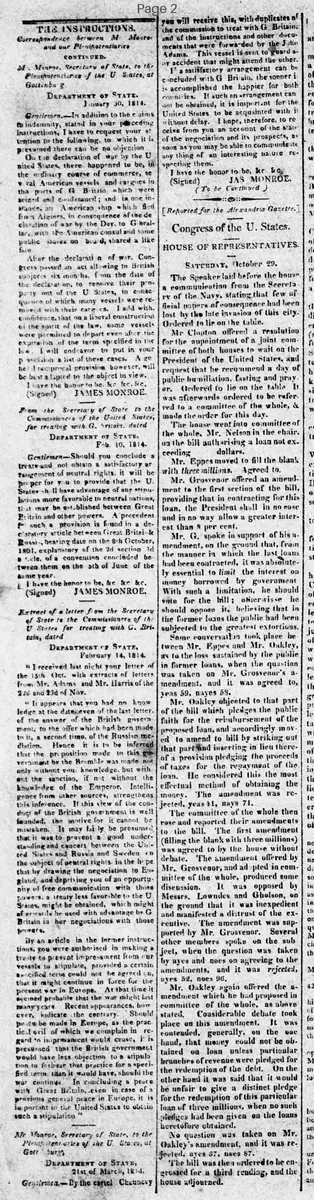
Correspondence between Mr. Monroe and our Plenipotentiaries.
CONTINUED.
Mr. Monroe, Secretary of State, to the Plenipotentiaries of the United States, at Ghent.
Department of State,
January 30, 1814.
Gentlemen,--In addition to the claims to indemnity, stated in your preceding instructions, I have to request your attention to the following, to which it is presumed there can be no objection.
On the declaration of war by the United States, there happened to be, in the ordinary course of commerce, several American vessels and cargoes in the ports of Great Britain which were seized and condemned: and in one instance an American ship which sailed from Algiers, in consequence of the declaration of war by the Dey, to Gibraltar, with the American consul and some public stores on board, shared a like fate.
After the declaration of war, Congress passed an act allowing to British subjects six months, from the date of the declaration, to remove their property out of the United States, in consequence of which, many vessels were removed with their cargoes. I add with confidence, that on a liberal construction of the spirit of the law, some vessels were permitted to depart even after the expiration of the term specified in the act. I will endeavor to put in your possession a list of these cases. A general reciprocal provision however, will be best adapted to the object in view.
I have the honor to be, &c. &c. &c.
(Signed)
JAMES MONROE.
From the Secretary of State to the Commissioners of the United States, for treating with G. Britain, dated
Department of State,
February 10, 1814.
Gentlemen,--Should you conclude a treaty and not obtain a satisfactory arrangement of neutral rights, it will be proper for you to provide that the United States shall have advantage of any stipulations more favorable to neutral nations, that may be established between Great Britain and other powers. A precedent for such a provision is found in a declaratory article between Great Britain & Russia, bearing date on the 8th October, 1801, explanatory of the 2d section 3d article, of a convention concluded between them on the 5th of June of the same year.
I have the honor to be, &c. &c. &c.
(Signed)
JAMES MONROE.
Extract of a letter from the Secretary of State to the Commissioners of the United States for treating with G. Britain, dated
Department of State,
February 14, 1814.
"I received last night your letter of the 15th Oct. with extracts of letters from Mr. Adams and Mr. Harris of the 22d and 23d of Nov.
"It appears that you had no knowledge at the date even of the last letter, of the answer of the British government to the offer which had been made to it, a second time, of the Russian mediation. Hence it is to be inferred that the proposition made to this government by the Bramble was made not only without your knowledge, but without the sanction, if not without the knowledge of the Emperor. Intelligence from other sources, strengthens this inference. In this view of the conduct of the British government is well founded, the motive of it cannot be mistaken. It may fairly be presumed that it was to prevent a good understanding and concert between the United States and Russia and Sweden on the subject of neutral rights, in the hope that by drawing the negotiation to England, and depriving you of an opportunity of free communication with those powers, a treaty less favorable to the United States, might be obtained, which might afterwards be used with advantage by Great Britain in her negotiations with those powers.
By an article in the former instructions, you were authorized in making a treaty to prevent impressment from our vessels to stipulate, provided a certain specified term could not be agreed on, that it might continue in force for the present war in Europe. At that time it seemed probable that the war might last many years. Recent appearances, however, indicate the contrary. Should peace be made in Europe, as the practical evil of which we complain in regard to impressment would cease, it is presumed that the British government would have less objection to a stipulation to forbear that practice for a specified term, than it would have, should the war continue. In concluding a peace with Great Britain, even in case of a previous general peace in Europe, it is important to the United States to obtain such a stipulation.
Mr. Monroe, Secretary of State, to the Plenipotentiaries of the U. States, at Ghent,
Department of State,
21st of March, 1814.
Gentlemen,--By the cartel schooner you will receive this, with duplicates of the commission to treat with G. Britain; and of the instructions and other documents that were forwarded by the John Adams. This vessel is sent to guard against any accident that might attend the other. If a satisfactory arrangement can be concluded with G. Britain, the sooner it is accomplished the happier for both countries. If such an arrangement can not be obtained, it is important for the United States to be acquainted with it without delay. I hope, therefore, to receive from you an account of the state of the negotiation and its prospects, as soon as you may be able to communicate any thing of an interesting nature respecting them.
I have the honor to be, &c. &c.
(Signed)
JAS. MONROE.
(To be Continued)
What sub-type of article is it?
What keywords are associated?
What entities or persons were involved?
Where did it happen?
Foreign News Details
Primary Location
Ghent
Event Date
January 30, February 10, 14, March 21, 1814
Key Persons
Outcome
instructions for negotiating indemnity for seized us vessels, favorable neutral rights stipulations, and impressment prevention; concerns over british tactics to isolate us from russian mediation.
Event Details
Letters from US Secretary of State James Monroe to plenipotentiaries at Ghent instruct on claims for seized American vessels post-war declaration, reciprocal property removal provisions, ensuring US benefits from better neutral rights treaties Britain makes with others, suspicions of British motives in rejecting Russian mediation to isolate US, adjustments to impressment stipulations based on European war prospects, and urgent requests for negotiation updates.