Thank you for visiting SNEWPapers!
Sign up free
Editorial
May 24, 1832
Martinsburg Gazette And Public Advertiser
Martinsburg, Berkeley County, West Virginia
What is this article about?
This editorial from the Boston Courier extols the virtue of economy amid hard times, critiques pride-driven imports and fictitious currency causing trade woes, and contrasts the security of farming with the risks of commerce, urging a return to agricultural self-sufficiency.
Clipping
OCR Quality
98%
Excellent
Full Text
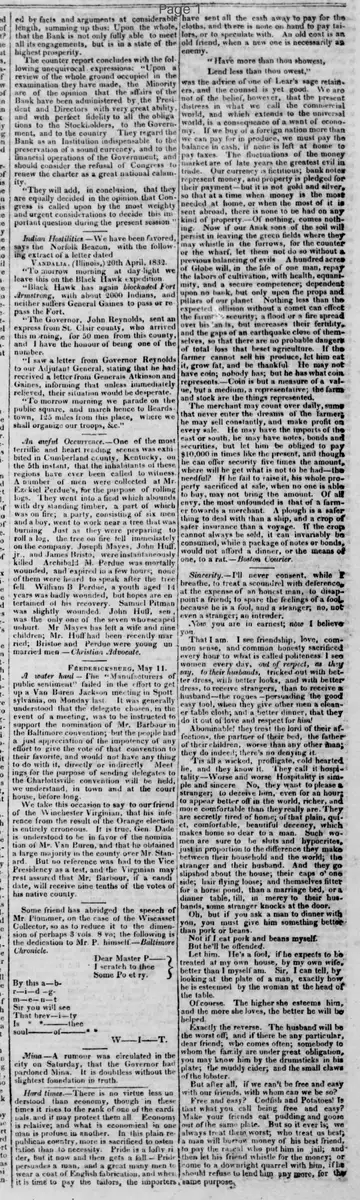
Hard times.—There is no virtue less understood than economy, though in these times it rises to the rank of one of the cardinals, and it may protect them all. Economy is relative; and what is economical in one man is profuse in another. In this plain republican country, more is sacrificed to ostentation than to necessity. Pride is a lofty rider, but it now and then gets a fall.—Pride persuades a man, and a great many men to wear a coat of English fabrication, and when it is time to pay the tailors, the importers have sent all the cash away to pay for the cloths, and there is none on hand to pay tailors, or to speculate with. An old coat is an old friend, when a new one is necessarily an enemy.
"Have more than thou showest,
Lend less than thou owest."
was the advice of one of Lear's sage retainers, and the counsel is yet good. We are not of the belief, however, that the present distress in what we call the commercial world, and which extends to the universal world, is a consequence of a want of economy. If we buy of a foreign nation more than we can pay for in produce, we must pay the balance in cash, if none is left at home to pay taxes. The fluctuations of the money market are of late years the greatest evil in trade. Our currency is fictitious; bank notes represent money, and property is pledged for their payment—but it is not gold and silver, so that at a time when money is the most needed at home, or when the most of it is sent abroad, there is none to be had on any kind of property.—Of nothing, comes nothing. Now if our Anak sons of the soil will persist in leaving the green fields where they may whistle in the furrows, for the counter or the wharf, let them not do so without a previous balancing of evils. A hundred acres of Globe will, in the life of one man, repay the labors of cultivation, with health, equanimity, and a secure competence; dependent upon no bank, but only upon the props and pillars of our planet. Nothing less than the expected collision without a comet can effect the farmer's security; a flood or a fire spread over his lands, but increases their fertility, and the gaps of an earthquake close of themselves, so that there are no probable dangers of total loss that beset agriculture. If the farmer cannot sell his produce, let him eat it, grow fat, and be thankful. He may not have coin; nobody has; but he has what coin represents.—Coin is but a measure of a value, but a medium, a representative; the farm and stock are the things represented. The merchant may count over daily, sums that never enter the dreams of the farmer; he may sell constantly, and make profit on every sale. He may have the imports of the east or south, he may have notes, bonds and securities, but let him be obliged to pay $10,000 in times like the present, and though he can offer security five times the amount, where will he get what is not to be had—the needful? If he fail to raise it, his whole property sacrificed at sale, when no one is able to buy, may not bring the amount. Of all envy, the most unfounded is that of a farmer towards a merchant. A plough is a safer thing to deal with than a ship, and a crop of safer insurance than a voyage. If the crop cannot always be sold, it can invariably be consumed, while a package of notes or bonds, would not afford a dinner, or the means of one, to a rat.—Boston Courier.
"Have more than thou showest,
Lend less than thou owest."
was the advice of one of Lear's sage retainers, and the counsel is yet good. We are not of the belief, however, that the present distress in what we call the commercial world, and which extends to the universal world, is a consequence of a want of economy. If we buy of a foreign nation more than we can pay for in produce, we must pay the balance in cash, if none is left at home to pay taxes. The fluctuations of the money market are of late years the greatest evil in trade. Our currency is fictitious; bank notes represent money, and property is pledged for their payment—but it is not gold and silver, so that at a time when money is the most needed at home, or when the most of it is sent abroad, there is none to be had on any kind of property.—Of nothing, comes nothing. Now if our Anak sons of the soil will persist in leaving the green fields where they may whistle in the furrows, for the counter or the wharf, let them not do so without a previous balancing of evils. A hundred acres of Globe will, in the life of one man, repay the labors of cultivation, with health, equanimity, and a secure competence; dependent upon no bank, but only upon the props and pillars of our planet. Nothing less than the expected collision without a comet can effect the farmer's security; a flood or a fire spread over his lands, but increases their fertility, and the gaps of an earthquake close of themselves, so that there are no probable dangers of total loss that beset agriculture. If the farmer cannot sell his produce, let him eat it, grow fat, and be thankful. He may not have coin; nobody has; but he has what coin represents.—Coin is but a measure of a value, but a medium, a representative; the farm and stock are the things represented. The merchant may count over daily, sums that never enter the dreams of the farmer; he may sell constantly, and make profit on every sale. He may have the imports of the east or south, he may have notes, bonds and securities, but let him be obliged to pay $10,000 in times like the present, and though he can offer security five times the amount, where will he get what is not to be had—the needful? If he fail to raise it, his whole property sacrificed at sale, when no one is able to buy, may not bring the amount. Of all envy, the most unfounded is that of a farmer towards a merchant. A plough is a safer thing to deal with than a ship, and a crop of safer insurance than a voyage. If the crop cannot always be sold, it can invariably be consumed, while a package of notes or bonds, would not afford a dinner, or the means of one, to a rat.—Boston Courier.
What sub-type of article is it?
Economic Policy
Agriculture
Moral Or Religious
What keywords are associated?
Hard Times
Economy
Frugality
Agriculture
Commerce
Currency
Trade Imbalance
Farming Security
What entities or persons were involved?
Farmers
Merchants
Boston Courier
Editorial Details
Primary Topic
Economy And Agriculture During Hard Times
Stance / Tone
Exhortation To Frugality And Preference For Farming Over Commerce
Key Figures
Farmers
Merchants
Boston Courier
Key Arguments
Economy Is A Misunderstood Virtue Essential In Hard Times
Pride Leads To Wasteful Imports Causing Cash Shortages
Commercial Distress Stems From Trade Imbalances And Fictitious Currency
Farming Offers Security, Health, And Self Sufficiency Unlike Risky Trade
Farm Produce Has Intrinsic Value Even If Unsellable, Unlike Paper Securities