Thank you for visiting SNEWPapers!
Sign up free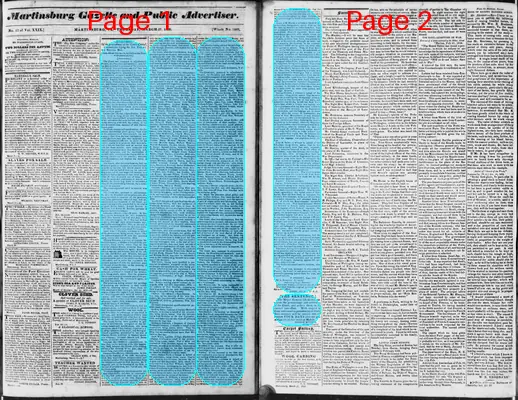
Martinsburg Gazette And Public Advertiser
Martinsburg, Berkeley County, West Virginia
What is this article about?
Proceedings of a 1814 court martial trying dozens of Tennessee militiamen for desertion and mutiny at Fort Jackson, stemming from belief their three-month service had ended. Most pled guilty, sentenced to repay lost time, pay stoppages, hair shaving, and drumming out. One officer, Capt. A. Roberts, dismissed for intoxication and improper boat seizures.
Merged-components note: Continuation of the court martial proceedings article across pages 1 and 2, including the sentence approval.
Clippings
1 of 2
OCR Quality
Full Text
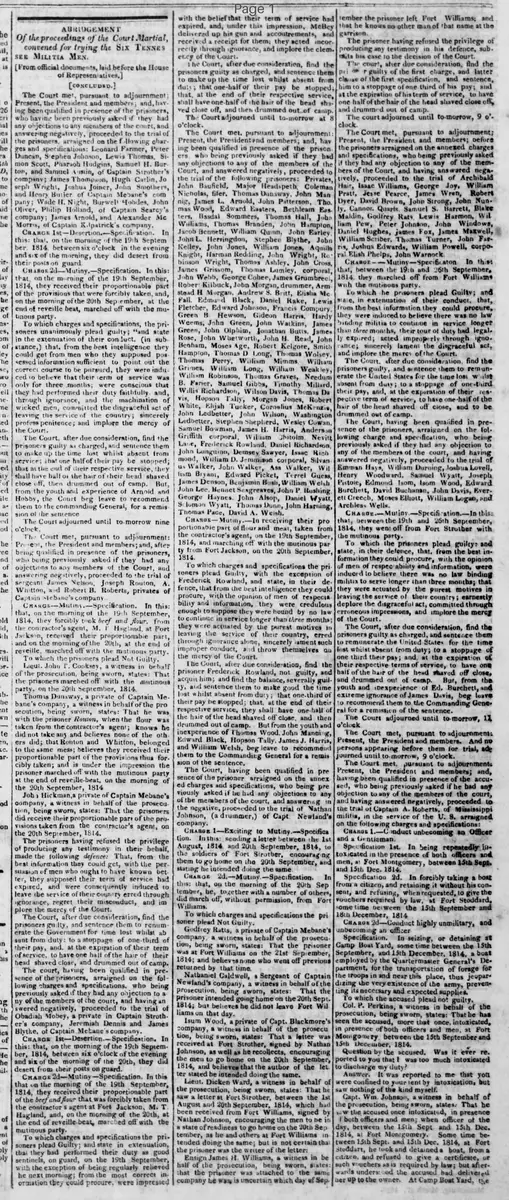
Of the proceedings of the Court Martial,
convened for trying the Six Tennessee
Militia Men.
[From official documents, laid before the House
of Representatives.]
[CONCLUDED.]
The Court met, pursuant to adjournment;
Present, the President and members; and, having been qualified in presence of the prisoners.
who having been previously asked if they had
any objections to any members of the court, and
answering negatively, proceeded to the trial of
the prisoners, arraigned on the following char-
ges and specifications: Leonard Farmer, Peter
Duncan, Stephen Johnson, Lewis Thomas, Simon Scott, Pharaoh Hudgins, Samuel H. Burton, and Samuel Austin, of Captain Strother's
company; James Thompson, Hugh Carlin, Joseph Wright, Joshua Joiner, John Smothers,
and Henry Butler of Captain Mebane's company; Wade H. Night, Burwell Hodges, John
Oliver, Philip Holland, of Captain Searcy's company; James Arnold, and Alexander Mc
Morris, of Captain Kilpatrick's company.
Charge 1st—Desertion.—Specification. In
this: that, on the morning of the 19th September, 1814, between six o'clock in the evening
and six of the morning, they did desert from
their posts on guard
Charge 2d—Mutiny.—Specification. In this
that, on the morning of the 19th September,
1814, they received their proportionable part
of the provisions that were forcibly taken, and,
on the morning of the 20th September, at the
end of reveille beat, marched off with the mutinous party
To which charges and specifications, the prisoners unanimously plead guilty; "and state
in the extenuation of their conduct. (in substance,) that, from the best intelligence they
could get from men who they supposed possessed information sufficient to point out the
correct course to be pursued, they were induced to believe that their term of service was
only for three months; were conscious that
they had performed their duty faithfully. and,
through ignorance, and the machination of
wicked men, committed the disgraceful act of
leaving the service of the country; sincerely
profess penitence; and implore the mercy of
the Court.
The Court, after due consideration, find the
prisoners guilty as charged, and sentence them
to make up the time lost whilst absent from
service; that one half of their pay be stopped;
that at the end of their respective service, they
shall have half of the hair of their head shaved
close off, then drummed out of camp. But,
from the youth and inexperience of Arnold and
McMorris, the Court beg leave to recommend
them to the commanding General, for a remission of the sentence
The Court adjourned until to-morrow nine
o'clock,
The Court met, pursuant to adjournment:
Present, the President and members; and, after
being qualified in presence of the prisoners,
who being previously asked if they had any
objections to any members of the Court, and
answering negatively, proceeded to the trial of
sergeant James Nelson, Joseph Routon, A.
Whitton, and Robert B. Roberts, privates of
Captain Mebane's company
Charge—Mutiny.—Specification. In this:
that, on the morning of the 19th September,
1814, they forcibly took beef and flour, from
the contractor's agent, M. T. Hagland, at Fort
Jackson, received their proportionable part,
and on the morning of the 20th, at the end of
reveille, marched off with the mutinous party.
To which the prisoners plead Not Guilty.
Lieut. John L. Cooksey, a witness in behalf
of the prosecution, being sworn, states: That
the prisoners marched off with the mutinous
party, on the 20th September, 1814.
Thomas Dunaway, a private of Captain Me-
bane's company, a witness in behalf of the prosecution, being sworn, states: That he was
with the prisoner Routon, when the flour was
taken from the contractor's agent; knows he
did not take any and believes none of the others did; that Routon and Whitton, belonged
to the same mess; believes they received their
proportionable part of the provisions thus forcibly taken; and is under the impression the
prisoner marched off with the mutinous party
at the end of reveille-beat, on the morning of
the 20th September, 1814
John Hickman, a private of Captain Mebane's
company, a witness in behalf of the prosecution, being sworn, states: That the prisoners
did receive their proportionable part of the provisions taken from the contractor's agent, on
the 20th September, 1814.
The prisoners having refused the privilege
of producing any testimony in their behalf,
made the following defence: That, from the
best information they could get, with the persuasion of men who ought to have known better, they supposed their term of service had
expired, and were consequently induced to
leave the service of their country erred through
ignorance, regret their misconduct, and implore the mercy of the Court.
The Court, after due consideration, find the
prisoners guilty, and sentence them to remunerate the Government for time lost whilst absent from duty: to a stoppage of one-third of
their pay, and. at the expiration of their term
of service, to have one half of the hair of their
head shaved close, and drummed out of camp.
The court, having been qualified in presence of the prisoners, arraigned on the following charges and specifications, who being
previously asked if they had any objection to any of the members of the court, and having answered negatively, proceeded to the trial of
Obadiah Mobey, a private in Captain Strother's company, Jeremiah Dennis and James
Blytke, of Captain Mebane's company.
Charge 1st—Desertion.—Specification. In
this: that, on the morning of the 19th September, 1814, between six o'clock of the evening
and six of the morning of the 20th, they did
desert from their posts on guard.
Charge 2d—Mutiny—Specification. In this
that on the morning of the 19th September,
1814, they received their proportionable part
of the beef and flour that was forcibly taken from the contractor's agent at Fort Jackson, M. T.
Hagland, and, on the morning of the 20th, at
the end of reveille-beat, marched off with the
mutinous party.
To which charges and specifications the prisoners plead Guilty; and state in extenuation,
that they had performed their duty as good
sentinels, on guard, on the 19th September,
with the exception of being regularly relieved the next morning; from the most correct information they could procure, were impressed
with the belief that their term of service had
expired, and, under this impression, Mobey
delivered up his gun and accoutrements, and
received a receipt for them; they acted incorrectly through ignorance, and implore the clemency of the Court.
The Court, after due consideration, find the
prisoners guilty as charged, and sentence them
to make up the time lost whilst absent from
duty; that one-half of their pay be stopped;
that, at the end of their respective service,
shall have one-half of the hair of the head shaved close off, and then drummed out of camp.
The Court adjourned until to-morrow at 8
o'clock.
The Court met. pursuant to adjournment:
Present, the President and members; and, having been qualified in presence of the prisoners, who being previously asked if they had
any objections to any of the members of the
Court, and answered negatively, proceeded to
the trial of the following prisoners: Privates,
John Banfield, Major Headspeth, Coleman
Nicholas, fifer. Thomas Dunaway. John Manning, James L. Arnold, John Patterson, Thomas Wood, Edward Easters, Bethlehem Eas-
ters, Basdal Sommers, Thomas Hall, John
Williams, Thomas Branden, John Hampton,
Jacob Bennett, William Quinn, John Earley.
John L. Herringdon, Stephen Blythe, John
Kelley, John Jones, William Jones, Aquilla
Knight, Harman Redding, John Wright, Robinson Wright, Thomas Ashley. John Cross,
James Grissom, Thomas Lumley, corporal,
John Webb, George Cobee, James Grumbreel,
Robert Kilbuck, John Morgan, drummer, Arm
Stead H Morgan. Andrew S. Britt, Elisha Mc-
Fall. Edmund Black, Daniel Rake, Lewis
Fletcher, Edward Johnson, Francis Company
Green B Hewson, Gideon Harris, Hardy
Weems, John Green, John Watkins, James
Green, John Olphim, Jonathan Butts, James
Rose, John Wheatworth, John H. Read, John
Beoham, Moses Age, Robert Kelgore, Smith
Hampton, Thomas D Long, Thomas Wolsey.
Thomas Perry, William Mimms. William
Grines, William Long, William Weakley,
William Robinson, Thomas Graves, Needum
B. Farier, Samuel Gibbs, Timothy Millard,
Willis Richardson, Wilson Davis, Thomas Davis, Hopson Tally, Morgan Jones, Robert
White, Elijah Tucker, Cornelius McKenzie,
John Ledbetter, John Wilson, Washington
Ledbetter, Stephen Shepherd, Wesley Cowan,
Samuel Bowman, James H. Harris, Anderson
Griffith corporal, William Shitolm. Nevitt
Lane, Frederick Rowland, Daniel Richardson,
John Lunguino, Demsey Sawyer, Isaac Richmond, William D. Jerumison corporal, Silvanus Walker, John Walker, Asa Walker, William Bryant, Edward Picket, Terrel Guess,
James Denson, Benjamin Bush, William Welsh
John Lee, Bennet Seagreaves, John P. Rushing
George Haynes, John Alsop, Daniel Wyatt
Solomon Wyatt, Thomas Dunn, John Harning
Thomas Pace, David A. Welsh.
Charge—Mutiny. In receiving their proportionable part of flour and meat, taken from
the contractor's agent, on the 19th September,
1814, and marching off with the mutinous party from Fort Jackson, on the 20th September,
1814.
To which charges and specifications the prisoners plead Guilty, with the exception of
Frederick Rowland, and state, in their defence, that from the best intelligence they could
procure, with the opinion of men of respectability and information, they were credulous
enough to suppose they were bound by no law
to continue in service longer than three months;
they were actuated by the purest motives in
leaving the service of their country, erred
through ignorance alone, sincerely lament such
improper conduct, and throw themselves on
the mercy of the Court.
The Court, after due consideration, find the
prisoner Frederick Rowland, not guilty, and
acquit him; and find the balance, severally guilty, and sentence them to make good the time
lost whilst absent from duty; that one-third of
their pay be stopped; that, at the end of their
respective service, they shall have one-half of
the hair of their head shaved off close, and then
drummed out of camp. But from the youth and
inexperience of Thomas Wood, John Manning,
Edward Black, Hopson Tally, James H. Harris,
and William Welsh, beg leave to recommend
them to the Commanding General for a remission of the sentence,
The Court, having been qualified in presence of the prisoner arraigned on the annexed charges and specifications, who being previously asked if he had any objections to any
of the members of the court, and answering in
the negative, proceeded to the trial of Nathan
Johnson, (a drummer,) of Capt. Newland's
company.
Charge 1—Exciting to Mutiny.—Specification. In this: sending a letter between the 1st
August, 1814, and 20th September, 1814, to
the soldiers of Fort Strother, encouraging
them to go home on the 20th September, and
stating he intended doing the same.
Charge 2d.—Mutiny.—Specification. In
this: that, on the morning of the 20th September, he, together with a number of others,
did march off, without permission, from Fort
Williams.
To which charges and specifications the prisoner plead Not Guilty.
Godfrey Ratts, a private of Captain Mebane's
company, a witness in behalf of the prosecution, being sworn, states: That the prisoner
was at Fort Williams on the 21st September,
1814; and believes none who went off previous
returned by that time.
Nathaniel Caldwell, Sergeant of Captain
Newland's company, a witness in behalf of the
prosecution. being sworn, states: That the
prisoner intended going home on the 20th Sept.
1814; but believes he did not leave Fort Williams on that day.
Isom Wood, a private of Capt. Blackmore's
company, a witness in behalf of the prosecution, being Sworn, states: That a letter was
received at Fort Strother. signed by Nathan
Johnson, as well as he recollects, encouraging
the men to go home on the 20th September,
1814, and believes that the author of the letter stated he intended doing the same.
Lieut. Dicken Ward, a witness in behalf of
the prosecution, being sworn, states: That he
saw a letter at Fort Strother. between the 1st
August and 20th September, 1814, which had
been received from Fort Williams, signed by
Nathan Johnson, encouraging the men to be in
a state of readiness to go home on the 20th September, as he and others at Fort Williams intended doing the same; but is not certain that
the prisoner was the writer of the letter:
Ensign James H. Williams, a witness in behalf of the prosecution, being sworn, states:
that the prisoner was attached to the same
company he was; is uncertain which day of September the prisoner left Fort Williams; and
that he knows no other man of that name at the
garrison.
The prisoner having refused the privilege of
producing any testimony in his defence, submits his case to the decision of the Court.
The court, after due consideration, find the
prisoner guilty of the first charge, and latter
clause of the first specification, and sentence,
him to a stoppage of one third of his pay; and
at the expiration of his term of service, to have
one half of the hair of their head shaved close off
and drummed out of camp.
The court adjourned until to-morrow, 9 o'
clock.
The Court met, pursuant to adjournment:
Present, the President and members; before
the prisoners arraigned on the annexed charges
and specifications, who being previously asked
if they had any objection to any of the members of the Court, and having answered negatively, proceeded to the trial of Archibald
Hair, Isaac Williams, George Joy, William
Pratt, Jesse Pearce, James Wren, Robert
Dyer, David Brown, John Strong, John Nunnly, Cannon Quarls, Samuel S. Barrett, Blake
Maldin, Godfrey Ratts, Lewis Harmon, William Pew, Peter Johnson, John Windows,
Daniel Hughes, James Fox, James Maxwell,
William Scriber. Thomas Turner, John Far-
ris, Joshua Edwards, William Powell, corporal Elish Phelps, John Warnock.
Charge —Mutiny—Specification. In this:
that, between the 19th and 26th September
1814. they marched off from Fort Williams
with the mutinous party.
To which the prisoners plead Guilty; and
state, in extenuation of their conduct, that,
from the best information they could procure,
they were induced to believe there was no law
binding militia to continue in service longer
than three months, their tour of duty had legally expired; acted improperly through ignorance; sincerely lament the disgraceful act,
and implore the mercy of the Court.
The Court. after due consideration. find the
prisoners guilty, and sentence them to remunerate the United States for the time lost whilst absent from duty; to a stoppage of one-third
their pay, and, at the expiration of their respective term of service, to have one-half of the
hair of the head shaved off close, and to be
drummed out of camp.
The Court, having been qualified in presence of the prisoners, arraigned on the following charge and specification, who being
previously asked if they had any objection to
any of the members of the court, and having
answered negatively, proceeded to the trial of
Emmau Hays. William Duroing, Joshua Lovell,
Henry Woodward. Samuel Wyatt, Joseph
Pistoie, Edmond Isor, Isom Wood, Edward
Burchett, David Buchanan, John Davis, Everett Creech, Moses Elliott, William Logan, and
Archless Wells.
CHARGE.—Mutiny,—Specification.—In this
that, between the 19th and 26th September,
1814, they went off from Fort Strother with
the mutinous party.
To which the prisoners plead guilty: and
state, in their defence, that. from the best information they could procure, with the opinion
of men of respectability and information, were
induced to believe there was no law binding
militia to serve longer than three months; that
they were actuated by the purest motives in
leaving the service of their country; earnestly
dep lore the disgraceful act, committed through
erroneous impressions, and implore the mercy
of the Court.
The Court, after due consideration, find the
prisoners guilty as charged, and sentence them
to remunerate the United States for the time
lost whilst absent from duty; to a stoppage of
one third their pay; and, at the expiration of
their respective terms of service, to have one
half of the hair of the head shaved off close,
and drummed out of camp. But, from the
youth and inexperience of Ed. Burchett, and
extreme ignorance of James Davis, beg leave
to recommend them to the Commanding General for a remission of the sentence.
The Court adjourned until to-morrow, 11
o'clock
The Court met, pursuant to adjournment:
Present, the President and members. And no
persons appearing before them for trial, adjourned until to-morrow, 9 o'clock.
The Court met, pursuant to adjournments
Present, the President and members; and,
having been qualified in presence of the accused, who being previously asked if he had any objection to any of the members of the court,
and having answered negatively, proceeded to
the trial of Captain A. Roberts, of Mississippi
militia, in the service of the U. S. arraigned
on the following charges and specifications:
CHARGES I. Conduct unbecoming an Officer and a Gentleman.
Specification 1st. In being repeatedly intoxicated in the presence of both officers and
men, at Fort Montgomery, between 15th Sept.
and 15th Dec. 1814.
Specification 2d. In forcibly taking a boat
from a citizen, and retaining it without his consent, and refusing, when requested, to give the
vouchers required by law, at Fort Stoddard,
some time between the 15th September and
18th December, 1814
Charge 2d—Conduct highly unilitary, and
unbecoming an officer
Specification. In seizing, or detaining at
Camp Boat Yard, some time between the 15th
September, and 15th December, 1814, a boat
employed by the Quartermaster General's Department, for the transportation of forage for
the troops in and near this place, thus jeopardizing the very existence of the army, preventing its necessary and expected supplies.
To which the accused plead not guilty.
Col. P. Perkins, a witness in behalf of the
prosecution, being sworn, states: That he has
seen the accused, more than once, intoxicated,
in presence of both officers and men, at Fort
Montgomery. between the 15th September and
15th December, 1814.
Question by the accused,
Was it ever reported to you that I was too much intoxicated to discharge my duty?
Answer. It was reported to me that you
were confined to your tent by intoxication, but
saw nothing of the kind myself.
Capt. Wm. Johnson, a witness in behalf of
the prosecution, being sworn, states: That he
saw the accused once intoxicated, in presence
of both officers and men; when officer of the
day, between the 15th Sept. and 15th Dec.
1814, at Fort Montgomery. Some time between 15th Sept. and 15th Dec. 1814, at Fort
Stoddart, he took and detained a boat, from a
citizen, and refused to give a certificate, or
such vouchers as is required by law; but afterwards understood the accused had delivered
her up to the owner. At Camp Boat Yard, the
The accused had in his possession a boat: that the commander of the boat stated that he was ordered after corn; that the boat was not restored; but an order was given by Capt. Roberts for the soldiers to go on board and proceed to Mobile.
Lieut. J. H. Moore, a witness in behalf of the prosecution, being sworn, states: That on the 5th Dec. he received an order from Gen. Taylor to procure water transportation for the baggage of Col. Perkins' regiment. Boats were accordingly provided; after which, a boat belonging to the Quartermaster General's Department, at Camp Boat Yard, was pressed by order of the accused, although an order had been issued by the General, to the contrary; and that it would not be given up, even when he to appear in person. That, at Fort Stoddart, on the 12th December, he understood an order had been given by the accused, to his command, to collect all the boats to be found. After one was taken possession of, it was claimed by a citizen, and given up.
Sergeant Adam Poole, a witness in behalf of the defendant, being sworn, states: That a boat in the possession of Captain Roberts' command, at Fort Stoddard, between the 15th Sept. and 15th Dec. 1814, was claimed by a citizen, and the accused said he would give him a receipt for her at Mobile, or somewhere down the river; that an order came from Gen. Taylor, concerning a boat at Camp Boat Yard, belonging to the Quartermaster General's Department, when some person observed that the order was incorrect, as the boat had been taken before, as he understood by some other person, and not Capt. Roberts.
George Graham, a witness in behalf of the defendant, being sworn, states: That he never knew the accused guilty of repeated intoxication; that he once saw him in that state, and believes it was the day he left the Boat Yard; that a boat, of which Everie was captain, was taken possession of at the Boat Yard, either by the order of the accused, or the Regimental Quartermaster, and the baggage put on board of her, while the owner, or commander, was absent at Fort Montgomery; it was detained there until an order was brought from the General, (without any date) directing the boat to be given up to the owner; when the Regimental Quartermaster asked the accused what he intended doing, when he ordered the men on board to put off, and afterwards said he would be a pretty fool to obey an order without any date; and further states, that he believes the accused had returned from Fort Montgomery before the baggage was placed on board the boat.
Isaac N. Selser, a witness in behalf of the defendant, being sworn, states: That he has seen the accused, more than once, unusually merry, which he believed to be the effect of intoxication, some time between the 15th Sept. and 15th Dec. 1814. At Camp Boat Yard he heard the accused ask the Regimental Quartermaster to press more boats to transport the troops, as well as baggage; to which the Quartermaster replied, that he had already pressed a sufficient number for the transportation of the baggage, and, if any more were taken, it would be at his own risk and responsibility.
Question by the accused. Was it not to press boats to transport the troops to old Fort Stoddart, when this answer was made me by the Regimental Quartermaster?
Answer. I do not recollect.
Captain Roberts states in his defence, that he supposed drinking to be merry was not amiss; but, being apprehensive it might be considered so, discontinued the practice. That he took a boat, agreeably to the verbal order of Gen. Taylor, from the Boat Yard, to transport the troops to Fort Stoddart, as the cut off was then considered impassible, and returned them again, of which the Quartermaster General's boat was not one. That Quartermaster Moore was ordered to furnish water transportation for the baggage of Col. Perkins' regiment. He directed the Quartermaster, Moore, to press, legally, the Quartermaster General's boats, and he informed him he had done so; from which he was induced to believe no further difficulty would arise. As respects the little boat at Fort Stoddart, she would not have been taken, had he not been informed that they were drifted boats, and belonged to no person in the vicinity of that place. But, after it was claimed by a citizen, who said he was the proper owner, it was given up to him.
The Court, after due consideration, find the accused guilty of the first and second charges, first specification of the first charge, first of the second charge, but not guilty of the second specification of the first charge; and sentence him to be dismissed the army of the U. States.
The Court, having been qualified in presence of the prisoner, who being previously asked if he had any objection to any of the Court, and having answered negatively, proceeded to the trial of John Bourke, a citizen; and no prosecutor, or charges, appearing against the prisoner, acquitted him.
The Court adjourned until to-morrow, nine o'clock.
The Court met, pursuant to adjournment: Present, the President and members; and, no prisoners appearing before them for trial, adjourned sine die.
P. PERKINS, Lieut. Col.
W. L. Robinson, Lt. 3d Inf. and acting Judge Advocate.
Adjutant General's Office, Jan. 21, 1828.
True copy from the original proceedings on file in this office.
R. JONES, Adjt. Gen. U. S. A.
[THE SENTENCE.]
The Major General [Jackson] approves the proceedings and sentences of the Court, and orders them to be carried into effect.
With respect to those sentenced to punishment of death, their sentence will be carried into execution FOUR DAYS after the promulgation of this order at Mobile.
ROBERT BUTLER,
Adjutant General.
What sub-type of article is it?
What themes does it cover?
What keywords are associated?
What entities or persons were involved?
Where did it happen?
Story Details
Key Persons
Location
Fort Jackson, Fort Williams, Fort Strother, Fort Montgomery, Fort Stoddard, Camp Boat Yard
Event Date
September 1814
Story Details
Court martial proceedings against numerous Tennessee militiamen for desertion and mutiny on September 19-20, 1814, after forcibly taking provisions and marching off, believing their three-month enlistment had expired. Most pled guilty due to ignorance, sentenced to repay lost time, partial pay stoppage, half head shaved, and drummed out of camp. Drummer Nathan Johnson guilty of exciting mutiny via letter. Captain A. Roberts dismissed for intoxication and unauthorized boat seizures.