Thank you for visiting SNEWPapers!
Sign up free
Letter to Editor
May 16, 1811
Virginia Argus
Richmond, Virginia
What is this article about?
Letter III concludes a historical series on Egypt, tracing conquests from Cambyses in 525 BC through Persian, Greek, Roman, Arab, Mameluke, and Ottoman rule to French invasion in 1798. Describes modern inhabitants including Copts and Arabs, their characteristics, and speculates on French ambitions to counter British India.
Clipping
OCR Quality
95%
Excellent
Full Text
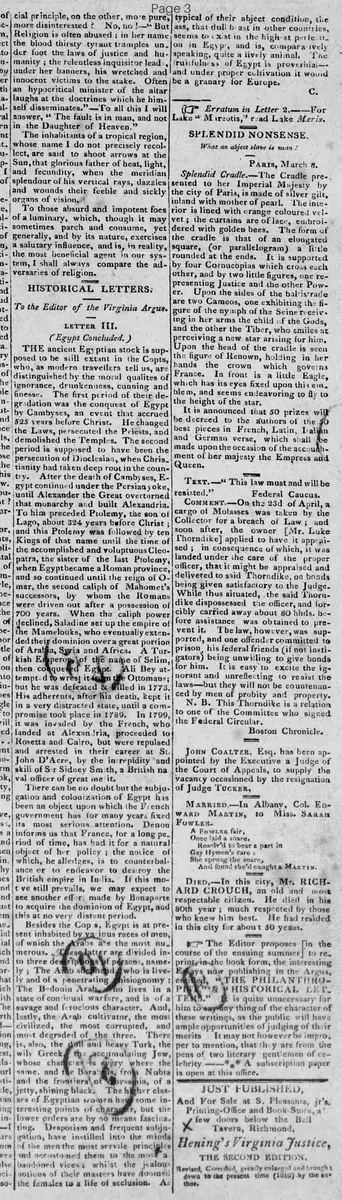
HISTORICAL LETTERS:
To the Editor of the Virginia Argus.
LETTER III.
(Egypt Concluded.)
THE ancient Egyptian stock is supposed to be still extant in the Copts, who, as modern travellers tell us, are distinguished by the moral qualities of ignorance, drunkenness, cunning and finesse. The first period of their degradation was the conquest of Egypt by Cambyses, an event that occurred 525 years before Christ. He changed the Laws, persecuted the Priests, and demolished the Temples. The second period is supposed to have been the persecution of Diocletian, when Christianity had taken deep root in the country. After the death of Cambyses, Egypt continued under the Persian yoke, until Alexander the Great overturned that monarchy and built Alexandria. To him succeeded Ptolemy, the son of Lago, about 324 years before Christ ; and this Ptolemy was followed by ten Kings of that name until the time of the accomplished and voluptuous Cleopatra, the sister of the last Ptolemy, when Egypt became a Roman province, and so continued until the reign of Omar, the second caliph of Mahomet's successors, by whom the Romans were driven out after a possession of 700 years. When the caliph power declined, Saladin set up the empire of the Mamelukes, who eventually extended their dominion over a great portion of Arabia, Syria and Africa. A Turkish Emperor, of the name of Selim, then conquered Egypt. Ali Bey attempted to wrest it from the Ottomans; but he was defeated & killed in 1773. His adherents, after his death, kept it in a very distracted state, until a compromise took place in 1789. In 1798, it was invaded by the French, who landed at Alexandria, proceeded to Rosetta and Cairo, but were repulsed and arrested in their career at St. John D'Acre, by the intrepidity and skill of Sir Sidney Smith, a British naval officer of great merit. There can be no doubt but the subjugation and colonization of Egypt has been an object upon which the French government has for many years fixed its most serious attention. Denon informs us that France, for a long period of time, has had it for a natural object of her policy ; the notice of which, he alleges, is to counterbalance or to endeavor to destroy the British empire in India. If this motive still prevails, we may expect to see another effort made by Bonaparte to acquire the dominion of Egypt, and this at no very distant period. Besides the Copts, Egypt is at present inhabited by various races of men, of which the Arabs are the most numerous. These latter are divided into three descriptions of persons, namely : The Arab she hend who is lively and of a penetrating physiognomy : The Bedouin Arab who lives in a state of continual warfare, and is of a savage and ferocious character. And, lastly, the Arab cultivator, the most civilized, the most corrupted, and most degraded of the three. There is, also, the dull and heavy Turk, the wily Greek the accumulating Jew, whose character is every where the same. and the Barbary, from Nubia and the frontiers of Abyssinia, of a jetty, shining black. The higher classes of Egyptian women have some interesting points of character, but the lower orders are by no means fascinating. Despotism and frequent subjugation, have instilled into the minds of the men the most servile principles and accustomed them to the most abandoned vices : whilst the jealous notions of their masters have doomed the females to a life of seclusion. As typical of their abject condition, the ass, that dull beast in other countries, seems to exist in the highest perfection in Egypt, and is, comparatively speaking, quite a lively animal. The fruitfulness of Egypt is proverbial-- and under proper cultivation it would be a granary for Europe.
c.
To the Editor of the Virginia Argus.
LETTER III.
(Egypt Concluded.)
THE ancient Egyptian stock is supposed to be still extant in the Copts, who, as modern travellers tell us, are distinguished by the moral qualities of ignorance, drunkenness, cunning and finesse. The first period of their degradation was the conquest of Egypt by Cambyses, an event that occurred 525 years before Christ. He changed the Laws, persecuted the Priests, and demolished the Temples. The second period is supposed to have been the persecution of Diocletian, when Christianity had taken deep root in the country. After the death of Cambyses, Egypt continued under the Persian yoke, until Alexander the Great overturned that monarchy and built Alexandria. To him succeeded Ptolemy, the son of Lago, about 324 years before Christ ; and this Ptolemy was followed by ten Kings of that name until the time of the accomplished and voluptuous Cleopatra, the sister of the last Ptolemy, when Egypt became a Roman province, and so continued until the reign of Omar, the second caliph of Mahomet's successors, by whom the Romans were driven out after a possession of 700 years. When the caliph power declined, Saladin set up the empire of the Mamelukes, who eventually extended their dominion over a great portion of Arabia, Syria and Africa. A Turkish Emperor, of the name of Selim, then conquered Egypt. Ali Bey attempted to wrest it from the Ottomans; but he was defeated & killed in 1773. His adherents, after his death, kept it in a very distracted state, until a compromise took place in 1789. In 1798, it was invaded by the French, who landed at Alexandria, proceeded to Rosetta and Cairo, but were repulsed and arrested in their career at St. John D'Acre, by the intrepidity and skill of Sir Sidney Smith, a British naval officer of great merit. There can be no doubt but the subjugation and colonization of Egypt has been an object upon which the French government has for many years fixed its most serious attention. Denon informs us that France, for a long period of time, has had it for a natural object of her policy ; the notice of which, he alleges, is to counterbalance or to endeavor to destroy the British empire in India. If this motive still prevails, we may expect to see another effort made by Bonaparte to acquire the dominion of Egypt, and this at no very distant period. Besides the Copts, Egypt is at present inhabited by various races of men, of which the Arabs are the most numerous. These latter are divided into three descriptions of persons, namely : The Arab she hend who is lively and of a penetrating physiognomy : The Bedouin Arab who lives in a state of continual warfare, and is of a savage and ferocious character. And, lastly, the Arab cultivator, the most civilized, the most corrupted, and most degraded of the three. There is, also, the dull and heavy Turk, the wily Greek the accumulating Jew, whose character is every where the same. and the Barbary, from Nubia and the frontiers of Abyssinia, of a jetty, shining black. The higher classes of Egyptian women have some interesting points of character, but the lower orders are by no means fascinating. Despotism and frequent subjugation, have instilled into the minds of the men the most servile principles and accustomed them to the most abandoned vices : whilst the jealous notions of their masters have doomed the females to a life of seclusion. As typical of their abject condition, the ass, that dull beast in other countries, seems to exist in the highest perfection in Egypt, and is, comparatively speaking, quite a lively animal. The fruitfulness of Egypt is proverbial-- and under proper cultivation it would be a granary for Europe.
c.
What sub-type of article is it?
Historical
Informative
What themes does it cover?
Military War
Politics
What keywords are associated?
Egypt History
Conquests
Copts
Arabs
French Ambitions
Bonaparte
British India
What entities or persons were involved?
C.
The Editor Of The Virginia Argus
Letter to Editor Details
Author
C.
Recipient
The Editor Of The Virginia Argus
Main Argument
concludes the historical account of egypt's conquests and inhabitants, highlighting its strategic importance and potential for future french ambitions under bonaparte to challenge british power in india.
Notable Details
Conquest By Cambyses In 525 Bc
Ptolemaic Dynasty From 324 Bc
Roman Province Until Omar
French Invasion 1798 Repulsed At Acre By Sir Sidney Smith
Description Of Copts, Arabs, Turks, Greeks, Jews
Speculation On French Policy Per Denon