Thank you for visiting SNEWPapers!
Sign up free
Literary
October 24, 1789
Gazette Of The United States
New York, New York County, New York
What is this article about?
An essay in The Tablet No. LVI explores how civilization and education modify human passions and behavior, making people more restrained and harmonious compared to the uneducated. It includes an extract on domestic harmony and an anecdote about the King of Prussia's saying on life.
Clipping
OCR Quality
98%
Excellent
Full Text
[No. LVI.]
THE TABLET.—No. LVI.
"The more untaught and inconsiderate men are, the more entirely they are swayed by the passion that is uppermost."
THOSE who assert, that human nature is the same in all ages and situations, do not speak with precision. The observation is partly true; but it is not wholly so. Men act equally in all stages of society, under the impulse of such motives as have the strongest influence.
Civilization does not destroy the passions, nor prevent the mind from being warped by prejudices.
In different situations, however, different passions take the lead; and men of education and reflection learn to make one passion subservient to another in such a degree, that that, which from present circumstances might be supposed uppermost, is not the predominating one. This is the effect of acting by system, and controlling the mental operations by habits of order and self-denial.
Some men, though they are constantly exposed to opposition, and meet with a thousand rubs and difficulties, seldom exhibit any marks of resentment or disquietude. The passion of anger resides in such a breast, as much as it does in one, that appears more turbulent and untractable.
But a sensible man knows that unless he governs his spirit, he will defeat his own views; and this makes him conquer his anger, by subjecting it to the stronger sway of avarice or ambition. Thus it appears that human nature may be so managed, that it cannot, judging from appearances and effects, be called precisely the same in all situations.
Persons, who have lived long under the restraint of good laws, and have been blessed with the refined regulations of civilized life, are changed into a different kind of beings, from those who have been educated under rude or careless institutions.
The force of the passions is not only restrained, but their bent and direction becomes very different. A well-bred man will not quarrel with his family or neighbors. He overlooks those little mistakes and incidents which throw a clown into petulance and anger. The objects which employ the mind of an ambitious citizen are calculated to soften and humanize the temper, and silence the impetuosity of passion, which rages with such violence in low scenes of life.
No conjecture can be formed how humane and amiable men may be rendered by more perfect institutions and laws. Were a person only acquainted with the conduct of people in obscure villages, he would not conceive it possible, how great a difference of deportment prevailed in cultivated society. May we not extend the idea, and anticipate improvements in the art of happy living as far superior to any that have yet been experienced, as the best specimens now known are to the worst? To live quietly and happily is a science which can be learned by study and attention. The best natural disposition, and the greatest sincerity of heart, which man ever possessed, will not secure his friends against his unsocial passions, unless by art and education he has been taught to curb them. I will close this speculation by an extract from an author who understood well the contexture of the human mind. His remarks are sprightly and sensible.
"Persons that are well-educated have learned to study their ease and the comforts of life; to tie themselves up to certain rules and decorums for their own advantage, and often submit to small inconveniencies to avoid greater. Among the lowest vulgar, and those of the meanest education at all, you seldom see a lasting harmony; you shall see a man and his wife, that have a real affection for one another, be full of love one hour and disagree the next about a trifle; and the lives of many are made miserable, from no other fault in themselves than the want of manners and discretion. Without design, they will often talk imprudently, till they raise one another's anger, which neither of them being able to stifle—the one calls at him—he beats her—she bursts into tears—this moves him—he is sorry—both repent, and are friends again—and with all the sincerity imaginable resolve never to quarrel for the future, as long as they live: All this will pass between them in less than half a day, and will perhaps be repeated once a month or oftener, as provocations offer, or either of them is more or less prone to anger. Affection never remained long uninterrupted between two persons without art; and the best friends, if they are always together, will fall out, unless great discretion be used on both sides."
ANECDOTE.
It was a saying of the late King of Prussia, that "Life was but a dream, and that the best dream, a man could have, would be, that he was King of France;"—were he, however, alive now, he would hold a different language.
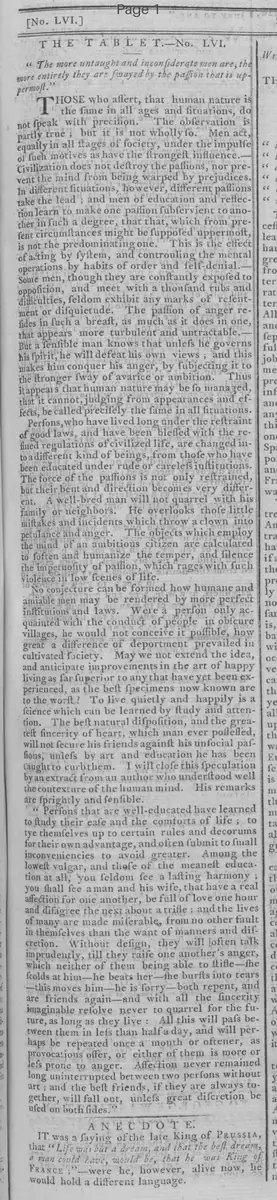
THE TABLET.—No. LVI.
"The more untaught and inconsiderate men are, the more entirely they are swayed by the passion that is uppermost."
THOSE who assert, that human nature is the same in all ages and situations, do not speak with precision. The observation is partly true; but it is not wholly so. Men act equally in all stages of society, under the impulse of such motives as have the strongest influence.
Civilization does not destroy the passions, nor prevent the mind from being warped by prejudices.
In different situations, however, different passions take the lead; and men of education and reflection learn to make one passion subservient to another in such a degree, that that, which from present circumstances might be supposed uppermost, is not the predominating one. This is the effect of acting by system, and controlling the mental operations by habits of order and self-denial.
Some men, though they are constantly exposed to opposition, and meet with a thousand rubs and difficulties, seldom exhibit any marks of resentment or disquietude. The passion of anger resides in such a breast, as much as it does in one, that appears more turbulent and untractable.
But a sensible man knows that unless he governs his spirit, he will defeat his own views; and this makes him conquer his anger, by subjecting it to the stronger sway of avarice or ambition. Thus it appears that human nature may be so managed, that it cannot, judging from appearances and effects, be called precisely the same in all situations.
Persons, who have lived long under the restraint of good laws, and have been blessed with the refined regulations of civilized life, are changed into a different kind of beings, from those who have been educated under rude or careless institutions.
The force of the passions is not only restrained, but their bent and direction becomes very different. A well-bred man will not quarrel with his family or neighbors. He overlooks those little mistakes and incidents which throw a clown into petulance and anger. The objects which employ the mind of an ambitious citizen are calculated to soften and humanize the temper, and silence the impetuosity of passion, which rages with such violence in low scenes of life.
No conjecture can be formed how humane and amiable men may be rendered by more perfect institutions and laws. Were a person only acquainted with the conduct of people in obscure villages, he would not conceive it possible, how great a difference of deportment prevailed in cultivated society. May we not extend the idea, and anticipate improvements in the art of happy living as far superior to any that have yet been experienced, as the best specimens now known are to the worst? To live quietly and happily is a science which can be learned by study and attention. The best natural disposition, and the greatest sincerity of heart, which man ever possessed, will not secure his friends against his unsocial passions, unless by art and education he has been taught to curb them. I will close this speculation by an extract from an author who understood well the contexture of the human mind. His remarks are sprightly and sensible.
"Persons that are well-educated have learned to study their ease and the comforts of life; to tie themselves up to certain rules and decorums for their own advantage, and often submit to small inconveniencies to avoid greater. Among the lowest vulgar, and those of the meanest education at all, you seldom see a lasting harmony; you shall see a man and his wife, that have a real affection for one another, be full of love one hour and disagree the next about a trifle; and the lives of many are made miserable, from no other fault in themselves than the want of manners and discretion. Without design, they will often talk imprudently, till they raise one another's anger, which neither of them being able to stifle—the one calls at him—he beats her—she bursts into tears—this moves him—he is sorry—both repent, and are friends again—and with all the sincerity imaginable resolve never to quarrel for the future, as long as they live: All this will pass between them in less than half a day, and will perhaps be repeated once a month or oftener, as provocations offer, or either of them is more or less prone to anger. Affection never remained long uninterrupted between two persons without art; and the best friends, if they are always together, will fall out, unless great discretion be used on both sides."
ANECDOTE.
It was a saying of the late King of Prussia, that "Life was but a dream, and that the best dream, a man could have, would be, that he was King of France;"—were he, however, alive now, he would hold a different language.
What sub-type of article is it?
Essay
What themes does it cover?
Social Manners
Moral Virtue
Temperance
What keywords are associated?
Human Nature
Civilization
Passions
Education
Manners
Self Control
Domestic Harmony
Literary Details
Title
The Tablet.—No. Lvi.
Key Lines
"The More Untaught And Inconsiderate Men Are, The More Entirely They Are Swayed By The Passion That Is Uppermost."
"Persons That Are Well Educated Have Learned To Study Their Ease And The Comforts Of Life; To Tie Themselves Up To Certain Rules And Decorums For Their Own Advantage, And Often Submit To Small Inconveniencies To Avoid Greater."
It Was A Saying Of The Late King Of Prussia, That "Life Was But A Dream, And That The Best Dream, A Man Could Have, Would Be, That He Was King Of France;"—Were He, However, Alive Now, He Would Hold A Different Language.