Thank you for visiting SNEWPapers!
Sign up free
Editorial
January 7, 1805
Jenks' Portland Gazette
Portland, Cumberland County, Maine
What is this article about?
An editorial excerpt criticizing Thomas Jefferson's political principles as differing from those of George Washington and John Adams, evidenced by Jefferson's removal of Washington-appointed officials, portraying Jefferson as an innovator hostile to Washington's approved men.
Clipping
OCR Quality
95%
Excellent
Full Text
Extract From the Repertory.
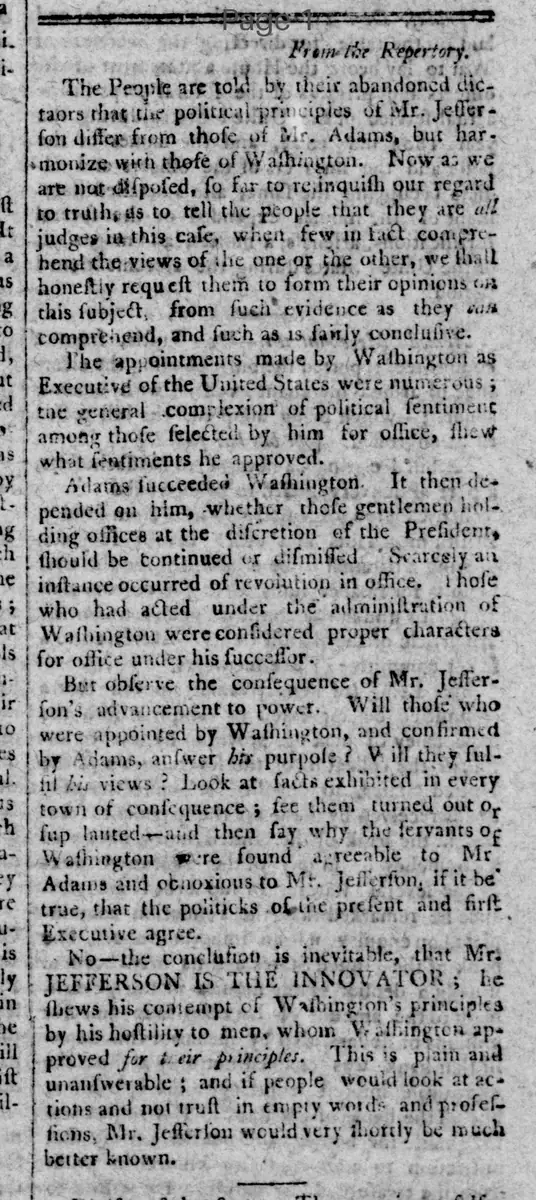
The People are told by their abandoned dictators that the political principles of Mr. Jefferson differ from those of Mr. Adams, but harmonize with those of Washington. Now as we are not disposed, so far to relinquish our regards to truth as to tell the people that they are all judges in this case, when, few in fact comprehend the views of the one or the other, we shall honestly request them to form their opinions upon this subject, from such evidence as they can comprehend, and such as is only conclusive.
The appointments made by Washington as Executive of the United States were numerous; the general complexion of political sentiments among those elected by him for office, show what sentiments he approved. Adams succeeded Washington. It then depended on him, whether those gentlemen holding offices at the discretion of the President, should be continued or dismissed. Scarce an instance occurred of revolution in office. Those who had acted under the administration of Washington were considered proper characters for office under his successor.
But observe the consequence of Mr. Jefferson's advancement to power. Will those who were appointed by Washington, and confirmed by Adams, answer his purpose? Will they fulfill his views? Look at facts exhibited in every town of consequence; see them turned out or supplanted--and then say why the servants of Washington are found agreeable to Mr. Adams and obnoxious to Mr. Jefferson, if it be true, that the politics of the present and first Executive agree.
No--the conclusion is inevitable, that Mr. JEFFERSON IS THE INNOVATOR; he avows his contempt of Washington's principles by his hostility to men, whom Washington approved for their principles. This is plain and unanswerable; and if people would look at actions and not trust in empty words and professions, Mr. Jefferson would very shortly be much better known.
The People are told by their abandoned dictators that the political principles of Mr. Jefferson differ from those of Mr. Adams, but harmonize with those of Washington. Now as we are not disposed, so far to relinquish our regards to truth as to tell the people that they are all judges in this case, when, few in fact comprehend the views of the one or the other, we shall honestly request them to form their opinions upon this subject, from such evidence as they can comprehend, and such as is only conclusive.
The appointments made by Washington as Executive of the United States were numerous; the general complexion of political sentiments among those elected by him for office, show what sentiments he approved. Adams succeeded Washington. It then depended on him, whether those gentlemen holding offices at the discretion of the President, should be continued or dismissed. Scarce an instance occurred of revolution in office. Those who had acted under the administration of Washington were considered proper characters for office under his successor.
But observe the consequence of Mr. Jefferson's advancement to power. Will those who were appointed by Washington, and confirmed by Adams, answer his purpose? Will they fulfill his views? Look at facts exhibited in every town of consequence; see them turned out or supplanted--and then say why the servants of Washington are found agreeable to Mr. Adams and obnoxious to Mr. Jefferson, if it be true, that the politics of the present and first Executive agree.
No--the conclusion is inevitable, that Mr. JEFFERSON IS THE INNOVATOR; he avows his contempt of Washington's principles by his hostility to men, whom Washington approved for their principles. This is plain and unanswerable; and if people would look at actions and not trust in empty words and professions, Mr. Jefferson would very shortly be much better known.
What sub-type of article is it?
Partisan Politics
What keywords are associated?
Jefferson Principles
Washington Appointments
Adams Continuity
Political Innovation
Office Revolutions
What entities or persons were involved?
Mr. Jefferson
Mr. Adams
Washington
Editorial Details
Primary Topic
Differences In Political Principles Between Jefferson, Adams, And Washington
Stance / Tone
Strongly Anti Jefferson, Pro Adams And Washington
Key Figures
Mr. Jefferson
Mr. Adams
Washington
Key Arguments
Political Principles Of Jefferson Differ From Adams But Claimed To Harmonize With Washington
Washington's Appointments Reflect His Approved Sentiments, Continued By Adams With Minimal Changes
Jefferson's Administration Removes Or Supplants Washington Appointed Officials
Jefferson's Actions Show Contempt For Washington's Principles, Making Him The Innovator